
Views: 231 Author: Keychain Venture Publish Time: 2026-09-13 Origin: Site


Content Menu
● What Are Fog Lights Used For?
>> Why High Beams Can Make Fog Worse
● Front Fog Lights vs. Rear Fog Lights
● When Should You Use Fog Lights?
>> Use Fog Lights When Visibility Is Seriously Reduced
>> Turn Fog Lights Off When Conditions Improve
● How to Turn On Fog Lights Safely
>> Safe Fog-Light Operating Steps
>> Understanding Fog-Light Dashboard Symbols
● Fog-Light Safety for Buses and Heavy Trucks
>> Why Heavy Vehicles Require More Planning
>> See, Be Seen, and Stop Safely
>> Example: Electric Coach in Mountain Fog
● Daily Fog-Light Inspection Checklist
>> Essential Pre-Trip Inspection Items
● Lighting Specifications for Fleet Buyers
● Common Fog-Light Mistakes to Avoid
>> Treating Fog Lights as Normal Driving Lights
>> Forgetting the Wider Safety System
● Summary
>> Are fog lights the same as headlights?
>> Should I use fog lights in heavy rain?
>> Can fog lights be used with high beams?
>> Why is my rear fog light brighter than my tail lights?
>> Are fog lights required on buses and heavy trucks?
Fog lights are supplemental vehicle lamps designed to improve visibility and make a vehicle easier to detect in seriously reduced-visibility conditions. For passenger cars, coaches, buses, dump trucks, and other heavy-duty vehicles, using them correctly can support safer operation. Using them unnecessarily, however, can create glare, distract other road users, and may conflict with local traffic regulations.
For operators of New Energy Vehicles (NEVs), buses, dump trucks, and heavy-duty trucks, fog lamps are not merely an exterior feature. They are part of a complete low-visibility safety system that includes dipped-beam headlights, rear lamps, side markers, reflective materials, mirrors, cameras, wipers, demisters, tyres, and trained drivers.
This guide explains what fog lights are, when to use them, how front and rear fog lights differ, and why professional fleet operators should treat vehicle lighting as a daily safety priority.

Fog lights are vehicle lamps designed for conditions where visibility is seriously reduced. These conditions may include dense fog, heavy rain, snowfall, road spray, dust, smoke, or blowing sand.
Their purpose is not to make every road brighter during normal night driving. Instead, fog lights help drivers see important areas close to the vehicle and help other road users identify the vehicle when weather conditions make ordinary lighting less effective.
Typical low-visibility driving conditions include:
- Dense fog and heavy mist
- Heavy rainfall and surface spray
- Snowfall and blowing snow
- Dust on construction roads, mining routes, or rural roads
- Smoke or haze in industrial areas
- Poorly lit mountain, coastal, or highway routes
Fog lights should be used as a supplement to dipped-beam headlights. They should not replace normal headlights, tail lamps, marker lamps, or safe driving behavior.
For commercial vehicles, this distinction is especially important. A bus carrying passengers, a loaded dump truck, or a heavy freight vehicle needs more time and more distance to stop safely than a passenger car. When visibility drops, the driver must use appropriate lighting while also reducing speed, increasing following distance, and remaining alert to road hazards.
Many drivers assume that high beams are the best option when the road becomes difficult to see. In fog, this is often not the case.
Fog contains countless suspended water droplets. High beams project light farther and higher into the air, causing more light to reflect back toward the driver. This reflected light can create a bright white glare, making lane markings, road edges, vehicles, and obstacles harder to see.
Fog lights are normally positioned lower on the vehicle than standard headlights. Their beam pattern is designed to project light closer to the road surface and across a wider near-field area. This can help the driver identify the road edge, lane lines, kerbs, and nearby hazards without producing as much upward reflection.
However, fog lights do not eliminate the danger of fog. They can support visibility, but they cannot create a clear view through extremely dense conditions. If visibility becomes very poor, the safest choice may be to slow significantly, leave the road when safe, or wait in an appropriate safe location until conditions improve.
Front and rear fog lights perform different functions. Drivers should understand these differences before using them, especially when operating buses, coaches, rigid trucks, dump trucks, or long-haul vehicles.
| Feature | Front Fog Lights | Rear Fog Lights |
|---|---|---|
| Primary purpose | Help illuminate the road area directly ahead of the vehicle | Help following traffic see the vehicle in poor visibility |
| Typical light color | White or selective yellow, depending on vehicle design and market requirements | Red |
| Typical installation location | Low on the front bumper, lower front body, or front fascia | On the rear of the vehicle, often one or two high-intensity lamps |
| Main benefit | Improves awareness of road edges, markings, and immediate hazards | Makes the vehicle more visible from behind |
| Key misuse risk | May create glare for oncoming traffic | May dazzle following drivers or reduce the contrast of brake lights |
Front fog lights are designed to improve the driver's view of the near-road environment. They are often mounted lower than the main headlights because low-mounted lamps can reduce the amount of light reflected directly back from fog, rain, and snow.
On a commercial truck or bus, front fog lamps can be especially useful on:
- Narrow rural roads
- Mountain routes
- Industrial parks
- Construction sites
- Port and logistics yards
- Unlit highways
- Areas with frequent rain, mist, or coastal fog
Front fog lights should be used responsibly. They are not intended to remain on during normal clear-weather driving, especially in urban traffic or on brightly lit roads.
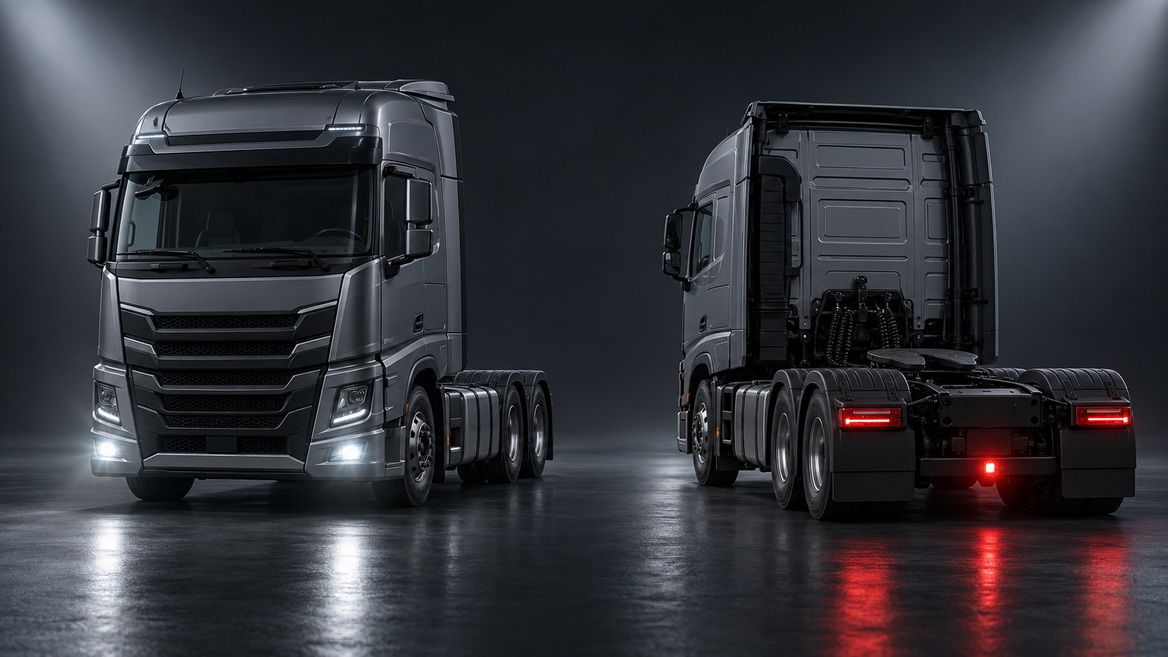
Rear fog lights are much brighter than standard tail lamps. Their main role is to help drivers behind identify a vehicle when visibility is seriously reduced.
This is particularly important for large vehicles. A coach, heavy truck, dump truck, or electric bus may be operating at low speeds in poor weather, carrying passengers, hauling materials, or travelling on roads with limited visibility. A rear fog lamp can provide an additional visual warning to approaching traffic.
Because rear fog lights are highly intense, they should be switched off as soon as visibility improves. If left on unnecessarily, they can be uncomfortable or distracting for following drivers. In some situations, their brightness may also make it harder for other drivers to notice a change in brake-light intensity.
A practical way to assess fog-light use is to consider whether you can clearly see the road, vehicles, signs, and hazards at a safe distance.
In many driving guidelines, visibility of less than approximately 100 metres or 328 feet is used as a useful benchmark for seriously reduced visibility. This is roughly equal to the length of a football pitch.
For drivers of commercial vehicles, it is wise to take action before visibility becomes dangerously limited. A larger vehicle requires more stopping distance, and a loaded truck may have reduced braking performance on wet, icy, muddy, or uneven road surfaces.
You may need fog lights when:
- Dense fog prevents you from seeing clearly ahead.
- Heavy rainfall creates significant water spray.
- Snow or blowing snow limits road visibility.
- Dust, smoke, or sand reduces the ability to see other vehicles.
- Road signs, lane markings, and traffic lights become difficult to identify.
- Other drivers may struggle to see the rear of your vehicle.
- You are travelling through mountain valleys, coastal roads, or rural areas with sudden fog banks.
- You are operating on a construction, quarry, mining, or industrial route with airborne dust.
Fog lights should be switched off when:
- Fog clears and normal visibility returns.
- Rain becomes light and road visibility is no longer significantly affected.
- You enter a well-lit urban road with clear conditions.
- You are travelling behind other vehicles and the rear fog lamp is no longer needed.
- Snow, dust, or spray no longer limits visibility.
- You can clearly see road signs, traffic, and hazards at a safe distance.
The decision should be based on visibility, not simply weather. Light rain or overcast skies do not automatically require fog lights. Conversely, severe dust or road spray may justify their use even when it is not raining or foggy.
Fog-light controls vary by vehicle manufacturer, model, market, and vehicle type. In passenger cars, controls may be found on a steering-column stalk, rotary switch, dashboard button, or touchscreen menu.
In buses and heavy-duty trucks, fog-light controls may be integrated into the main dashboard, body-control panel, multi-function switch, or central instrument display.
In many vehicles, dipped-beam headlights must be activated before fog lights can be switched on.
1. Switch on dipped-beam headlights before entering a low-visibility area.
2. Locate the front and rear fog-light controls on the dashboard, steering-column stalk, light-control panel, or touchscreen.
3. Turn on front fog lights when serious fog, snow, rain, dust, or spray affects your view of the road.
4. Turn on the rear fog light only when following traffic may struggle to see the vehicle.
5. Check the instrument panel to make sure the correct fog-light indicator is illuminated.
6. Slow down early and increase the distance between your vehicle and the vehicle ahead.
7. Reassess visibility frequently, especially on mountain roads, highways, bridges, coastal routes, and open industrial areas.
8. Turn fog lights off promptly when conditions improve.
Most vehicles use internationally familiar dashboard symbols, although their appearance can vary slightly.
- The front fog-light symbol normally shows a lamp facing left with angled light lines.
- The rear fog-light symbol normally shows a lamp facing right with horizontal light lines.
Drivers should identify these symbols during vehicle familiarisation and pre-trip preparation. No driver should need to search for lighting controls while entering an unexpected fog bank.
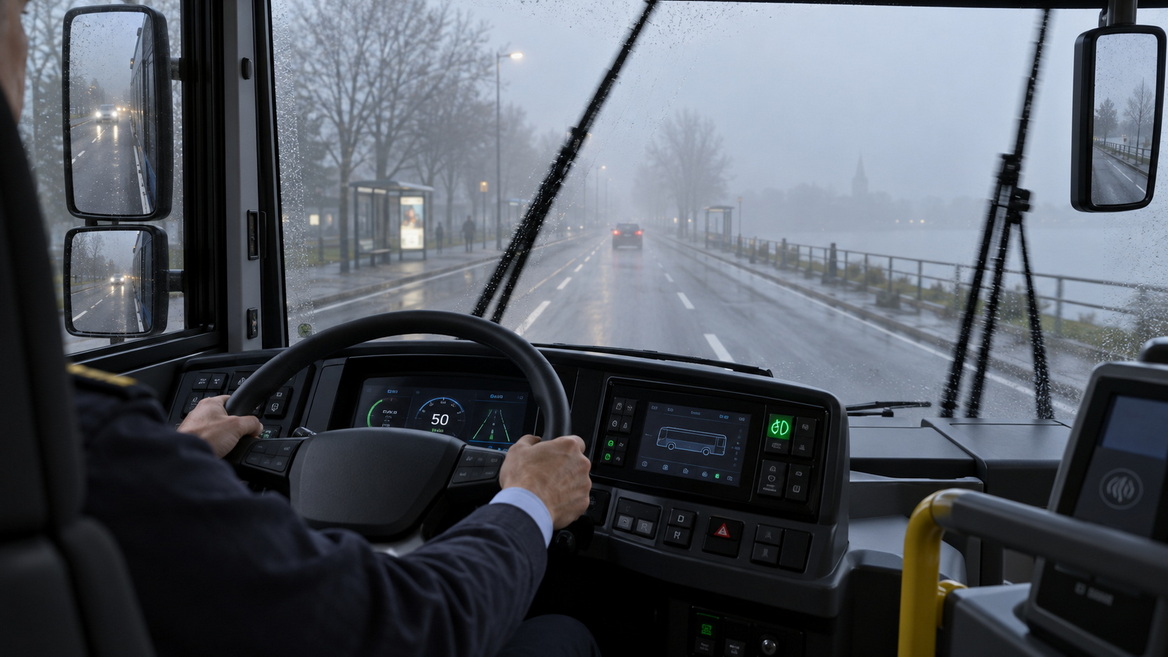
For professional fleets, fog-light use should be part of a wider low-visibility driving process. Correct lighting is important, but it cannot compensate for high speed, poor tyre condition, dirty windows, worn wipers, damaged mirrors, or unsafe following distances.
Buses, coaches, dump trucks, and heavy-duty trucks have unique operational risks in low visibility.
They are larger, heavier, and often require more stopping distance. They may also create more water spray in wet conditions, have larger blind spots, operate on unlit roads, and travel through industrial or off-road environments.
A fully loaded dump truck may be affected by wet or loose surfaces. A coach may carry passengers who depend on the driver's ability to anticipate hazards. An electric bus may operate quietly in urban or suburban conditions where pedestrians, cyclists, and smaller vehicles are more difficult to detect in rain or mist.
For these reasons, commercial drivers should use a simple principle:
See: Maintain clean windscreens, working wipers, effective demisters, properly adjusted mirrors, camera systems, dipped beams, and fog lamps where conditions require them.
Be seen: Confirm that headlights, tail lamps, side markers, reflective materials, rear lamps, and fog lights are clean and operational.
Stop safely: Reduce speed before visibility becomes critical, increase following distance, avoid abrupt braking, and maintain enough space to stop within the visible road distance.
Consider a battery-electric coach travelling on an early-morning mountain route. The road includes curves, gradients, limited street lighting, and sudden fog banks.
A safe operating sequence would include:
1. Activating dipped-beam headlights before visibility becomes severely reduced.
2. Switching on front fog lights if the driver needs clearer awareness of road edges and lane markings.
3. Using the rear fog light when traffic behind may struggle to see the coach.
4. Reducing speed well before bends, bridges, tunnels, and downhill sections.
5. Maintaining wipers, demisters, and side mirrors in clear working condition.
6. Leaving a larger gap to vehicles ahead.
7. Turning the rear fog light off after leaving the fog bank and returning to normal visibility.
The lesson is straightforward: fog lights support good driver judgment, but they never replace it.

Vehicle lighting should be checked before every shift, especially for buses, long-haul trucks, logistics fleets, construction vehicles, and export operations.
This is particularly important for vehicles operating in wet, cold, mountainous, coastal, dusty, or high-traffic conditions.
- Check that both dipped-beam headlights operate correctly.
- Test front fog lights and inspect them for cracks, loose housings, water ingress, dirt, and poor alignment.
- Test rear fog lights and confirm that the dashboard indicator is working.
- Inspect tail lamps, brake lamps, reversing lamps, side-marker lamps, and high-mounted lamps where fitted.
- Clean mud, dust, snow, salt, insects, and road film from all lamp lenses.
- Check windscreen wipers, washer fluid, front demisters, heated mirrors, and rear-view camera systems.
- Inspect mirrors for damage and ensure they are properly adjusted.
- Look for dashboard warnings related to lighting, electrical systems, battery voltage, or electronic control modules.
- Record defects immediately and arrange repair before vehicle dispatch where required.
For dump trucks and construction vehicles, lamp cleaning may be needed more than once per day. Dust, mud, slurry, and road debris can quickly reduce light output and vehicle visibility.
For fleet buyers, distributors, contractors, transport companies, and importers, lighting requirements should be addressed during the vehicle specification stage.
A vehicle built for one market may not be suitable for another market without changes to lamp configuration, certification markings, wiring, switches, reflective materials, or documentation.
When sourcing New Energy Vehicles, buses, dump trucks, and heavy-duty trucks, buyers should clarify the following points before production:
- Destination-country vehicle lighting requirements
- Required front and rear fog-light configuration
- Lamp approval markings and certification standards
- LED, halogen, or other lighting technology options
- Vehicle wiring-harness compatibility
- Dashboard-control layout and driver usability
- Body-builder and trailer electrical interfaces
- Side-marker lamp and reflective-marking requirements
- Availability of replacement lamps and spare parts
- Service manuals, electrical diagrams, and driver instructions
A well-specified lighting system can reduce downtime, support driver confidence, simplify maintenance, and help fleets prepare vehicles for local inspections and operating conditions.
Fog lights are useful only when drivers understand their limitations. The following errors are common in both private and commercial driving.
High beams can reflect off fog droplets, rain, and snow, creating glare that makes the road more difficult to see. Use dipped beams as the primary lighting mode in foggy conditions.
Rear fog lights should be turned off after visibility improves. Leaving them on can distract or dazzle following drivers.
Fog lights are not daytime running lights and are not a replacement for standard headlights. Their use should be limited to conditions with seriously reduced visibility.
A lamp covered with mud, dust, snow, salt, or road grime cannot produce its intended light output. This is a frequent issue for construction, quarry, mining, and dump-truck operations.
Fog lights do not reduce braking distance. If visibility is reduced, speed must also be reduced. Drivers should always be able to stop safely within the distance they can see ahead.
Lighting is only one part of low-visibility safety. Tyres, brakes, wipers, mirrors, cameras, driver alertness, route planning, and communication systems all affect operational safety.
Fog lights are an important low-visibility feature for cars, buses, coaches, dump trucks, and heavy-duty vehicles. Front fog lights help drivers see the road area close to the vehicle, while rear fog lights make the vehicle more visible to traffic behind.
The safest approach is to use dipped-beam headlights first, activate fog lights only when visibility is seriously reduced, avoid high beams in fog, reduce speed, maintain a larger following distance, and switch rear fog lights off once conditions improve.
For commercial fleets, the best results come from combining suitable vehicle lighting, regular inspections, correct destination-market specifications, and consistent driver training. This approach helps protect passengers, drivers, cargo, equipment, and other road users in demanding weather and operating conditions.
KeyChain provides high-quality New Energy Vehicles, buses, dump trucks, and heavy-duty truck solutions for domestic and international customers. Vehicle configurations can be evaluated according to operating routes, climate conditions, lighting requirements, fleet applications, and destination-market needs.
No. Headlights are the main forward-lighting system used for normal night driving and reduced visibility. Fog lights are supplementary lamps designed for use when fog, rain, snow, dust, smoke, or spray seriously reduces visibility.
It depends on how much visibility is reduced. Dipped-beam headlights should be used in rain. Fog lights may be suitable if heavy rainfall or road spray makes it difficult to see vehicles, signs, lane markings, or hazards.
Fog lights may operate differently depending on vehicle design, but high beams are generally not recommended in fog. High beams can create glare by reflecting light from water droplets, snow, or mist back toward the driver.
Rear fog lights are intentionally brighter than normal tail lamps. They are designed to help following drivers see your vehicle when visibility is seriously reduced. They should be turned off once weather and visibility improve.
Requirements vary by country, vehicle category, operating environment, and destination market. Some lighting features may be mandatory, while others may be optional or dependent on the vehicle's approval specification. Buyers should verify local requirements before ordering or importing a vehicle.
1. Evans Halshaw. "[Fog Lights: What Are They and When to Use Them]."
2. National Weather Service. "[Driving in Fog]."
3. National Highways. "[Travelling in Fog]."
4. Ask the Police. "[A Lot of Cars Have Their Fog Lights On When It's Not Foggy—Is It Allowed?]."
5. United Nations Economic Commission for Europe / EUR-Lex. "[UN Regulation No. 19: Front Fog Lamps]/oj/eng)."


