
Views: 241 Author: Keychain Venture Publish Time: 2026-09-12 Origin: Site


Content Menu
● What Are Cat's Eyes on the Road?
● Why Cat's Eyes Matter for Bus and Truck Safety
>> How Reflective Road Studs Support Drivers
>> Why Traditional Cat's Eyes Can Be Self-Cleaning
● Types of Reflective Road Studs
>> Traditional Reflective Studs
● What Do Cat's Eye Colours Mean?
>> Green and Yellow Cat's Eyes
● A Simple Motorway Memory Guide
● How Bus and Truck Drivers Should Use Road Studs at Night
>> A Practical Night-Driving Checklist
>> Example: Night-Time Electric Bus Operation
● Cat's Eyes, Smart Roads, and New Energy Vehicles
● Summary
>> What are cat's eyes used for on roads?
>> Why are they called cat's eyes?
>> What do white cat's eyes mean?
>> What do red cat's eyes mean on a motorway?
>> What do amber cat's eyes mean?
Cat’s eyes, also known as reflective road studs, are raised road markers that help drivers identify lanes, road edges, junctions, and traffic separations in darkness, rain, fog, and other low-visibility conditions.
For car drivers, they provide a clear visual reference. For bus operators, heavy-truck fleets, and New Energy Vehicles (NEVs), they are an important part of the road environment that supports safer lane positioning and more predictable driving.
A row of illuminated road studs can make the road layout easier to understand when painted lines are wet, worn, partially covered, or difficult to see under headlights. They are especially valuable on motorways, dual carriageways, rural roads, freight corridors, tunnels, and construction zones.
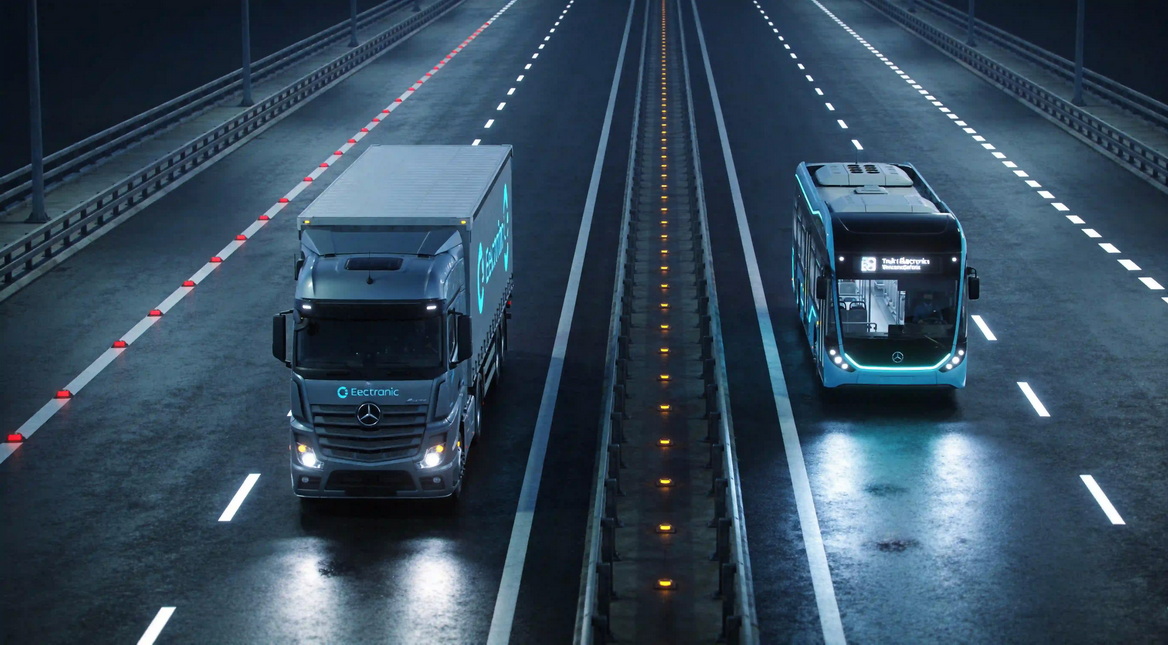
Cat's eyes are small retroreflective road studs installed in, or slightly above, the road surface. They reflect a vehicle's headlight beam back towards the driver, creating visible points of light that indicate the route ahead.
The name "cat's eyes" comes from the way the reflectors shine in darkness, similar to the glow seen in a cat's eyes when light hits them at night.
Other common names include:
- Reflective road studs
- Retroreflective pavement markers
- Raised pavement markers
- Reflective motorway studs
- Lane delineators
- Road reflectors
Cat's eyes are designed to complement road paint, traffic signs, barriers, lighting systems, and driver awareness. They do not replace the need for safe driving practices, but they can provide a highly effective visual guide when normal road markings are difficult to see.
They are often used in high-risk or high-traffic areas, including:
- Motorways and expressways
- Dual carriageways
- Junction approaches
- Slip roads and roundabouts
- Tunnels and bridge crossings
- Urban bus lanes
- Freight and logistics routes
- Rural roads with limited street lighting
- Temporary roadwork layouts
- Industrial parks and port-access roads
For buses, coaches, and heavy trucks, reflective road studs are particularly helpful because larger vehicles require more precise lane control. A driver operating a wide city bus, long-distance coach, electric truck, or heavy-duty tractor unit needs clear visual information about lane boundaries, road edges, and upcoming route changes.
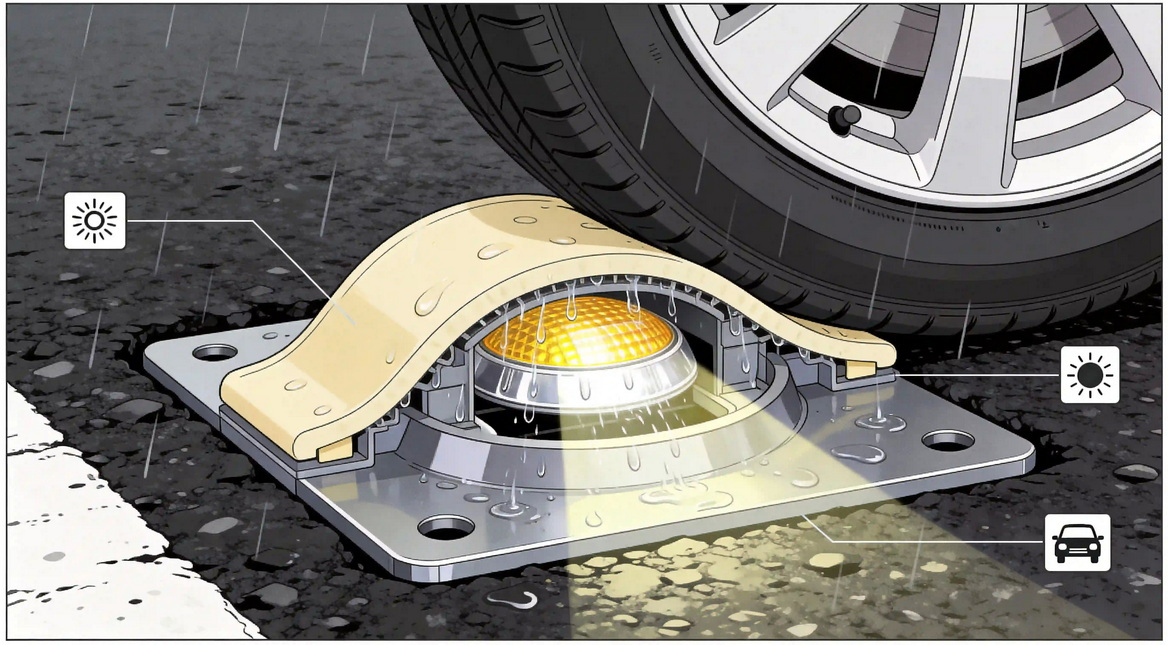
Reflective road studs are a small part of road infrastructure, but their safety role can be significant. They help drivers understand the shape, direction, and boundaries of the road ahead.
This is especially useful for commercial vehicles, which often have:
- Wider vehicle bodies
- Longer wheelbases
- Larger turning circles
- Longer braking distances
- Higher operating weights
- Greater blind-spot exposure
- More demanding lane-positioning requirements
A passenger car can often recover more easily from a small lane-positioning error. A large bus or heavy truck may have less margin for error, particularly on narrow roads, wet motorways, bridge approaches, or construction diversions.
Reflective road studs can help drivers:
- Maintain lane discipline when visibility is reduced.
- Identify the road edge before drifting toward a shoulder, verge, kerb, barrier, or drainage channel.
- Recognise lane separations on multi-lane roads.
- See central reservation boundaries on motorways and dual carriageways.
- Prepare for slip roads and junction transitions.
- Understand temporary lane layouts during roadworks.
- Reduce steering corrections by providing an earlier visual indication of the road's alignment.
- Improve driver confidence when travelling through unfamiliar areas at night.
For fleets operating electric buses and new energy trucks, smoother driving is also operationally valuable. Clear lane guidance can help reduce unnecessary steering movements, abrupt braking, harsh acceleration, and late lane changes.
These driving behaviours can affect passenger comfort, tyre wear, driver fatigue, energy consumption, and overall vehicle safety.
However, reflective road studs should always be treated as a visual support system rather than a complete safety solution. Drivers must still manage speed, observe traffic signs, maintain safe following distances, use proper vehicle lighting, and remain alert to changing road and weather conditions.
The modern cat's eye was developed by British inventor Percy Shaw, who lived in Halifax, West Yorkshire. His invention was patented in the 1930s and became one of the best-known examples of practical road-safety engineering.
The idea is widely associated with driving in poor visibility and observing the way a cat's eyes reflected light. This simple observation inspired a durable road marker that could make road layouts more visible to approaching drivers.
The invention became important because many roads at the time had limited lighting, inconsistent road markings, and difficult driving conditions during rain, fog, and darkness.
Cat's eyes helped solve several practical problems:
- Road lines could become difficult to see in wet weather.
- Fog could reduce visibility dramatically.
- Rural roads often had little or no street lighting.
- Painted markings could wear down under heavy traffic.
- Drivers needed clearer guidance at night.
- Road infrastructure required durable components that could tolerate repeated tyre impacts.
The success of the cat's eye shows how a relatively simple physical design can improve road safety for millions of drivers. It requires no driver activation, no wireless network, and no onboard software connection. Instead, it uses the vehicle's own headlight beam to create a visible route guide.
Today, the original concept remains relevant, even as road networks become more advanced and vehicles gain intelligent safety systems.
Cat's eyes work through a principle called retroreflection. This means that when light hits the reflective surface, much of that light is directed back toward the original source.
In practical driving terms, the original light source is usually the vehicle's headlights.
When headlights shine on a reflective road stud:
1. The light reaches the reflector or lens inside the stud.
2. The lens redirects the light back towards the approaching vehicle.
3. The driver sees a bright point of reflected light on the road.
4. A series of road studs creates a visible line that indicates lane direction, road edge, or route alignment.
This effect helps drivers identify the road layout even when they cannot clearly see every painted line or road surface detail.
Traditional cat's-eye designs often include a flexible rubber housing and a metal base. When a vehicle tyre passes over the road stud, the rubber section compresses and the reflective element moves downward.
This movement helps protect the reflector from direct impact. It can also support a self-cleaning effect.
Rainwater and moisture can collect within the unit. When the lens retracts and rises again, the movement may help remove dirt, dust, road grime, or debris from the reflective surface.
This does not mean that cat's eyes never need maintenance. Road studs can still become damaged, faded, blocked, dislodged, or less reflective over time.
Common causes of reduced performance include:
- Heavy vehicle traffic
- Road salt and winter treatment
- Tyre residue
- Dirt and mud
- Oil contamination
- Snow and ice
- Surface wear
- Poor installation
- Road resurfacing activity
- Damage from construction equipment
Regular road inspection and maintenance remain essential to ensure that road studs continue to provide clear visual guidance.
Not all road studs work in exactly the same way. Traditional retroreflective cat's eyes remain widely used, but modern road authorities may also install solar-powered or LED road studs.
| Road Stud Type | Light Source | Main Advantage | Main Consideration |
|---|---|---|---|
| Traditional reflective stud | Vehicle headlights | Durable and does not need electrical power | Visibility depends on vehicle headlights |
| Solar road stud | Solar-charged internal lighting | Can remain highly visible in darkness | Requires battery and solar-panel maintenance |
| LED road stud | Electrical or solar-powered LEDs | Offers stronger active illumination | More complex installation and maintenance |
| Temporary roadwork stud | Reflective or active lighting | Helps guide drivers through changing layouts | Must be installed and removed correctly |
| Snowploughable road stud | Reflective material in a protective recess | Better protection in harsh winter conditions | Requires specialised road installation |
Traditional reflective studs are passive devices. They do not produce their own light. Instead, they reflect the light from vehicle headlights back towards the driver.
Their main strengths are durability, simplicity, and low dependence on electrical systems.
Solar road studs contain small solar panels and internal light sources. During daylight hours, they collect solar energy. At night, they use stored energy to emit light.
They can be useful in areas with very limited lighting, sharp curves, rural routes, bridge approaches, pedestrian crossings, and high-risk junctions.
LED road studs use small light-emitting diodes to create active illumination. They may be powered by electricity, solar energy, batteries, or a connected road-infrastructure system.
These studs can provide strong visibility and may be used in smart-road applications, temporary traffic management, dangerous curves, tunnels, airport zones, or complex intersections.
For transport operators, the difference is important. A traditional stud depends on vehicle headlights, while an active solar or LED stud may remain visible before the vehicle is close enough for its lights to fully illuminate the road surface.
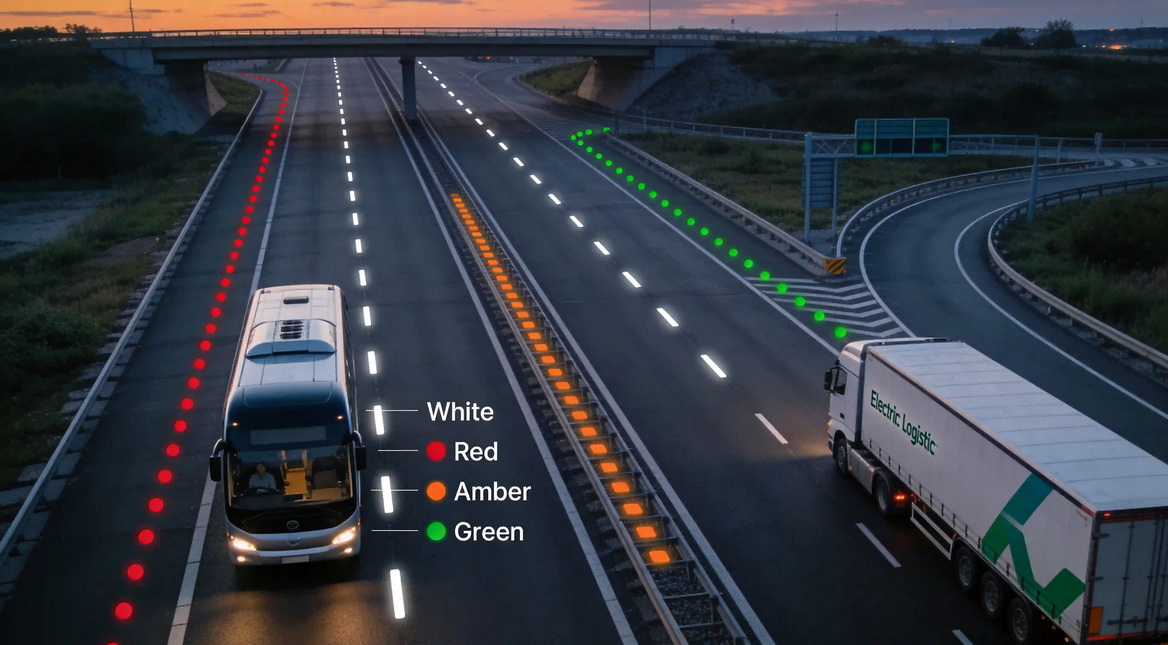
Road-stud colours provide a quick visual language for drivers. Each colour indicates a different road boundary, lane position, or permitted crossing area.
Understanding these colours is especially useful for new drivers, international drivers, bus operators, truck fleets, and anyone travelling on unfamiliar motorways.
| Road Stud Colour | Typical Meaning | What Drivers Should Remember |
|---|---|---|
| White | Marks traffic lanes or the centre of the road | Use white studs to understand lane alignment and separation |
| Red | Marks the left edge of the running carriageway | Red usually means you are close to the road edge or hard shoulder side |
| Amber | Marks the central reservation side of a motorway or dual carriageway | Amber studs are usually on the right-hand side for left-driving traffic |
| Green | Marks areas where the carriageway edge may be crossed | Green often appears near slip roads, lay-bys, and permitted entry or exit points |
| Green and yellow | Highlights temporary road-layout changes | Commonly used near roadworks, diversions, and temporary lane arrangements |
White cat's eyes mark lanes or the centre of the road. They are commonly found between motorway lanes, on dual carriageways, and on many other multi-lane roads.
For drivers, white studs provide a clear indication of lane position. They are particularly helpful when wet roads create glare or when road paint becomes difficult to see.
Red cat's eyes indicate the left-hand edge of the running carriageway. On a motorway, they often help drivers understand that they are close to the hard shoulder, emergency area, verge, or outside road boundary.
For heavy vehicles, red studs can be a critical warning sign. A truck or coach should not drift towards the red-stud side of the carriageway unless the road layout, signs, or authorised traffic movement clearly permit it.
Amber cat's eyes mark the side of the road next to the central reservation. For traffic driving on the left, amber studs are generally positioned on the right-hand side of the carriageway.
They help drivers identify the boundary between their carriageway and the central reservation or barrier system.
Green cat's eyes usually identify areas where a vehicle may cross the edge of the carriageway. They are often used at:
- Slip-road entrances
- Slip-road exits
- Lay-bys
- Rest areas
- Service-road access points
- Some junction areas
Green studs do not mean that drivers should make an immediate manoeuvre. Instead, they indicate that an entry, exit, or crossing point may be present. Drivers should continue to follow signs, lane arrows, traffic signals, and road conditions.
Green-and-yellow road studs are commonly linked with temporary traffic arrangements. They may be used during roadworks, resurfacing projects, bridge repairs, lane closures, or emergency diversions.
When drivers see these studs, they should expect a non-standard road layout. Lane positions may have changed, road widths may be reduced, and vehicle speeds may need to be lower.
For roads where traffic drives on the left, the following memory guide can help:
- Red on the left
- Amber on the right
- White in the middle
- Green where roads join or leave
This is a useful rule for drivers who are learning motorway colour systems. It can also support fleet training for international operators, visiting drivers, and newly recruited commercial-vehicle staff.
However, drivers should never rely on a memory rule alone. Road signs, road markings, electronic lane signals, speed limits, traffic officers, construction instructions, and local regulations always take priority.
Reflective road studs can improve a driver's understanding of the road, but only when they are used as part of a disciplined driving routine.
Commercial drivers should avoid looking only at the road directly in front of the vehicle. A professional visual scan should include the road ahead, lane markings, mirrors, roadside signs, traffic behaviour, pedestrians, cyclists, weather conditions, and road-surface hazards.
1. Check all vehicle lights before departure.
Make sure headlights, side-marker lamps, rear lamps, brake lamps, and indicator lights are clean and functioning correctly.
2. Keep windscreens, mirrors, and cameras clean.
Dirt, rain, condensation, and spray can reduce visibility even when road studs are working properly.
3. Adjust speed to the visible road distance.
If the road ahead is difficult to read, reduce speed. A driver must be able to stop safely within the distance they can see.
4. Use road studs to confirm lane position.
Watch the stud pattern to understand whether the vehicle is centred in the lane and whether the road is turning, widening, narrowing, or approaching a junction.
5. Maintain a larger following distance in rain or fog.
Water spray from other vehicles can create glare and obscure road markings. A greater gap gives more time to see and react.
6. Be cautious near green and green-yellow studs.
These areas may involve merging traffic, exit traffic, temporary lanes, narrow sections, or altered road layouts.
7. Avoid visual fixation.
Road studs are helpful, but drivers must keep their eyes moving. Focus on the full driving environment rather than staring at one line of reflected lights.
8. Report damaged road markings when appropriate.
Fleet drivers who regularly use the same routes may notice missing studs, faded lines, poor lighting, or dangerous road layouts. Reporting these issues can support safer operations over time.
Imagine an electric city bus travelling on a wet outer-urban route after evening service. Road paint is difficult to see because rainwater reflects headlights and oncoming traffic creates glare.
White reflective studs help the driver maintain lane position. Red studs make the outer road boundary easier to identify. Green studs near a bus lay-by or exit point provide an additional indication that the vehicle is approaching a permitted crossing area.
The driver still needs to monitor passengers, pedestrians, cyclists, mirrors, bus-stop activity, traffic signals, and changing speed limits. Yet the road-stud system reduces uncertainty and supports smoother, more controlled vehicle movement.
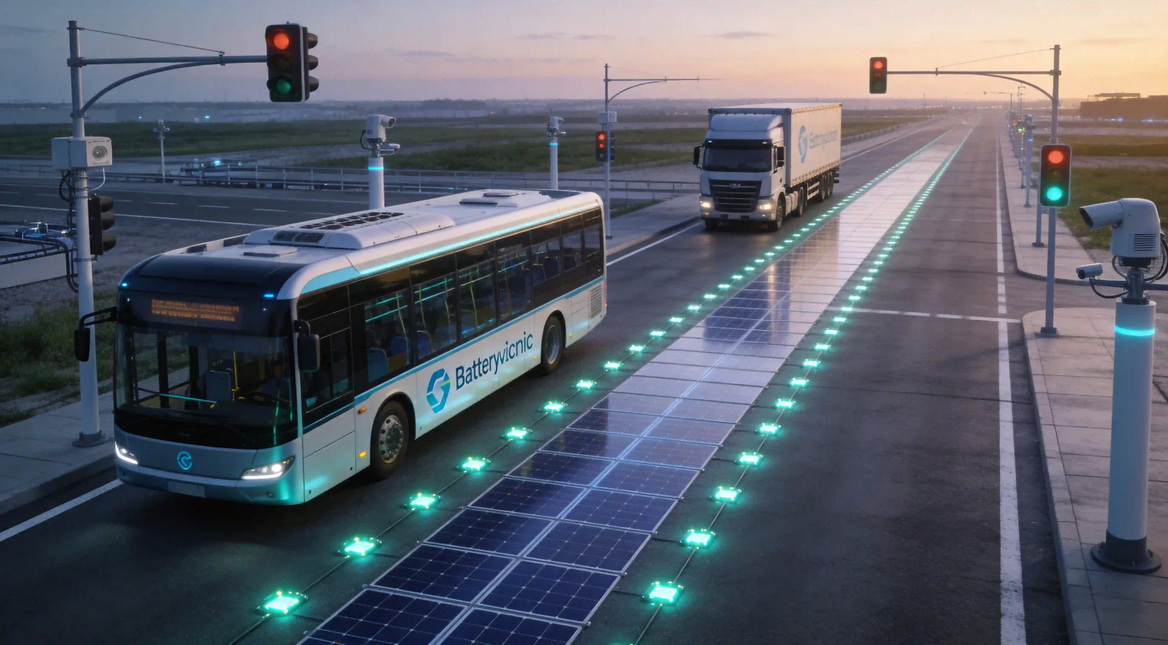
Reflective road studs are an established technology, but they remain highly relevant in modern transport systems.
Today's roads are increasingly connected with new technologies, including advanced driver-assistance systems, electric commercial vehicles, intelligent traffic management, solar lighting, vehicle sensors, and digital fleet platforms.
The future of road safety is likely to depend on a combination of traditional infrastructure and intelligent technologies:
- High-visibility road paint
- Reflective road studs
- Solar-powered road studs
- LED road guidance systems
- Smart traffic signals
- Vehicle-to-infrastructure communication
- Lane-departure warning systems
- Driver-monitoring technologies
- Forward cameras and radar sensors
- Predictive road-maintenance systems
- Real-time weather and traffic alerts
The role of road studs may become even more valuable as fleets adopt battery-electric buses, electric trucks, hybrid commercial vehicles, and connected transport platforms.
Advanced vehicles can provide important warnings and assistance, but they still operate in the real world. Road visibility, surface quality, weather, lane markings, signage, lighting, and human decision-making remain essential.
A reliable commercial vehicle performs best when it is supported by clear and well-maintained transport infrastructure.
Cat's eyes are more than small reflective markers on the road. They are practical safety tools that help drivers understand lane boundaries, road edges, central reservations, entry points, exits, and temporary traffic layouts.
For car drivers, they improve confidence during night driving. For bus fleets, logistics operators, heavy-truck drivers, and new energy vehicle users, they can support more accurate lane positioning and safer decision-making in demanding road conditions.
The most important points to remember are simple:
- White studs generally mark lanes or the centre of the road.
- Red studs mark the left edge of the carriageway.
- Amber studs mark the central reservation side.
- Green studs indicate areas where vehicles may join, leave, or cross the road edge.
- Green-and-yellow studs often indicate temporary traffic arrangements.
- Cat's eyes are most effective when combined with good headlights, safe speed, careful observation, and responsible driving behaviour.
KeyChain supports customers seeking high-quality buses, heavy-duty trucks, and new energy vehicle solutions for urban transportation, logistics, intercity routes, and international operations. Selecting the right commercial vehicle involves more than vehicle specifications—it requires an understanding of the real operating environment, including road conditions, driver requirements, route characteristics, and long-term safety needs.
For fleet planners, distributors, public-transport operators, and commercial-vehicle buyers, a well-matched vehicle solution can help create safer, more efficient, and more reliable transport operations.
Cat's eyes are reflective road studs used to help drivers identify lanes, road edges, central reservations, junctions, and route changes. They are especially useful during night driving, rain, fog, and low-visibility conditions.
They are called cat's eyes because they reflect light in darkness in a way that resembles the visible glow of a cat's eyes when light shines on them at night.
White cat's eyes generally mark traffic lanes or the centre of the road. They help drivers understand lane separation and road alignment.
Red cat's eyes normally mark the left edge of the running carriageway. They can indicate that the driver is close to the hard shoulder, road edge, verge, or outside boundary of the road.
Amber cat's eyes usually mark the side of a motorway or dual carriageway next to the central reservation. For left-driving traffic, amber studs are generally on the right-hand side of the carriageway.
1. Evans Halshaw. "What Are Cat's Eyes? Reflective Motorway Studs Explained."
[https://www.evanshalshaw.com/blog/what-are-cats-eyes-reflective-studs/]
2. GOV.UK. "Road Markings."
[https://www.gov.uk/government/publications/know-your-traffic-signs/road-markings]
3. Department for Transport. "Traffic Signs Manual: Chapter 5 – Road Markings."
4. Driver and Vehicle Standards Agency. "Reflective Road Studs."
[https://content.govdelivery.com/accounts/UKDVSA/bulletins/12e350f]
5. BBC. "Cat's Eyes: How a Pub Trip Made the World's Roads Safer."
[https://www.bbc.com/news/av/stories-64512319]
6. BBC / British Museum. "Cat's Eyes."
[https://www.bbc.co.uk/ahistoryoftheworld/objects/aztoAsvNQ4GBWiQqzOLo5Q]
7. Yorkshire Philosophical Society. "Percy Shaw OBE (1890–1976)."
[https://www.ypsyork.org/resources/yorkshire-scientists-and-innovators/percy-shaw/]


