
Views: 283 Author: Keychain Venture Publish Time: 2026-09-16 Origin: Site


Content Menu
● How the Meaning of SUV Has Changed
● SUV vs. Crossover: What Is the Difference?
>> Traditional SUV vs. Crossover SUV
>> Compact SUVs for Urban Driving
>> Mid-Size SUVs for Family and Business Use
>> Large SUVs and Seven-Seat SUVs
>> SUV Coupés for Style and Road Presence
>> 4x4 SUVs for Tough Conditions
● Electric SUVs: A Practical Buying Guide
>> Why Choose an Electric SUV?
>> Look Beyond the Advertised Range
>> Understanding Electric SUV Energy Use
>> Charging Infrastructure Matters
>> Step 1: Define the Main Purpose
>> Step 2: Check Passenger and Cargo Space
>> Step 3: Compare Total Operating Cost
>> Step 4: Confirm Local Compatibility
● Vehicle Solutions for Modern Mobility
>> What is the difference between an SUV and a crossover?
>> Are electric SUVs suitable for long-distance driving?
>> Are SUVs good for families?
An SUV, short for Sport Utility Vehicle, is a passenger vehicle designed to offer a practical balance of comfort, space, visibility, and versatility. Most SUVs have a higher ride height than sedans or hatchbacks, a spacious cabin, a rear tailgate, flexible seating, and room for passengers, luggage, equipment, or commercial-use items.
The SUV category has expanded significantly. It now includes compact city-friendly models, family-oriented seven-seat vehicles, luxury SUVs, rugged 4x4 vehicles, hybrid SUVs, and fully electric SUVs. As a result, "SUV" is no longer a single vehicle type with one purpose. It is a broad category that serves different lifestyles, road conditions, passenger needs, and operating requirements.
For private buyers, the right SUV can make family travel more comfortable and everyday errands easier. For fleet operators, distributors, and commercial users, the right model can support passenger transport, corporate mobility, tourism, light-duty logistics, or long-distance travel. The key is to select an SUV based on real operating needs rather than appearance alone.
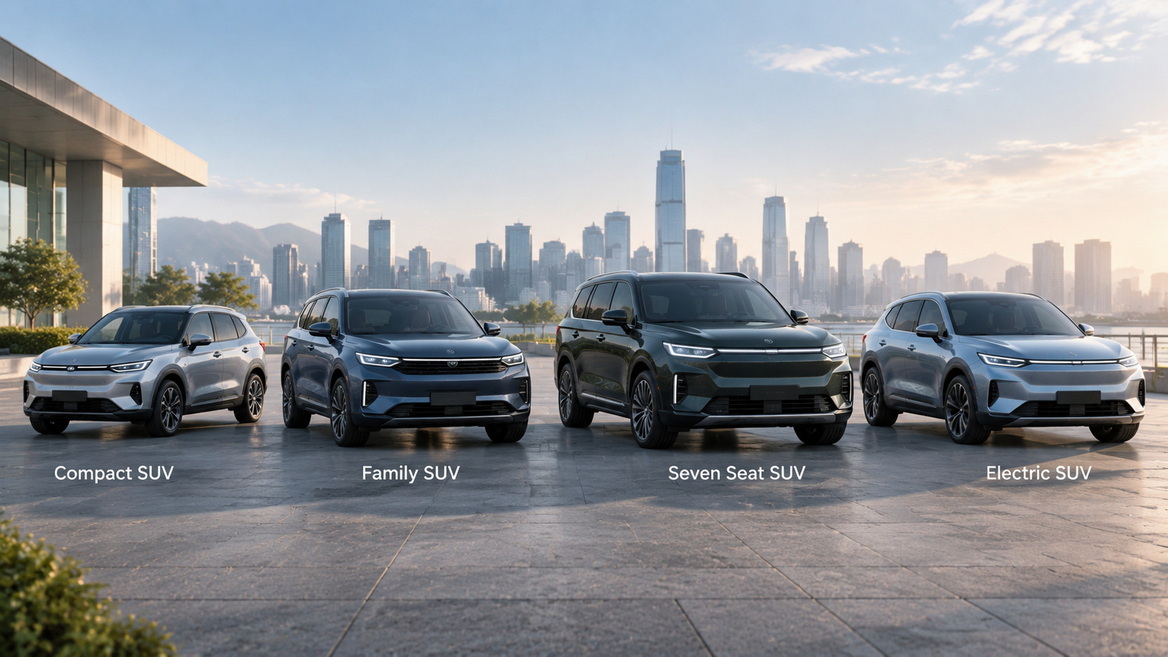
SUV means Sport Utility Vehicle. Traditionally, SUVs were designed with a stronger focus on utility, outdoor travel, mixed-road driving, and four-wheel-drive capability. Many early SUVs were larger, tougher vehicles with high ground clearance and durable chassis designs.
Modern SUVs have evolved. Today, many are designed mainly for urban commuting, family transportation, highway travel, and comfort. Some are capable of light off-road use, while others are built almost entirely for paved roads.
Most SUVs have several common features:
- A higher driving position than a sedan or hatchback
- A larger cargo area with a rear tailgate
- Flexible seating arrangements, often with folding rear seats
- More headroom and cabin space than smaller passenger cars
- Higher ground clearance for uneven roads, speed bumps, or poor surfaces
- Available all-wheel drive or four-wheel drive on selected models
- A wide variety of powertrains, including petrol, diesel, hybrid, plug-in hybrid, and electric
Not every SUV is designed for off-road driving. Many smaller SUVs and crossovers are created for city use and highway comfort. Their raised seating position, cargo space, and practical body design still make them attractive to buyers who do not need serious off-road capability.
The original idea behind an SUV was simple: create a vehicle that could carry people and equipment while handling more demanding roads than a conventional passenger car.
Over time, consumer priorities changed. Buyers increasingly wanted better comfort, lower running costs, improved safety technology, easier parking, quieter cabins, and more efficient powertrains. Vehicle manufacturers responded by creating many different SUV formats.
Today, SUVs range from compact electric crossovers for city use to full-size seven-seat vehicles for large families and commercial transport.
| SUV Type | Typical Use | Main Benefits | Possible Limitations |
|---|---|---|---|
| Compact SUV | City driving and daily commuting | Easy to park, practical, efficient | Limited rear-seat and cargo space |
| Crossover SUV | Family and everyday travel | Car-like driving, versatile cabin | Usually not designed for difficult off-road use |
| Mid-size SUV | Family trips and mixed use | Strong balance of space and comfort | Higher cost than compact models |
| Large SUV | Large families and long-distance travel | More seats, larger cargo area | More difficult to park in cities |
| Seven-seat SUV | Passenger transport and family use | Flexible seating and capacity | Cargo space may be limited when all seats are used |
| SUV Coupé | Personal and lifestyle use | Stylish shape and sporty appearance | Less rear headroom and luggage space |
| 4x4 SUV | Rural roads, towing, rough terrain | Strong traction and durability | Higher weight and operating cost |
| Electric SUV | City, family, and fleet use | Quiet driving and zero tailpipe emissions | Charging planning is important |
The wide variety of SUV styles gives buyers more choices than ever before. However, it also means that buyers need to understand the difference between vehicle appearance and vehicle capability.
A large-looking SUV may not be suitable for towing. A compact all-wheel-drive crossover may not be designed for off-road work. A seven-seat SUV may not have enough luggage room when every seat is occupied. An electric SUV may offer strong performance but require reliable charging access.
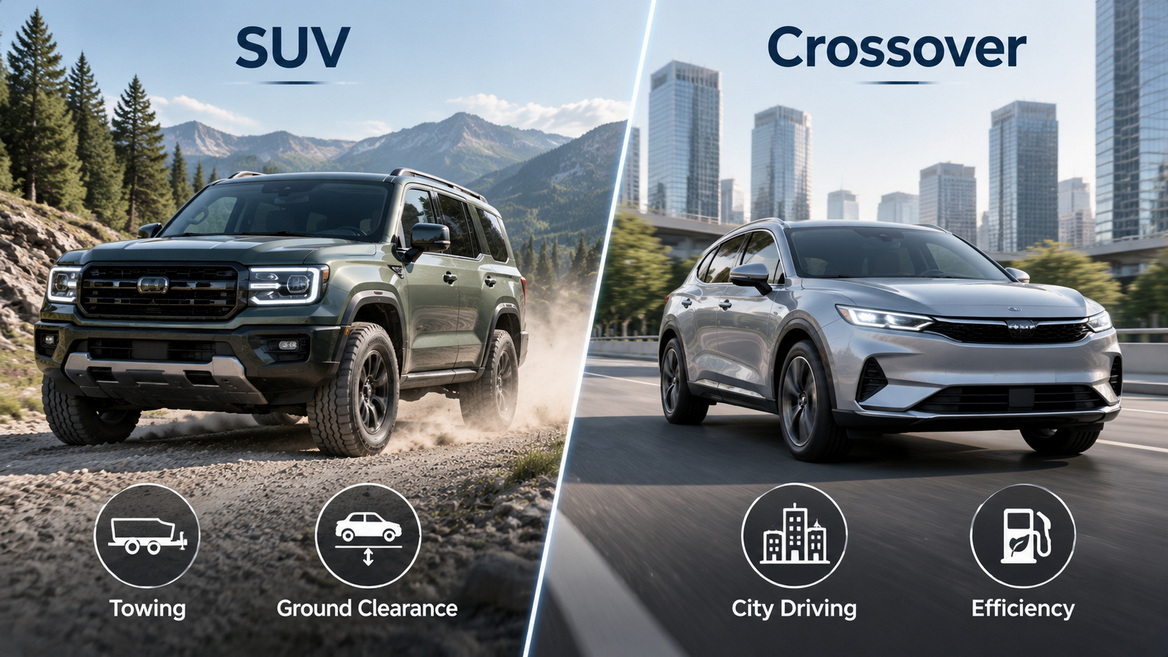
The terms SUV and crossover are often used in the same way, but they can describe different vehicle designs.
A traditional SUV may use a stronger, more truck-like construction. In this design, the body and chassis are separate. This can provide greater durability for towing, poor roads, heavy loads, and more demanding use.
A crossover SUV usually uses a car-based construction. Its body and frame are integrated into one structure. This often makes the vehicle lighter, more efficient, easier to drive, and more comfortable for normal road use.
| Feature | Traditional SUV | Crossover SUV |
|---|---|---|
| Vehicle structure | Often more rugged and heavy-duty | Usually lighter and car-based |
| Driving character | Stronger and more robust | Smoother and more refined |
| Off-road ability | Often better suited to rough terrain | Usually designed for paved roads and light conditions |
| Towing potential | Often higher | Depends on the model and powertrain |
| Energy efficiency | Can be lower due to size and weight | Often more efficient |
| Best suited for | Towing, uneven roads, demanding use | Families, commuting, city driving, highway travel |
A crossover is still commonly called an SUV because it has SUV-like styling, seating height, and practicality. The more important question is whether the vehicle is designed for normal road use, mixed-road use, or demanding off-road and towing work.
Compact SUVs are popular because they offer the advantages of an SUV without the large size of a full-size model. They are often easier to park, easier to maneuver in city traffic, and more economical to operate than larger SUVs.
A compact SUV may be suitable for:
- Daily commuting
- Small families
- Urban professionals
- First-time SUV buyers
- Airport transfers
- Light commercial travel
- Fleet use in cities
Many compact SUVs now offer hybrid and electric versions. This makes them particularly useful for buyers who want a higher seating position and flexible cargo space while reducing fuel use or tailpipe emissions.
Compact electric SUVs can be a practical choice for city fleets, corporate mobility programs, residential communities, and users with regular access to home, workplace, or depot charging.
Mid-size SUVs are often considered the most balanced choice in the SUV market. They usually provide enough interior space for families while remaining manageable on city roads and highways.
These vehicles may offer:
- Comfortable seating for five adults
- Larger luggage areas
- Flexible rear-seat configurations
- Modern infotainment systems
- Advanced safety features
- Strong highway performance
- Available all-wheel-drive systems
- Optional hybrid or electric powertrains
For many buyers, a mid-size SUV offers the best combination of practicality, comfort, and everyday usability. It can work well for school runs, business travel, airport pick-ups, weekend trips, and longer family journeys.
Commercial users may also find mid-size SUVs useful for executive transport, hotel shuttle support, client visits, rental fleets, and regional business travel.
Large SUVs are designed for buyers who need more passenger capacity, more cargo room, or greater towing capability. Many large SUVs include three rows of seating and can carry six or seven passengers.
However, not all seven-seat SUVs provide the same level of comfort. In some models, the third row is mainly suitable for children or occasional use. In others, the third row is designed for regular adult passengers.
Before choosing a seven-seat SUV, buyers should check:
1. Third-row access: Can passengers reach the third row easily?
2. Third-row comfort: Is there sufficient legroom, headroom, and ventilation?
3. Luggage space: How much cargo room remains when all seats are occupied?
4. Payload capacity: Can the vehicle safely carry passengers and luggage together?
5. Rear climate control: Are there air vents and temperature controls for rear passengers?
6. Seat-folding flexibility: Can the second and third rows fold flat when more cargo space is needed?
A seven-seat SUV can be useful for large families, tourism businesses, airport transportation, hotel operations, and corporate passenger services. However, buyers should carefully review the real cabin layout rather than focusing only on the advertised seat count.
SUV coupés combine a raised SUV body with a sloping roofline. They often look sportier and more dynamic than traditional SUVs. Their design can appeal to buyers who want a premium appearance, bold styling, and a more distinctive road presence.
However, the sloping roof can reduce rear headroom and cargo space. This means SUV coupés are often better suited to buyers who prioritize design and do not regularly need maximum passenger capacity or large loads.
SUV coupés can work well for:
- Personal use
- Executive mobility
- Lifestyle-focused buyers
- Premium rental fleets
- Customers who mainly carry one or two passengers
A 4x4 SUV is designed for more challenging driving conditions. It may include four-wheel-drive hardware, terrain modes, higher ground clearance, stronger suspension, underbody protection, and durable tyres.
These vehicles may be suitable for:
- Rural roads
- Construction sites
- Mining areas
- Agricultural operations
- Mountain regions
- Towing trailers or equipment
- Unpaved roads
- Harsh weather conditions
However, all-wheel drive and four-wheel drive are not always the same thing. Some all-wheel-drive systems are designed mainly to improve traction on wet, slippery, or lightly uneven roads. A true off-road SUV may offer more advanced systems, including low-range gearing, stronger chassis protection, and specialized terrain settings.
For buyers who need genuine rough-road capability, it is important to review the vehicle's ground clearance, tyre specification, approach angle, departure angle, towing capacity, cooling system, and underbody protection.
SUVs are popular because they can combine several useful features in one vehicle. They provide a practical body shape for everyday life while offering a stronger visual presence than many sedans or hatchbacks.
The most common reasons buyers choose SUVs include:
- Higher seating position: Drivers often appreciate the elevated view of the road.
- Easy entry and exit: The raised cabin can make getting in and out more convenient.
- Flexible cargo space: Rear seats can often fold to create more room for luggage, equipment, or large items.
- Family-friendly layout: SUVs may provide more headroom, storage compartments, and passenger comfort.
- Wide size range: Buyers can choose compact, mid-size, large, luxury, hybrid, or electric SUVs.
- All-weather confidence: Available all-wheel-drive systems can help improve traction in rain, snow, or poor road conditions.
- Towing capability: Some SUVs are suitable for towing trailers, boats, caravans, or work equipment.
- Modern technology: Many SUVs include parking cameras, collision warning systems, driver-assistance features, and connected infotainment systems.
The growing popularity of electric vehicles has also strengthened demand for electric SUVs. Buyers increasingly want the practicality of an SUV together with quiet driving, instant torque, lower energy costs, and reduced tailpipe emissions.
SUVs can be highly practical, but they are not the best choice for every buyer. The right decision depends on driving environment, passenger needs, cargo requirements, budget, energy use, and maintenance expectations.
| SUV Advantages | SUV Considerations |
|---|---|
| Higher driving position and clear road view | Larger models can be difficult to park |
| Flexible passenger and cargo space | Purchase costs can be higher than smaller cars |
| Wide choice of vehicle sizes | Larger tyres may cost more to replace |
| Available AWD and 4x4 systems | Heavier models can consume more fuel or electricity |
| Suitable for family and business travel | Taller vehicles may feel different during sharp turns |
| Increasing number of hybrid and electric options | Electric models require charging planning |
| Practical for luggage, equipment, and long trips | Large SUVs may have a wider turning circle |
A larger vehicle is not automatically the right vehicle. Buyers should consider the roads they use every day, the parking spaces available, the number of passengers they carry, and the actual amount of cargo they need to transport.
Safety should be evaluated based on the individual vehicle rather than vehicle size alone. A well-designed SUV can include strong structural protection, modern braking systems, stability control, multiple airbags, cameras, and advanced driver-assistance features.
However, taller vehicles may handle differently from lower passenger cars because of their higher center of gravity. Drivers should be aware of vehicle height, weight, tyre condition, load distribution, and speed when turning or changing direction.
Important features to consider include:
- Automatic emergency braking
- Electronic stability control
- Lane-departure warning
- Lane-keeping support
- Blind-spot monitoring
- Rear-view camera
- Parking sensors
- Adaptive cruise control
- Strong child-seat attachment points
- Reliable tyre quality and braking performance
For family and fleet use, safety equipment should be matched to the vehicle's daily operating environment. A city-focused SUV may benefit from parking sensors and pedestrian detection. A highway-focused SUV may benefit from adaptive cruise control and lane support. A work-oriented 4x4 SUV may require robust tyres, underbody protection, and strong traction systems.
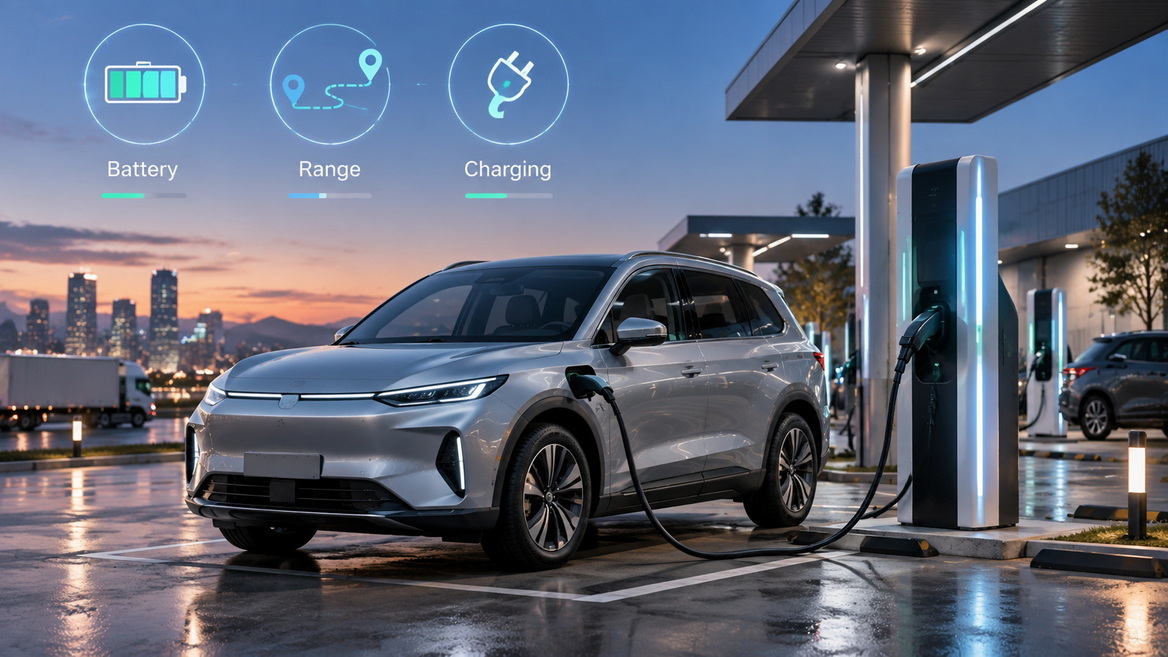
An electric SUV uses battery power instead of a conventional petrol or diesel engine. It can offer quiet operation, smooth acceleration, instant torque, and zero tailpipe emissions while driving.
Electric SUVs are increasingly used for private transportation, corporate fleets, ride services, airport transfers, tourism operations, and urban business mobility.
Electric SUVs can offer several practical advantages:
- Quiet driving experience
- Instant acceleration from low speeds
- No tailpipe emissions during driving
- Potentially lower energy costs
- Reduced routine maintenance needs
- Suitable for urban driving and stop-start traffic
- Convenient overnight charging for suitable users
- Modern digital displays and connected vehicle features
For businesses and fleet operators, electric SUVs may be particularly attractive when vehicles follow predictable daily routes and return to a fixed location for charging.
Range is important, but it should not be the only factor when choosing an electric SUV. Buyers should also review battery capacity, energy consumption, charging speed, payload, climate conditions, and regular driving patterns.
Actual electric SUV range can change because of:
- High highway speeds
- Cold weather
- Hot weather and air-conditioning use
- Heavy passenger loads
- Cargo weight
- Steep roads
- Aggressive acceleration
- Tyre pressure
- Roof boxes or roof racks
- Towing trailers
- Frequent stop-start traffic
For fleet planning, it is wise to select a vehicle with enough practical range for the normal daily route plus a reasonable reserve. This gives drivers more flexibility when traffic, weather, detours, or charging delays affect the planned journey.
Electric SUV efficiency is often measured in kilowatt-hours per 100 kilometers.
A lower consumption figure generally means the vehicle uses less electricity to travel the same distance. This can help reduce operating costs and make charging requirements easier to manage.
This means the vehicle would need approximately 34.2 kWh of electricity for that daily distance, before considering charging losses and additional operating conditions.
For commercial users, this calculation can help estimate:
- Daily charging demand
- Depot charging capacity
- Electricity cost
- Number of chargers required
- Fleet energy planning
- Expected operating range
An electric SUV purchase should include a charging plan. The vehicle, charger, electricity supply, and daily route should work together.
Before selecting an electric SUV, consider:
1. Where will the vehicle charge?
Home, office, depot, public charger, hotel, or fleet facility.
2. How long can the vehicle stay parked?
Overnight charging may be sufficient for many daily-use vehicles.
3. What charging speed is required?
AC charging may suit regular overnight use, while DC fast charging may be important for longer routes.
4. Is public charging available on key routes?
Drivers should understand the charging network before long-distance operation.
5. Does the vehicle support the local charging standard?
Charging compatibility should be confirmed before import or fleet deployment.
6. What is the battery warranty?
Battery warranty terms, service support, and replacement procedures should be reviewed carefully.
Choosing the right SUV begins with understanding how the vehicle will actually be used. Buyers should focus on daily travel patterns, road quality, passenger count, cargo needs, energy availability, and long-term operating costs.
Start by identifying the vehicle's primary job.
Common SUV use cases include:
- City commuting
- Family transportation
- School runs
- Long-distance travel
- Corporate mobility
- Airport transfers
- Tourism operations
- Rural driving
- Construction-site access
- Towing
- Executive transport
- Light commercial use
A compact electric SUV may be ideal for city-based fleet use. A mid-size SUV may be better for family trips and business travel. A seven-seat SUV may suit passenger transport. A 4x4 SUV may be necessary for challenging terrain or towing work.
Do not make a decision based only on the exterior size of the vehicle. Check the actual usable interior space.
Important measurements include:
- Front and rear headroom
- Rear legroom
- Third-row space, if applicable
- Cargo volume with all seats in use
- Cargo volume with seats folded
- Tailgate opening size
- Payload capacity
- Roof-load capacity
- Towing capacity
- Door-opening width
For commercial and export buyers, payload is especially important. A vehicle may have enough seats for several passengers but may not be able to carry the same number of passengers plus heavy luggage or equipment.
The purchase price is only one part of the total cost. Buyers should also consider:
- Energy or fuel cost
- Charging equipment cost
- Maintenance intervals
- Tyre cost
- Insurance
- Registration fees
- Spare-parts availability
- Warranty coverage
- Battery warranty for electric vehicles
- Expected resale value
- Service-network support
- Vehicle downtime risk
A lower purchase price may not always result in the lowest long-term cost. A vehicle with better efficiency, reliable parts supply, and strong service support may offer better value over its operating life.
For international buyers, the vehicle must be suitable for the destination market.
Important checks include:
- Local certification requirements
- Steering-wheel position
- Charging standard compatibility
- Lighting requirements
- Safety equipment requirements
- Climate suitability
- Road conditions
- Local service support
- Spare-parts supply
- Registration and approval procedures
This is particularly important for electric SUVs, buses, heavy-duty trucks, and other new-energy vehicles. A vehicle should be technically suitable, commercially viable, and ready for practical operation in its intended market.
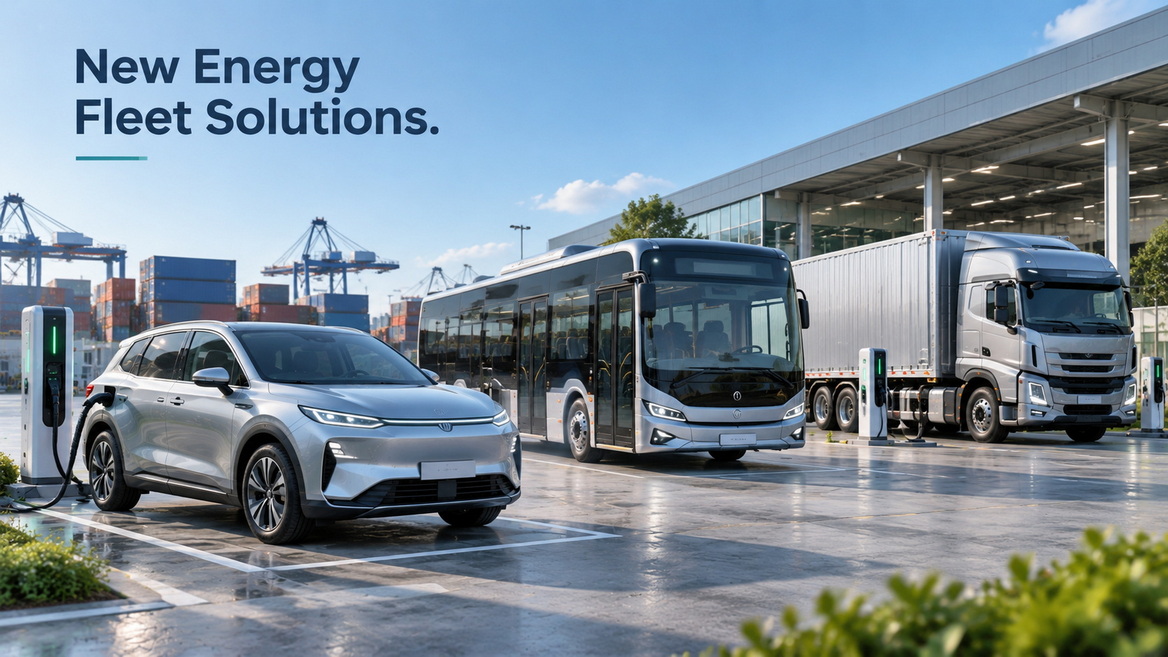
Modern buyers need more than a vehicle with attractive specifications. They need a solution that fits their route conditions, passenger requirements, energy strategy, maintenance capability, and long-term operating goals.
KeyChain is a China-based supplier and exporter focused on high-quality buses, heavy-duty trucks, and new-energy vehicles. We support domestic and international customers looking for practical passenger transport, commercial vehicle, and electrified mobility solutions.
Our approach considers the full vehicle application, including:
- Suitable vehicle category
- Passenger capacity
- Cargo and payload requirements
- Battery and charging specifications
- Driving range requirements
- Fleet operation needs
- Export-market compatibility
- Service and spare-parts planning
- Long-term operating value
Whether the requirement is for an electric SUV, a new-energy bus, a heavy-duty truck, or a vehicle solution for fleet deployment, a clear understanding of daily operations is the foundation of a successful vehicle selection.
An SUV is more than a high-riding passenger vehicle. It is a flexible vehicle category that can support family travel, daily commuting, business transport, tourism, towing, fleet operations, and electrified mobility.
The right SUV depends on the intended use. A compact SUV may be ideal for city driving. A mid-size SUV may be the best choice for families and business users. A seven-seat SUV may support larger passenger groups. A 4x4 SUV may be necessary for tough roads and heavy-duty use. An electric SUV may provide a practical solution for urban travel and predictable fleet routes.
Before making a final decision, buyers should compare real passenger space, cargo capacity, energy use, safety equipment, charging requirements, total operating cost, and destination-market compatibility. Choosing the right vehicle begins with understanding the journey it needs to complete.
SUV stands for Sport Utility Vehicle. It usually refers to a vehicle with a higher seating position, practical cargo space, flexible passenger capacity, and a versatile body design.
No. Many SUVs are front-wheel drive, while others use all-wheel drive. A 4x4 SUV is generally designed for more demanding conditions, such as rough roads, towing, or off-road driving.
A crossover is usually built on a car-based platform, making it lighter and more comfortable for normal road use. A traditional SUV may have a more rugged structure and may be better suited to towing or off-road conditions.
Electric SUVs can be suitable for long-distance travel when there is reliable charging access along the route. Buyers should consider real driving range, weather, speed, passenger load, charging time, and available charging stations.
SUVs can be excellent family vehicles because they often provide more headroom, cargo space, flexible seating, and a higher driving position. Families should compare rear-seat comfort, child-seat mounting points, safety features, and luggage capacity before choosing a model.
1. Evans Halshaw. [What Is an SUV? Pros, Cons, & Features Explained]
2. International Energy Agency. [Global EV Outlook 2026]
3. International Energy Agency. [Close to 30% of Cars Sold This Year Are Set to Be Electric]
4. U.S. Department of Energy and U.S. Environmental Protection Agency, FuelEconomy.gov. [Electric Vehicles: Learn More About the Label]


