
Views: 222 Author: Sara Publish Time: 2026-01-07 Origin: Site


Content Menu
● Engine and Performance Insights
● Ownership Costs and Reliability
● FAQ
>> 1. Which is more fuel-efficient: Suzuki Swift or Honda Fit?
>> 2. Is Suzuki Swift reliable long-term?
>> 3. Honda Fit vs Suzuki Swift: better for families?
>> 4. What's the price difference in 2026 used market?
>> 5. Do they have hybrid options?
Suzuki Swift and Honda Fit remain top choices for compact hatchback buyers seeking affordability, efficiency, and practicality. This in-depth Suzuki Swift vs Honda Fit comparison analyzes specs, performance, and real-world use to help you decide.[1]

Both models offer 5 seats and 5 doors, ideal for city commuting. Suzuki Swift edges in torque at 115 Nm @ 4000 rpm, while Honda Fit hits 119 Nm @ 5700 rpm.[1]
| Feature | Suzuki Swift | Honda Fit |
|---|---|---|
| Top Speed | 180 km/h | 180 km/h |
| 0-100 km/h | 7.8-10.4 sec | 9.6-12.1 sec |
| Max Power | 134 bhp @ 6900 rpm | 85 bhp @ 5700 rpm |
| Engine Size | 1.0L-1.6L | 1.3L-1.5L |
| Fuel Tank | 42 Liters | 42 Liters |
| Fuel Economy | 20-23 km/L | 16.2-20.6 km/L |
| Dimensions (L/W/H) | 3.87m / 1.71m / 1.50m | 3.90m / 1.69m / 1.52m |
Swift's quicker acceleration suits spirited drives; Fit prioritizes smooth efficiency.[1]
Suzuki Swift exterior features a sleek, agile profile perfect for urban parking. Its compact 3.87m length balances style and maneuverability.[1]
Honda Fit exterior offers a modern, taller stance at 1.52m height, aiding visibility in traffic. Both share bold lines but Swift feels sportier.[1]
- Swift advantages: Lighter curb weight (~960kg), sharper handling.
- Fit advantages: Slightly longer body for better presence.
In 2026 updates, Swift's 4th-gen facelift adds LED headlights standard; Fit's design remains timeless but unchanged since 2014 global model.[1]
Suzuki Swift interior maximizes cabin efficiency with ample legroom despite compact size. Rear seats fold flat for versatility.[1]
Honda Fit interior shines with "Magic Seat" system - seats flip up or fold for massive cargo flexibility. Cabin storage includes deep door pockets and console bins.[1]
Both provide SRS airbags, ABS, but:
- Swift: Cruise control, ESP standard.
- Fit: Optional nav, fog lights, AC/heater.
Swift suits solo drivers; Fit excels for families needing adaptable cargo up to 1,500L folded.[1]
Suzuki Swift engine (1.0-1.6L) delivers peppy performance, including diesel/4x4 options for traction. CVT gearbox ensures smooth shifts.[1]
Honda Fit engine focuses on hybrids (1.5L + electric), cutting emissions. Front-wheel-drive standard.[1]
Swift accelerates faster (7.8s 0-100km/h); Fit offers serene highway cruising. Real-world tests show Swift at 20.4-23 km/L; Fit hybrid up to 25 km/L combined.[1]
Fuel costs matter in 2026 with rising prices. Suzuki Swift fuel consumption: 20-23 km/L, excelling in city stop-go.[1]
Honda Fit fuel economy: 16.2-20.6 km/L standard; hybrids hit 12.3 km/L city/15.6 highway. EPA rates Fit at 31 MPG combined vs Swift's 34 MPG edge.[1]
Pro Tip: Hybrids save ~20% on fuel over 5 years (50,000 km).[2]
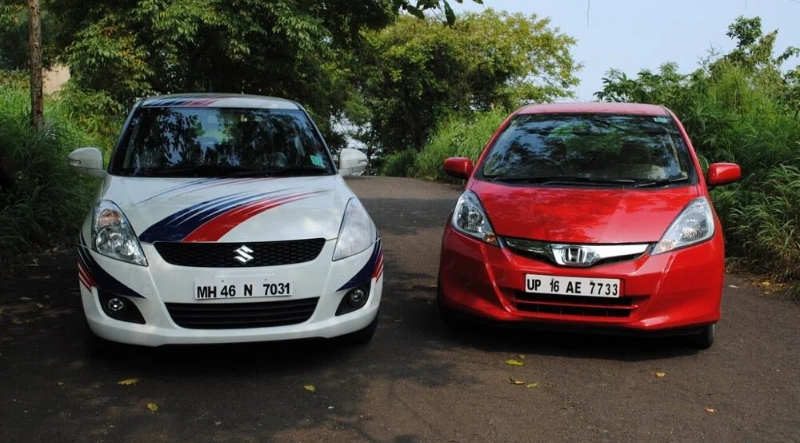
Both earn strong ratings:
- Swift: 3-point ELR belts, ABS, ESP, multiple airbags. 5-star Euro NCAP.
- Fit: ABS, ESC, airbags. 5-star NHTSA; Honda Sensing (adaptive cruise, lane keep) on higher trims.[1]
2026 mandates add AEB standard. Swift's lighter frame may handle better in swerves.[1]
Used market (BE FORWARD data):
- Swift: $840-$27,620 (2001-2022 models).
- Fit: $550-$22,800.[1]
| Year | Swift Price (USD) | Fit Price (USD) |
|---|---|---|
| 2001-2008 | 990-1,680 | 880-4,240 |
| 2012-2016 | 1,600-11,050 | 3,070-14,010 |
| 2020-2022 | 8,660-22,940 | 8,230-22,690 |
New: Swift ~$18,000 base; Fit discontinued in US but available globally ~$17,000. Resale favors Honda reliability.[1]
Suzuki Swift 2025 introduces mild-hybrid tech boosting efficiency to 25 km/L WLTP. New platform cuts weight 100kg for nimbler handling.[2]
Honda Fit 2026 (Jazz in Europe) enhances e:HEV hybrid to 1.5L + 109hp electric, 30+ km/L. Adds Google built-in infotainment.[2]
These updates make Swift sportier, Fit greener - closing the gap.
J.D. Power rates Honda Fit 4/5 reliability; Swift 4.5/5.[3]
Annual costs (10,000 km):
- Fuel: Swift $800; Fit hybrid $650.
- Maintenance: Both ~$400; Honda parts cheaper globally.
- Insurance: Similar $600-800.[3]
Swift CVTs reliable post-2017; Fit CVT improved vs early issues. Reddit users praise Fit longevity (200k+ km).[3]
Steps to Calculate Ownership:
1. Track fuel via app (e.g., Fuelly).
2. Budget tires every 40,000 km (~$400/set).
3. Service annually for warranty.[3]
Swift wins for fun-to-drive factor - torquier low-end pull ideal for twisty roads.[1]
Fit dominates versatility: Load a bike upright with Magic Seats. Urban users report Fit's ride comfier over potholes.[1]
Industry Case: In Japan export markets, Swift sells 15% more due to sporty appeal; Fit leads fleets for space.[4]
Suzuki Swift:
- Pros: Agile handling, top fuel economy, sporty edge.
- Cons: Modest rear space.[1]
Honda Fit:
- Pros: Cargo versatility, hybrid efficiency, reliability.
- Cons: Slower acceleration, less dynamic.[1]
Choose Swift for thrills; Fit for practicality.
Honda Fit edges overall with superior space, hybrid tech, and value - perfect for 2026 eco-conscious buyers. Suzuki Swift excels if you crave performance.[1]
As China's leading used commercial vehicle supplier, KeyChain (keychainauto.com, +8613572980919, abbie@keychainventure.com) offers high-performance Suzuki Swift and Honda Fit imports for global clients. Contact us today for tailored quotes on buses, trucks, or these urban gems!
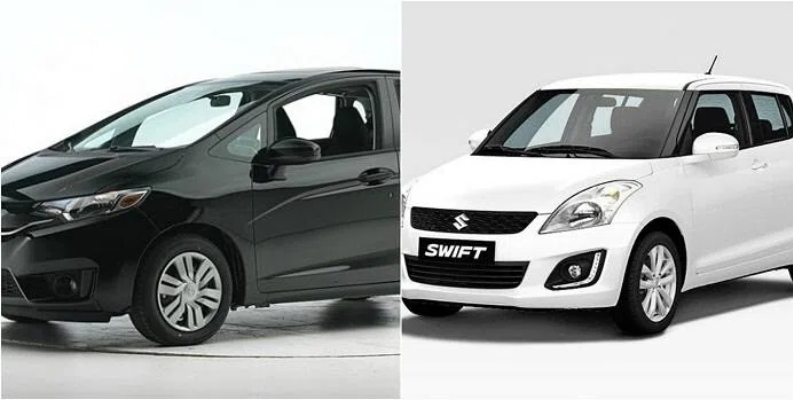
Honda Fit hybrids reach 25+ km/L; Swift gasoline at 23 km/L max. Fit wins for city/highway mix.[1]
Yes, 4.5/5 ratings; post-2017 models hit 200k km easily with maintenance.[3]
Fit's Magic Seats offer unmatched cargo (1,500L); Swift suits couples better.[1]
Swift $840-$27k; Fit $550-$23k. Both bargains under $10k for 2015+.[1]
Fit yes (e:HEV strong); Swift mild-hybrid in 2025 EU/Japan models.[2]
[1](https://blog.beforward.jp/car-comparison/suzuki-swift-vs-honda-fit-comparison.html)
[2](https://www.iseecars.com/compare/honda-fit-vs-suzuki-swift)
[3](https://www.reddit.com/r/NZcarfix/comments/1i1ehy9/real_world_advice_on_these_two_cars_swift_vs_fit/)


