
Views: 273 Author: Keychain Venture Publish Time: 2026-07-08 Origin: Site


Content Menu
● Why SmartDrive video safety matters for heavy trucks
● What Penske actually implemented
● What changed in fleet safety after video adoption
● Why this is relevant for heavy truck exporters
● What the market is telling us
● What fleets should learn from the Penske model
● A practical framework for OEMs and exporters
● FAQ
>> 1. What is SmartDrive video solution in fleet safety?
>> 2. Why do fleets use driver-facing and road-facing cameras?
>> 3. Do video safety systems reduce accidents?
>> 4. Are event-triggered cameras better than always-on recording?
>> 5. How can heavy truck exporters benefit from this trend?
In modern fleet operations, video-based safety technology is no longer just a compliance tool. It has become a practical way to reduce collisions, coach drivers, protect the business in claims disputes, and support safer operations across heavy-duty truck fleets. Penske Logistics' adoption of SmartDrive event-triggered cameras is a strong example of how a structured camera-and-coaching program can improve fleet safety in a measurable way.
For OEMs, exporters, and heavy truck suppliers such as KeyChain, this topic is especially relevant because buyers of dump trucks, buses, and new-energy commercial vehicles increasingly expect advanced safety features as part of the total solution. In other words, safety tech is now tied directly to purchasing decisions, fleet reputation, and total cost of ownership.
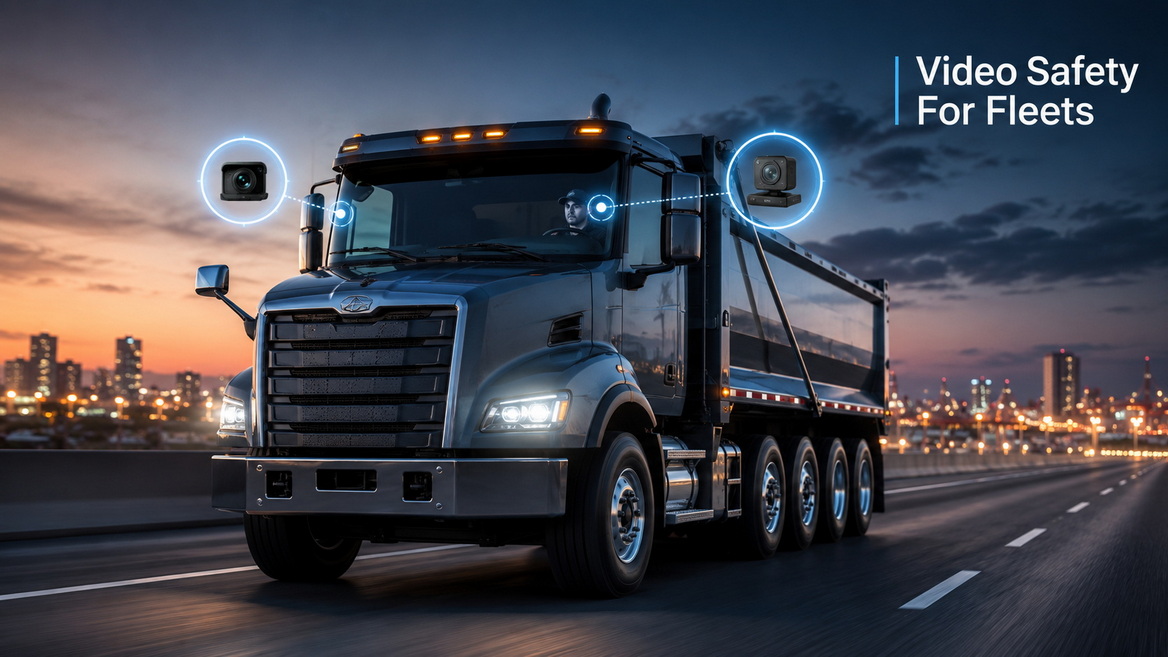
Penske installed SmartDrive event-triggered onboard cameras facing both the cab and the road, with the goal of supporting driver coaching and incident review. The system does not continuously record in normal operation; instead, it records when an event is triggered while the vehicle is in use, which helps focus attention on meaningful risk events rather than creating unnecessary data overload.
The program was deployed alongside a wider safety stack that already included backup alarms, collision avoidance, lane departure systems, stability control, air disc brakes, electronic logs, telematics, vehicle diagnostics, speed governors, and visibility-enhancing headlights. That matters because the strongest fleets do not rely on one technology alone; they combine multiple layers of protection into a single safety system.
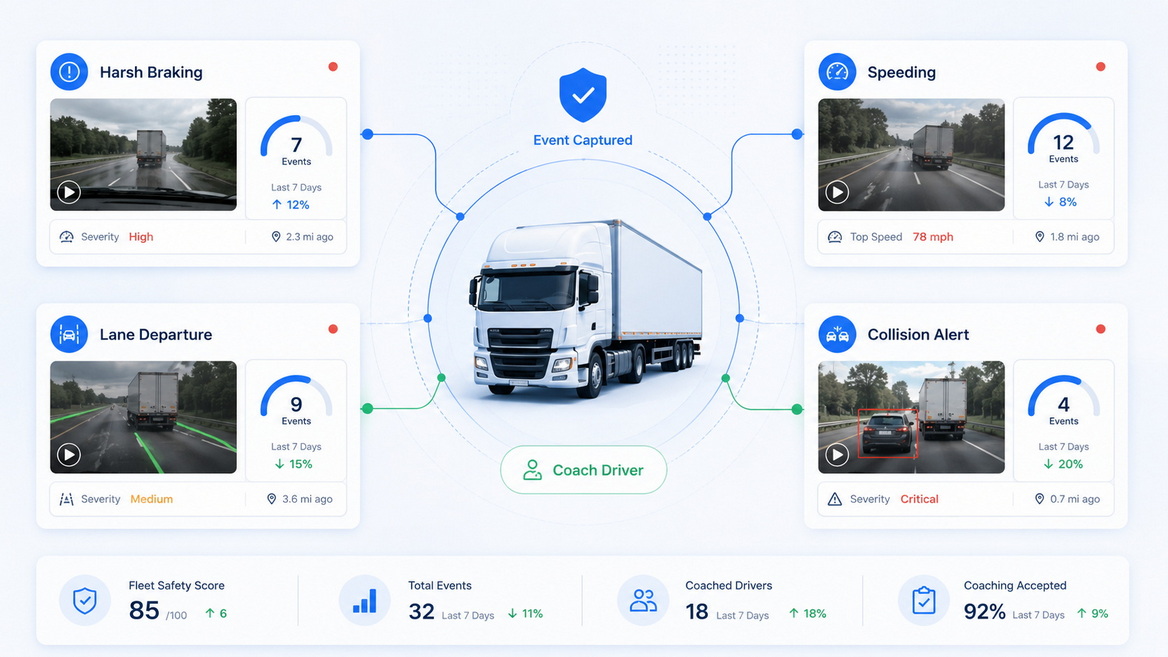
Penske's message is not simply "we installed cameras." The deeper lesson is that safety improves when technology is paired with coaching, scorecards, and repeatable process discipline. Penske described the recorded clips as "game film," which is a useful analogy: footage is used to review performance, reinforce good habits, and correct unsafe patterns before they become recurring losses.
This is where many fleets fail. They buy hardware, but they do not build a coaching workflow, assign ownership, or define what happens after an event is captured. Penske's approach shows that the value comes from the operating model, not just the camera itself.
According to Penske's own safety page, its video-based safety program has delivered fewer total incidents, fewer DOT recordable accidents, improved safety scores, and savings in injuries, vehicle repairs, and liability claims. Earlier reporting on the rollout also noted that a pilot program produced significant reductions in total incidents and improved safety scores across locations.
That is important for two reasons. First, it suggests the ROI is not limited to accident prevention; it also includes claims defense and operational efficiency. Second, it shows why fleets increasingly treat video safety as part of digital logistics rather than as a standalone safety gadget.
For companies exporting dump trucks, heavy trucks, buses, and new-energy commercial vehicles, the Penske case offers a clear commercial lesson: buyers want vehicles that support safety, visibility, and driver accountability from day one. In many markets, fleet operators now evaluate cameras, telematics, lane assistance, and stability control as part of the total vehicle package, not as optional extras.
This matters especially in industries with high-risk operation patterns, such as construction, ready-mix, waste hauling, and regional freight. These fleets face backing incidents, blind-spot exposure, distracted driving risks, and claim disputes that can be costly even when the driver is not at fault. A supplier that can speak credibly about safety architecture has a stronger position in both domestic and export sales.
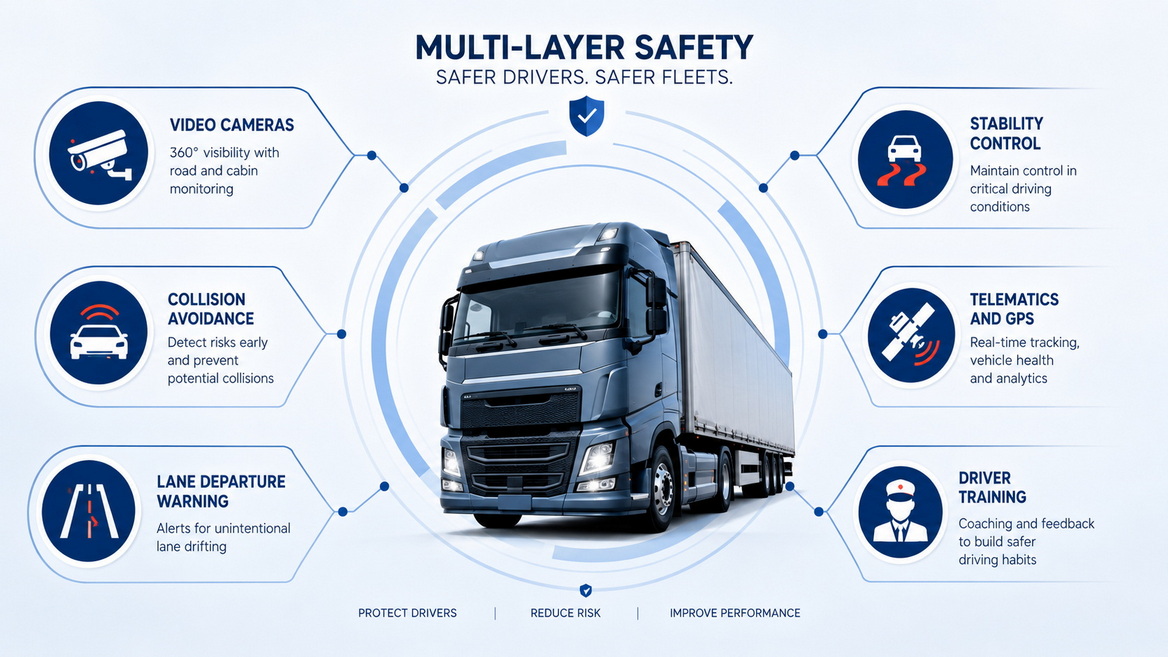
Industry reporting in 2024 showed that camera systems remain among the most used truck safety technologies, alongside air disc brakes, speed limiters, lane departure warning, collision mitigation, and blind-spot monitoring. That means the market is moving from "Should we install cameras?" to "How do we use cameras effectively with training and analytics?".
A separate market forecast found that the commercial-vehicle camera solutions market is expected to grow strongly through 2032, driven by safety, compliance, operational efficiency, transparency, and insurance-related needs. For SEO and content strategy, this trend creates a strong keyword cluster around fleet safety technology, dual-facing cameras, video telematics, truck driver coaching, and claims exoneration.
If you run or supply heavy trucks, here is the practical takeaway: cameras work best when they are deployed as part of a complete safety program. Based on the Penske approach and current market practice, fleets should consider the following steps:
1.Define the safety objective first. Decide whether the priority is coaching, claims defense, backing safety, distracted driving reduction, or all of the above.
2.Use event-based recording intelligently. Recording only relevant events keeps the system more manageable and reduces noise.
3.Pair video with telematics. Video is stronger when matched with speed, location, braking, and other vehicle data.
4.Build a driver coaching workflow. The real value comes from consistent review, feedback, and tracking over time.
5.Measure business outcomes. Track incident rate, claim cycle time, repair costs, and safety score improvements.
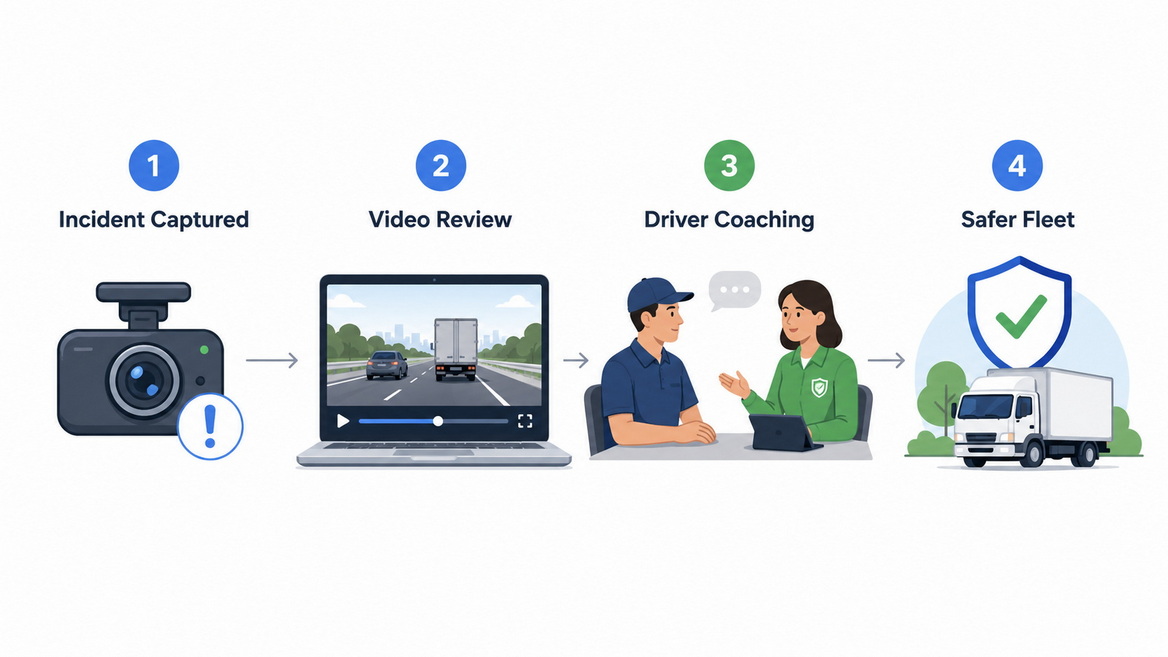
For a manufacturer or exporter like KeyChain, the strongest way to position safety technology is to present it as a vehicle value-add system. That means your product messaging should not only list features such as air brakes, ABS, collision mitigation, or cameras; it should also explain how those features reduce risk in real fleet operations.
If your fleet is evaluating dump trucks, heavy trucks, buses, or new-energy commercial vehicles, the right question is not whether safety technology matters. The real question is whether your vehicle platform supports a full safety ecosystem that helps reduce incidents, defend claims, and improve driver performance. KeyChain can position its vehicles as part of that ecosystem by emphasizing advanced visibility, integrated safety systems, and export-ready fleet reliability.
SmartDrive is a video-based safety program that uses event-triggered cameras to capture road and cab activity for coaching, incident review, and exoneration purposes.
Dual-facing cameras help fleets understand both what happened on the road and what the driver was doing at the time, which improves coaching and claims defense.
Penske reports fewer incidents, fewer DOT recordable accidents, and improved safety scores after adopting its video-based safety approach.
Event-triggered systems reduce unnecessary footage and focus attention on meaningful incidents, which can make coaching and review more efficient.
Exporters can differentiate their vehicles by highlighting integrated safety systems, camera readiness, and fleet-friendly technologies that support lower risk and better operational outcomes.
1. Penske Logistics. "Penske Logistics Improves Fleet Safety with New SmartDrive Video Solution." https://www.gopenske.com/blog/logistics/penske-logistics-improves-fleet-safety-with-new-smartdrive-video-solution/
2. Penske Logistics. "Truck Safety Joins the Supply Chain Tech Revolution." https://www.penskelogistics.com/solutions/dedicated-transportation/dedicated-contract-carriage/truck-safety-technology/
3. Overdrive Online. "Penske Logistics adds driver-facing, road-facing cameras to trucks." https://www.overdriveonline.com/business/article/14894143/penske-logistics-adds-driver-facing-road-facing-cameras-to-trucks
4. TruckingInfo. "What Safety Strategies and Technologies are Trucking Fleets Using in 2024." https://www.truckinginfo.com/articles/safety-strategies-and-technologies-are-trucking-fleets-using-in-2024
5. Intermountain Trailer. "2024 Trucking Fleet Safety Strategies & Technologies." https://www.intermountaintrailer.com/what-safety-strategies-and-technologies-are-trucking-fleets-using-in-2024/
6. SmartDrive. "Ready-Mix Leader Rasmussen Group Deploys Industry-Acclaimed Safety Program SmartDrive 360 to Reduce Accidents." https://www.smartdrive.net/rasmussen-group-deploys-smartdrive-360-to-reduce-accidents
7. British Safety Council. "Fleet safety technology: a wealth of options." https://www.britsafe.org/safety-management/2023/fleet-safety-technology-a-wealth-of-options [britsafe](https://www.britsafe.org/safety-management/2023/fleet-safety-technology-a-wealth-of-options)
8. GlobeNewswire. "Camera Solutions for Commercial Vehicle Fleet Management Market 2024-2032." https://www.globenewswire.com/news-release/2024/10/24/2968510/0/en/Camera-Solutions-for-Commercial-Vehicle-Fleet-Management-Mark...
9. HD Fleet. "When drivers are wrongly blamed: the role of video in fleet exoneration." https://hdfleet.com/when-drivers-are-wrongly-blamed-the-role-of-video-in-fleet-exoneration/
10. SureCam. "AI-powered driver coaching system" https://transportuk.co.uk/2024/08/01/surecam-introduces-ai-driver-coaching-tool-to-support-efficient-video-enabled-road-safety-s...


