
Views: 249 Author: Keychain Venture Publish Time: 2026-08-08 Origin: Site


Content Menu
● Why the Ford Sierra RS Cosworth Became an Icon
● The Motorsport Purpose Behind the Sierra Cosworth
● The Engineering Behind the Famous Rear Wing
● The Original Three-Door Sierra RS Cosworth
● Ford Sierra RS500 Cosworth: The Ultimate Evolution Model
● Sierra Sapphire RS Cosworth: Performance with Greater Practicality
● What Determines Sierra RS Cosworth Value?
● Expert Buying Checklist for Sierra Cosworth Buyers
● Why the Sierra Cosworth Still Matters
● A Legacy of Purposeful Engineering
>> How many Ford Sierra RS Cosworths were built?
>> What makes the Ford Sierra RS500 Cosworth special?
>> Was the Sierra RS Cosworth designed for racing?
>> Is the Sierra Sapphire RS Cosworth different from the original model?
The Ford Sierra RS Cosworth is more than a high-performance version of a family car. It was created with a specific purpose: to provide Ford with a competitive platform for Group A touring-car racing.
When it appeared in the mid-1980s, the Sierra RS Cosworth looked radically different from most cars on the road. Its large rear wing, aggressive stance and turbocharged engine gave it an unmistakable identity. It was a Ford, but it did not behave like an ordinary Ford.
The car quickly earned the nickname "Cossie," a reference to Cosworth, the engineering company behind its famous engine. Over time, that nickname became part of British and European car culture. Today, the Sierra RS Cosworth remains a symbol of turbocharged performance, motorsport ambition and accessible automotive excitement.
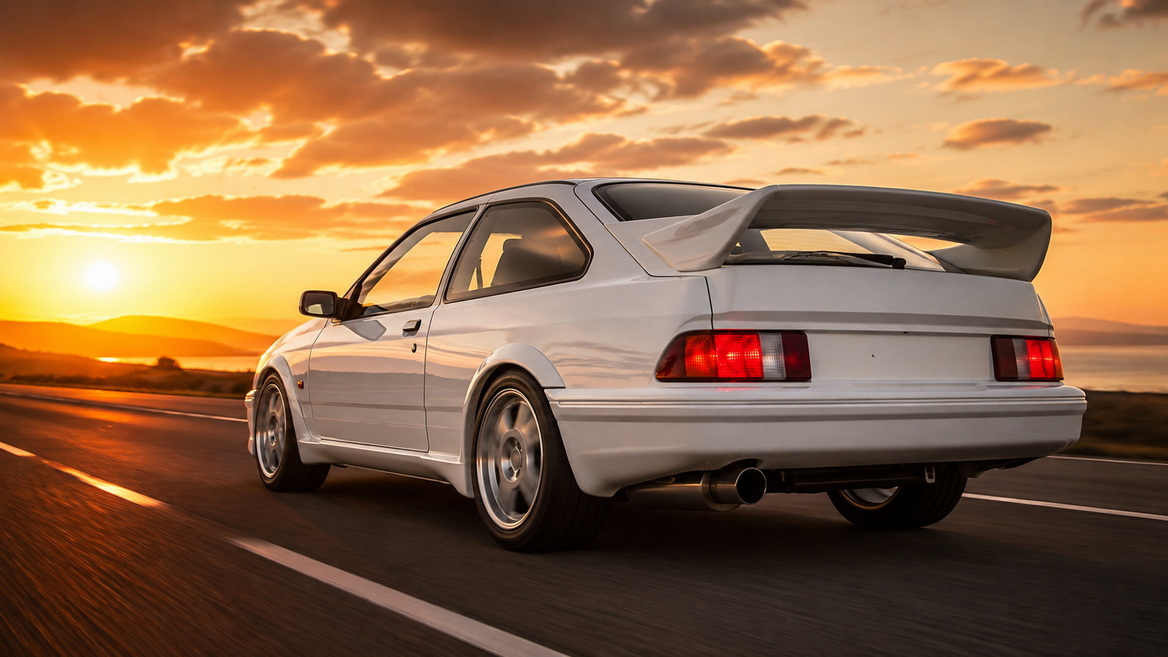
Several factors explain its enduring appeal:
- It was developed from a genuine competition-driven concept.
- It used a powerful turbocharged Cosworth engine.
- It featured one of the most recognisable aerodynamic designs of its era.
- It had strong tuning potential and a passionate enthusiast following.
- It connected ordinary road users with the world of touring-car racing.
- It became a cultural icon in the United Kingdom and across Europe.
The Sierra RS Cosworth was not designed to disappear into traffic. Every major element of the car, from its engine to its rear spoiler, communicated performance intent.
Ford needed a competitive car for Group A touring-car racing, a category that required manufacturers to sell a sufficient number of road-going vehicles before entering an equivalent competition version. This requirement created some of the most memorable performance cars of the era.
The Sierra platform was chosen because it offered a relatively lightweight and aerodynamic foundation. Ford's Special Vehicle Engineering division worked with Cosworth to develop an engine that could provide strong road performance while also supporting future competition development.
The result was the turbocharged YB engine, a 2.0-litre, twin-cam, 16-valve four-cylinder unit. In standard road-car form, the original Sierra RS Cosworth produced around 204 bhp. At the time, this gave the car serious performance credentials and placed it among the most exciting turbocharged European cars available.
The Sierra RS Cosworth was built around a simple but powerful idea: the road car should feel connected to the race car.
This approach created a vehicle with a clear purpose. It was not simply given a sporty badge, upgraded wheels or cosmetic body styling. Its mechanical layout, engine specification and aerodynamics were all influenced by motorsport requirements.
The large rear spoiler is the Sierra RS Cosworth's most famous design feature. Often described as a "whale tail," it helped create the car's instantly recognisable silhouette.
However, the rear wing was more than a visual statement. Ford's engineers needed to improve high-speed stability and manage aerodynamic lift. The Sierra's hatchback shape required careful aerodynamic work, particularly for competition use. The large rear spoiler was part of the solution.
The result was a design that looked extreme but served a technical purpose.
| Feature | Function | Enthusiast Appeal |
|---|---|---|
| Turbocharged Cosworth engine | Strong power output and future tuning potential | Delivers a distinctive boost-driven driving experience |
| Rear-wheel-drive layout | Traditional sporting handling balance | Creates an engaging and mechanical feel |
| Large rear spoiler | Improves aerodynamic stability at speed | Defines the visual identity of the car |
| Three-door hatchback body | Supports a focused performance image | Makes the original model highly recognisable |
| Competition-led development | Supports touring-car ambitions | Gives the car a genuine motorsport story |
The engineering philosophy behind the Sierra RS Cosworth is one reason it continues to attract collectors. It represents a period when manufacturers were willing to create highly focused road cars to support competition programmes.
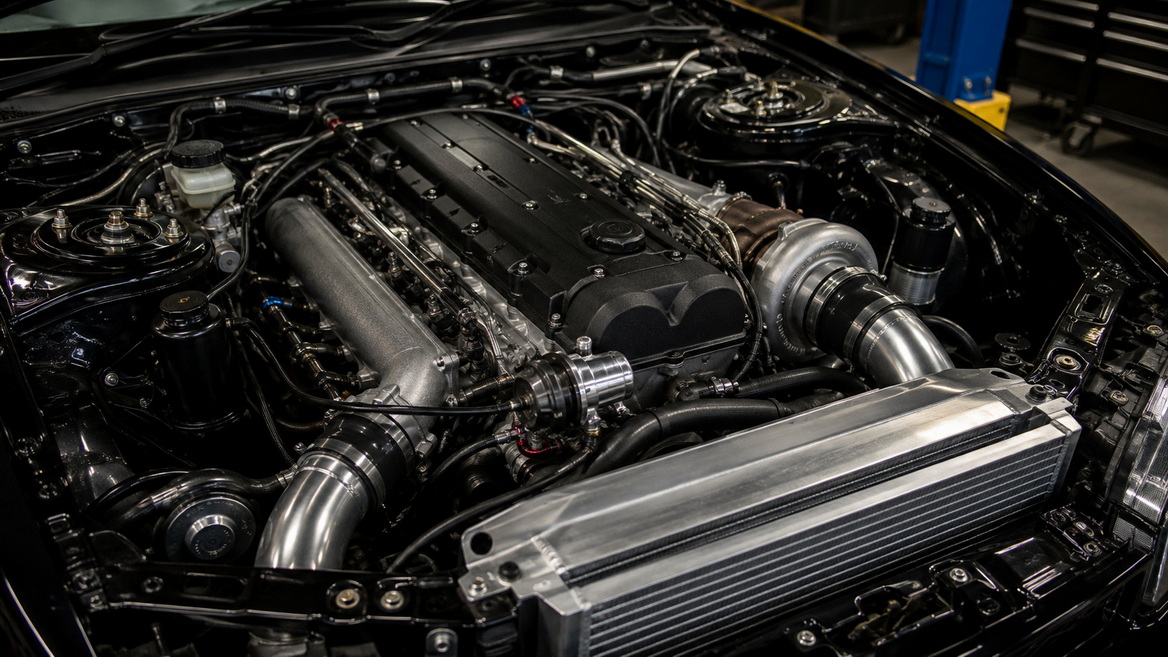
The original three-door Ford Sierra RS Cosworth remains the version most people picture first. Its compact hatchback body, dramatic rear wing and strong turbocharged engine character gave it a raw, purposeful personality.
Production of the three-door Sierra RS Cosworth was relatively limited, with 5,545 examples commonly cited. That number was enough to satisfy homologation requirements while also making the model special from the beginning.
Today, finding an original example can be difficult. Many cars were modified heavily during the 1990s and early 2000s, while others suffered accident damage, corrosion or theft. This makes well-preserved, well-documented cars increasingly important to collectors.
An original car with its correct engine, body panels, trim, wheels and service documentation is generally more desirable than one with undocumented changes. However, carefully executed period-style modifications can still appeal to enthusiasts when the work is professionally completed and properly recorded.
The most important factor is not whether a car is entirely standard. It is whether the vehicle's condition, history and specification are transparent.
The Ford Sierra RS500 Cosworth took the original concept further. Introduced in 1987, it was created as an evolution model designed to make the Sierra more competitive in touring-car racing.
Only 500 RS500s were produced, making it one of the rarest and most desirable Fast Ford models. The cars were converted by Aston Martin Tickford and included important mechanical and aerodynamic changes.
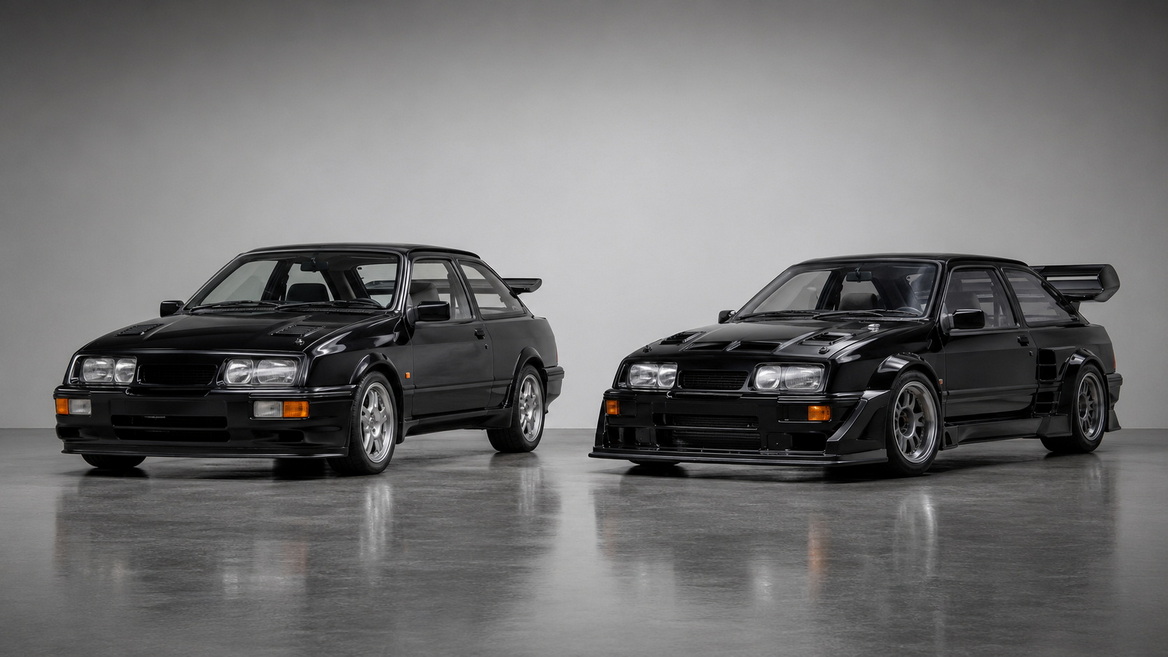
The RS500 featured:
- A larger turbocharger.
- An upgraded intercooler.
- Revised fuelling and intake systems.
- Improved cooling capacity.
- Additional aerodynamic components.
- A power output of approximately 224 bhp in road specification.
The RS500 was not dramatically faster than the standard road-going Sierra RS Cosworth in everyday driving. Its true importance was its development potential. In race trim, the upgrades gave teams a stronger foundation for extracting far greater performance.
This made the RS500 one of the defining touring-car homologation specials of its era.
Its success on track transformed its reputation. The RS500 became associated with powerful turbocharged racing cars, aggressive bodywork and dominant performances in touring-car championships. For many enthusiasts, it remains the ultimate expression of the Sierra Cosworth formula.
Ford later expanded the Cosworth concept with the Sierra Sapphire RS Cosworth. Unlike the three-door hatchback, the Sapphire used a more conventional four-door saloon body.
This made the car more practical for daily use. It could carry passengers more comfortably, provide easier rear-seat access and attract buyers who wanted performance without the visual drama of the original hatchback.
The Sierra Sapphire RS Cosworth retained the turbocharged Cosworth engine and rear-wheel-drive character that defined the earlier model. Later four-wheel-drive variants added another dimension, offering improved traction and greater confidence in varied road conditions.
The Sapphire demonstrated that high-performance engineering could exist inside a more discreet and versatile body style. It appealed to buyers who wanted strong acceleration and motorsport heritage while maintaining the usability of a family saloon.
This broadened the Cosworth audience. The original three-door model was the visual statement. The Sapphire was the more practical performance tool.
The Ford Sierra RS Cosworth has become a serious modern classic, but value varies widely. Rarity matters, especially for the RS500, yet rarity alone does not guarantee desirability.
The strongest examples usually combine originality, excellent condition and complete history. A low-mileage RS500 with exceptional provenance can attract major collector attention, while a heavily modified or poorly restored car may require substantial investment to return to a more desirable specification.
When evaluating a Sierra RS Cosworth, consider the following areas:
- Originality: Check whether the engine, turbo system, interior, bodywork and wheels match the car's original specification.
- Service history: Look for detailed invoices, specialist maintenance records and proof of important work.
- Body condition: Inspect for corrosion, accident repairs, uneven panel gaps and poor-quality paintwork.
- Engine condition: Confirm the condition of the turbocharger, cooling system, fuelling components and timing-belt service history.
- Modification history: Determine whether upgrades were professionally installed and clearly documented.
- Ownership records: Review registration documents, previous ownership information and supporting photographs where available.
- Model rarity: RS500 models are highly collectible, while well-preserved original three-door and Sapphire models also attract strong interest.
A classic car should be evaluated carefully and independently. The cost of a specialist inspection is often small compared with the financial risk of buying a car with hidden structural, mechanical or documentation problems.
A Sierra RS Cosworth can be rewarding to own, but it requires informed ownership. Before completing a purchase, arrange an inspection by a recognised Ford or Cosworth specialist.
Use the following checklist during the buying process:
1. Confirm whether the car retains its original engine and correct chassis details.
2. Review invoices for timing-belt changes, turbocharger work, cooling-system repairs and engine rebuilds.
3. Check for corrosion around the chassis, suspension mounting points, wheel arches, sills and floorpan.
4. Inspect the quality of paintwork, panel alignment and evidence of previous accident repairs.
5. Ask whether the engine has been remapped or modified beyond factory output.
6. Check the condition of the brakes, suspension, differential and gearbox.
7. Examine the interior for correct trim, instruments, seats and original features.
8. Verify that major modifications are documented and, where relevant, legally compliant.
9. Request a cold start and observe the car for smoke, unusual noises or unstable idle.
10. Obtain an independent pre-purchase inspection before committing to the vehicle.
A well-maintained Sierra Cosworth can deliver a unique driving experience. A neglected example can become expensive very quickly.
The Ford Sierra RS Cosworth remains important because it represents a clear and focused approach to vehicle development. It was designed around a real performance objective, and that objective influenced the final road car.
Its engine, drivetrain, aerodynamics and visual identity all worked together. The car was memorable because it had a story that buyers could understand: this was a road-going Ford shaped by racing ambition.
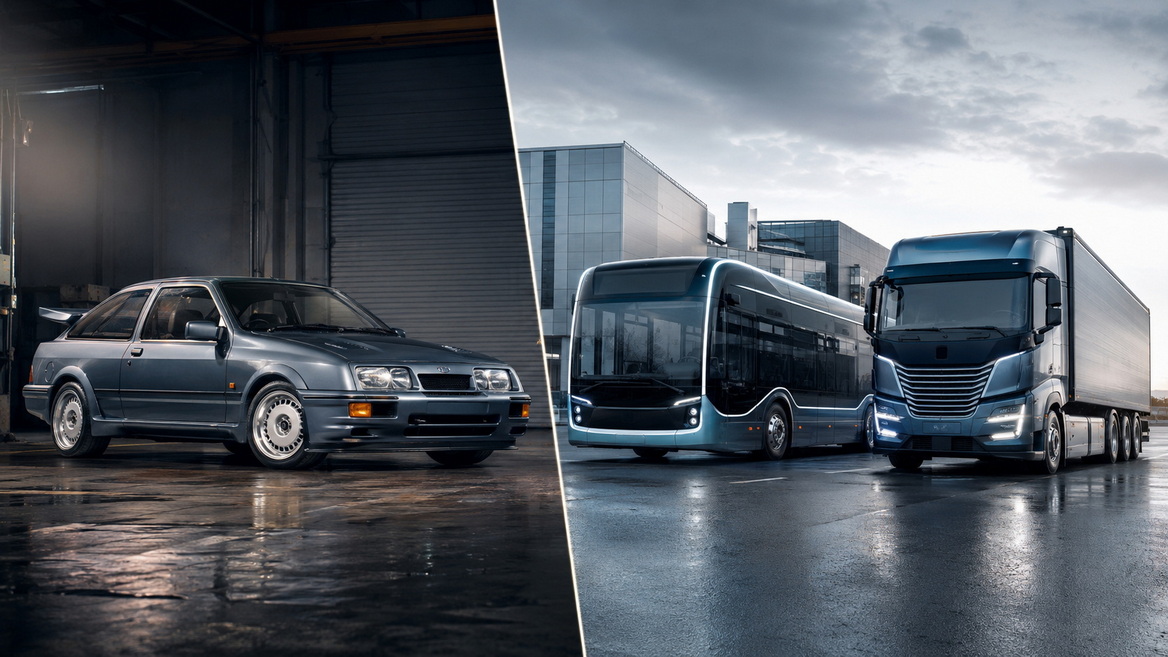
That principle remains relevant in modern commercial transport. Today's new energy buses and heavy-duty trucks may serve a very different market, but successful vehicle development still depends on matching engineering choices to operating requirements.
For commercial vehicle buyers, the priorities may include battery capacity, range, payload, passenger volume, charging compatibility, route conditions, maintenance access and total operating cost. A vehicle must be designed not only to look capable, but to perform reliably in its intended environment.
Modern electric buses and new energy heavy-duty trucks require the same discipline that made the Sierra Cosworth special: a clear mission, carefully selected technology and a configuration suited to real-world use.
The Sierra RS Cosworth was never just about a large spoiler or a powerful turbocharged engine. It was about purpose. Ford created a car that translated competition ambition into a road-going vehicle with personality, technical credibility and lasting emotional appeal.
Decades later, the Sierra RS Cosworth remains one of the most celebrated Fast Ford models because it feels authentic. Its engineering story is visible in its shape, audible in its turbocharged engine and reinforced by its racing history.
For collectors, it represents an important chapter in performance-car history. For enthusiasts, it remains a symbol of an era when turbocharged power and motorsport influence could transform a practical family-car platform into something unforgettable.
For vehicle buyers and industry professionals, it offers a lasting lesson: the most respected vehicles are those built around a genuine operating purpose. Whether the application is a classic performance car, a city bus or a heavy-duty new energy truck, the strongest solutions begin with engineering that understands the job ahead.
"Cossie" is a popular nickname for Ford Cosworth-powered models. It comes from the name Cosworth, the engineering company associated with the Sierra's turbocharged YB engine.
The original three-door Sierra RS Cosworth production total is commonly listed as 5,545 vehicles. Of these, 500 were converted into the more specialised RS500 evolution model.
The RS500 was a limited-production evolution model created to improve Ford's touring-car competitiveness. It featured upgraded turbocharging, cooling, fuelling and aerodynamic components, with only 500 examples produced.
Yes. The original Sierra RS Cosworth was developed to meet homologation requirements for Group A touring-car competition. Its road-car specification supported Ford's wider motorsport programme.
Yes. The Sierra Sapphire RS Cosworth used a four-door saloon body rather than the original three-door hatchback body. It provided greater practicality while retaining the turbocharged Cosworth performance character.
1. Evans Halshaw — Ford Sierra RS Cosworth: The Most Iconic Fast Ford?https://www.evanshalshaw.com/blog/ford-sierra-rs-cosworth-the-most-iconic-fast-ford/
2. Classic & Sports Car — Buyer's Guide: Ford Sierra RS Cosworthhttps://www.classicandsportscar.com/features/buyers-guide-ford-sierra-rs-cosworth
3. Iconic Auctioneers — Immaculate, Rare Mileage Ford Sierra Cosworth RS500https://www.iconicauctioneers.com/news/immaculate-rare-mileage-ford-sierra-cosworth-rs500
4. Sports Car Market — 1987 Ford Sierra Cosworth RS500https://www.sportscarmarket.com/profile/1987-ford-sierra-cosworth-rs500
5. Classic. com — Ford Sierra RS500 Cosworth Markethttps://www.classic.com/m/ford/sierra/rs500-cosworth/
6. Hagerty UK — The Most Expensive Fords Sold at Auctionhttps://www.hagerty.co.uk/articles/lists/most-expensive-fords-sold-auction-since-2020/


