
Views: 240 Author: Keychain Venture Publish Time: 2026-08-19 Origin: Site


Content Menu
● What Is an 18–26 ft Refrigerated Box Truck?
>> Common Uses for Refrigerated Delivery Trucks
● Why the Right Reefer Truck Matters
>> A Refrigerated Truck Is a Complete System
● Key Specifications to Review Before Buying
>> Understand Holding Capacity and Pull-Down Capacity
● How to Select the Right Refrigerated Truck Configuration
>> Step 1: Define the Required Temperature Range
>> Step 2: Map the Daily Delivery Route
>> Step 3: Choose the Right Door and Loading Layout
>> Step 4: Add Temperature Monitoring and Records
● Daily Cold-Chain Operating Checklist
>> During Loading and Delivery
● Common Refrigerated Truck Buying Mistakes
>> Choosing a Body Size Without Reviewing Cargo Density
>> Ignoring High Ambient Temperatures
>> Using One Temperature for Mixed Cargo
>> Treating Temperature Monitoring as Optional
>> Overlooking Maintenance and Parts Support
● Refrigerated Truck Solutions for Commercial Fleets
● Summary
>> What size refrigerated truck should I choose?
>> Can a 26 ft refrigerated truck be operated without a CDL?
>> What temperature can a refrigerated box truck maintain?
>> What is the difference between a reefer truck and an insulated truck?
>> Why does a refrigerated truck need a data logger?
A refrigerated box truck is not simply a truck with a cooling unit. It is a mobile cold-chain system that protects product quality, supports reliable deliveries, and helps businesses manage operational risk.
For food distributors, catering companies, pharmacies, retailers, and temperature-sensitive logistics providers, an 18–26 ft refrigerated truck can provide a practical balance of cargo capacity, maneuverability, payload, and delivery flexibility. The right configuration depends on what you carry, where you operate, how often you stop, and how consistently you need to maintain the required temperature.

An 18–26 ft refrigerated box truck—often called a reefer truck—is a medium-duty commercial vehicle equipped with an insulated cargo body and an active refrigeration system. The system removes heat from the cargo area and helps maintain products within a required temperature range during transport.
This truck size is widely used for urban and regional distribution. It offers more cargo room than a van while remaining easier to operate, park, and route through cities than a tractor-trailer combination.
Depending on the final vehicle specification, an 18–26 ft refrigerated truck can be configured for chilled goods, frozen products, multi-temperature delivery, or specialized temperature-sensitive cargo. Its final payload and usable cargo volume will vary according to the chassis, insulated body, refrigeration unit, liftgate, fuel capacity, and optional equipment.
- Fresh produce, dairy products, meat, seafood, and frozen foods
- Restaurant, hotel, and catering distribution
- Bakery, beverage, and convenience-store delivery
- Pharmaceutical and healthcare logistics
- Floral, agricultural, and specialty products
- Temperature-sensitive cosmetics and laboratory materials
- Retail replenishment and local cold-chain delivery
The most suitable refrigerated truck is determined by actual operating conditions, not body length alone. Buyers should consider cargo temperature, cargo density, packaging, route duration, ambient climate, delivery frequency, and loading requirements before selecting a vehicle.
The main purpose of a refrigerated truck is not just to create a cold cargo compartment. Its purpose is to keep products within a controlled temperature range while the vehicle is loaded, driven, stopped, opened, and unloaded.
For many food applications, cold products need to be held at 41°F (5°C or below. However, the required setpoint should always be based on the specific cargo, the customer's quality procedures, and applicable local regulations.
A truck carrying pharmaceutical products or vaccines may require even more precise temperature control. In these cases, continuous monitoring, temperature logs, alarms, and documented handling procedures become essential parts of daily transport operations.
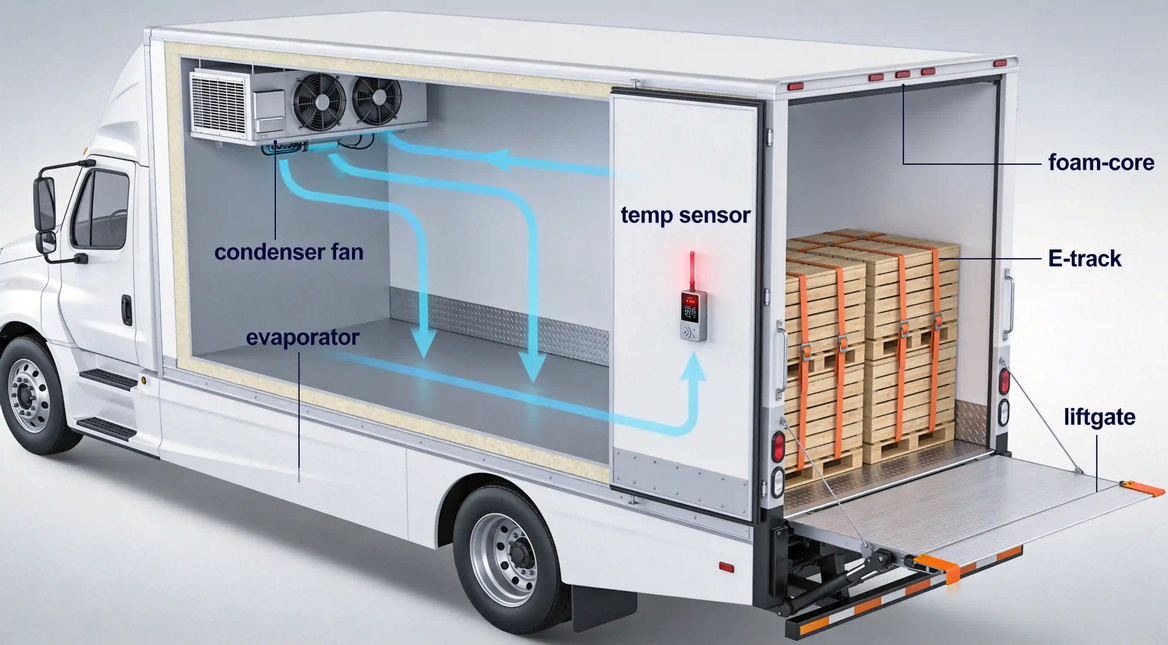
A dependable refrigerated transport solution includes more than a refrigeration unit. It should combine:
- Insulated wall panels, roof, floor, and doors
- A refrigeration unit matched to the cargo and route
- Proper airflow throughout the cargo compartment
- Durable door seals that reduce heat intrusion
- Temperature sensors and digital monitoring equipment
- Suitable door configurations for efficient unloading
- Cargo restraints for safe pallet transport
- Preventive maintenance for refrigeration and vehicle systems
- Driver training for loading, temperature checks, and incident handling
A successful refrigerated truck project begins with a clear operating profile. Instead of requesting only "a 24 ft refrigerated truck," define the full delivery requirement.
| Specification | Why It Matters | What to Confirm |
|---|---|---|
| Cargo body length | Determines loading layout and available cargo space | 18 ft, 20 ft, 22 ft, 24 ft, or 26 ft body length |
| Internal cargo volume | Shows usable loading space | Interior length, width, height, and wheel-well space |
| Payload | Determines the legal and practical cargo weight | Final payload after body, refrigeration unit, liftgate, fuel, and equipment |
| Temperature range | Determines refrigeration requirements | Chilled, frozen, deep-frozen, or multi-temperature application |
| Insulation level | Affects temperature stability and energy use | Wall, roof, floor, and door insulation construction |
| Refrigeration capacity | Determines cooling performance | Performance under high ambient temperatures and frequent stops |
| Door configuration | Affects delivery efficiency and heat loss | Roll-up door, swing door, side door, or multi-door layout |
| Liftgate | Supports pallet delivery without a dock | Lift capacity, platform dimensions, and safety functions |
| Temperature monitoring | Supports product control and traceability | Data logger, alerts, reports, and sensor calibration |
| Service support | Reduces downtime | Spare-parts access, maintenance guidance, and warranty support |
A common mistake is to assume that a truck's gross vehicle weight rating is the same as available payload. It is not.
Payload is calculated as:
Payload=GVWR−Completed Vehicle Weight
The completed vehicle weight includes the cab and chassis, insulated body, refrigeration equipment, liftgate, fuel, driver, tools, spare tire, and all installed options.
For example, a truck with a 26,000 lb GVWR may appear suitable for large cargo loads. However, if the completed refrigerated vehicle weighs 18,500 lb with fuel and equipment, the remaining legal payload is approximately 7,500 lb.
Before approving a truck configuration, request the expected completed vehicle weight and calculate the remaining payload based on your actual cargo requirements.
Refrigeration performance should be evaluated in two different ways.
- Holding capacity is the ability to maintain the cargo body at the required temperature once it has been pre-cooled.
- Pull-down capacity is the ability to reduce the cargo body temperature from a higher starting temperature to the required setpoint.
These capabilities are not the same.
A vehicle transporting pre-chilled dairy products from a temperature-controlled warehouse has a different cooling requirement from a truck handling frequent deliveries in hot weather. Multiple door openings allow warm and humid air to enter the cargo area, creating a heavier refrigeration load.
When reviewing a refrigeration system, confirm its performance based on:
- Required cargo temperature
- Outside ambient temperature
- Cargo body dimensions and insulation level
- Route duration
- Number of delivery stops
- Frequency and duration of door openings
- Whether products are pre-cooled before loading
- Chilled, frozen, or multi-temperature cargo requirements
A refrigerated truck should be built around the delivery workflow rather than selected only from standard dimensions. The chassis, insulated body, refrigeration system, cargo-access layout, and monitoring package should work together.
Begin with the cargo.
Different products have different temperature requirements. Fresh produce, dairy products, frozen foods, pharmaceuticals, and floral cargo may need different setpoints, airflow conditions, and delivery procedures.
A product specification should clearly state:
- Required transport temperature range
- Allowable temperature variation
- Maximum route duration
- Required pre-cooling conditions
- Monitoring and record-keeping requirements
- Packaging and pallet arrangement
- Delivery acceptance requirements
Do not use one generic temperature setting for all products. A truck carrying different product categories may require separated cargo zones or a multi-temperature body design.
The truck should match how it will work every day.
Ask these questions before selecting the body and refrigeration unit:
1. How many stops will the truck make each day?
2. How long will doors remain open at each stop?
3. Will loading take place at a chilled loading dock?
4. Will the truck operate in high-temperature or humid climates?
5. Will it spend long periods in urban traffic?
6. Does it need to maintain temperature during overnight parking?
7. Will drivers need to deliver to locations without loading docks?
8. Will the truck travel on highways, city roads, or rough rural routes?
A multi-stop urban delivery truck may need a durable side door, strip curtains, fast recovery refrigeration, and strong airflow design. A longer regional route with fewer stops may prioritize higher payload, stable temperature holding, and fuel efficiency.
The cargo-access design affects delivery speed, worker safety, and temperature retention.
Common options include:
- Rear roll-up doors for dock loading and frequent deliveries
- Rear swing doors for wide-opening access
- Curbside doors for roadside or local retail delivery
- Liftgates for locations without loading docks
- E-track rails for cargo restraint
- Load bars and cargo straps for pallet stability
- Internal partitions for separated temperature zones
- Strip curtains to limit warm-air entry during unloading
A liftgate can improve delivery flexibility, especially for palletized cargo. However, it adds weight to the truck and may reduce available payload. Buyers should compare lift capacity, platform dimensions, safety features, and overall impact on the completed vehicle weight.
Temperature monitoring helps operators confirm that the cargo compartment remained within the intended operating range during delivery.
A practical monitoring system may include:
- Calibrated temperature sensors
- Digital data logger
- In-cab temperature display
- Remote monitoring capability
- High- and low-temperature alarms
- Downloadable route reports
- Door-open event records
- GPS location integration
- A clear procedure for handling temperature deviations
The most valuable monitoring system is one that drivers and fleet managers can actually use. Data should be easy to review, export, and retain when required by customers or internal quality procedures.
Vehicle design is important, but daily operation determines whether the cold chain remains stable.
- Pre-cool the cargo compartment to the correct setpoint.
- Confirm that products are already at the required loading temperature.
- Inspect doors, seals, drains, walls, flooring, and interior panels.
- Check that the refrigeration unit is operating normally.
- Confirm adequate fuel and battery condition.
- Verify that the temperature logger is active.
- Position products to maintain clear airflow paths.
- Avoid stacking cargo directly against evaporator outlets or air-return channels.
- Load products quickly and reduce door-open time.
- Keep pallets and cartons arranged for adequate air circulation.
- Secure cargo with suitable rails, straps, load bars, or restraints.
- Avoid mixing products with conflicting temperature requirements.
- Review temperature readings at planned intervals.
- Respond immediately to abnormal temperature alerts.
- Record any operational issue that may affect product condition.
- Review temperature records when required.
- Clean and sanitize the cargo body according to the cargo type.
- Inspect the insulated body for damage or water ingress.
- Check door seals and hinges for wear.
- Record refrigeration faults and service needs.
- Schedule preventive maintenance based on operating hours and vehicle use.
- Keep maintenance records for the truck, refrigeration unit, and monitoring equipment.

A larger cargo body is not always the better commercial choice.
Some businesses run out of volume before reaching the available payload. Others reach the legal payload limit before filling the cargo area. The first situation is limited by cargo volume; the second is limited by cargo weight.
The best truck body size depends on the relationship between your average shipment weight and average shipment volume.
A reefer truck may perform well in mild conditions but face much higher cooling loads in hot climates. High outdoor temperatures, strong sunlight, traffic congestion, frequent stops, and repeated door openings all increase the demand on the refrigeration unit.
Specify the refrigeration system based on the most demanding expected route conditions, not only normal operating conditions.
Frozen products, chilled food, produce, pharmaceuticals, and floral cargo may have different temperature requirements. If mixed loads are necessary, use physical separation, separate airflow paths, and a properly designed multi-temperature configuration.
For valuable or sensitive products, temperature records help protect the carrier, shipper, customer, and insurer. They can also help identify recurring operational problems, such as poor door seals, insufficient airflow, excessive door-open time, or weak refrigeration recovery.
A refrigerated truck creates value only when it remains in service. Before selecting a vehicle supplier, evaluate access to spare parts, refrigeration service guidance, maintenance documentation, technical assistance, and warranty support.

KeyChain supplies and exports commercial vehicles, including dump trucks, buses, heavy-duty trucks, and new-energy vehicle solutions. For refrigerated transport projects, the objective is to match the truck configuration with the customer's cargo, route, delivery environment, and local operating requirements.
A well-planned refrigerated truck project should consider:
- Suitable chassis and GVWR category
- Left-hand-drive or right-hand-drive configuration
- Cargo body length and internal dimensions
- Insulation construction and floor design
- Refrigeration system capacity and temperature range
- Liftgate, side door, E-track, and cargo-restraint options
- Multi-temperature zone requirements
- Local vehicle regulations and registration requirements
- Spare-parts planning and maintenance materials
- Shipping, export documents, and after-sales coordination
The most reliable refrigerated transport solution is the one that fits the business's real delivery conditions. A correctly specified truck can support better product protection, smoother delivery operations, reduced waste, and more predictable fleet performance.
An 18–26 ft refrigerated box truck can be an effective choice for businesses that need flexible cold-chain delivery capacity without using a full-size trailer combination.
The right truck is determined by far more than exterior body length. Buyers should evaluate real payload, cargo volume, temperature range, refrigeration performance, insulation quality, access configuration, route conditions, and monitoring requirements.
When the body, refrigeration system, cargo layout, and operating procedures are designed as one complete solution, the truck becomes a dependable tool for protecting temperature-sensitive products and supporting long-term fleet growth.
Choose the truck size based on cargo volume, cargo weight, route length, delivery frequency, loading method, and available parking space. An 18–26 ft refrigerated truck is often suitable for local and regional distribution, but usable internal dimensions and final payload should guide the decision.
In the United States, trucks with a GVWR of 26,000 lb or less may generally be operated without a commercial driver's license. However, licensing requirements can vary depending on the state, vehicle configuration, cargo type, and local regulations.
The temperature range depends on the refrigeration unit, insulation level, cargo body size, outside temperature, cargo condition, and delivery pattern. Some systems are designed for chilled goods, while others support frozen or deep-frozen products.
An insulated truck uses insulation to reduce heat transfer, but it may not have active cooling equipment. A reefer truck combines insulation with an active refrigeration unit to help maintain a controlled temperature range during transport.
A data logger records cargo-area temperatures during the route. It helps operators confirm product conditions, identify temperature deviations, improve fleet management, and provide records when customers request proof of cold-chain handling.
1. Penske Truck Rental. Vehicle Spotlight: 18 to 26 Foot Non-CDL Refrigerated Truck https://www.gopenske.com/blog/vehicle-spotlight-18-to-26-foot-refrigerated-truck/
2. U. S. Centers for Disease Control and Prevention. Chapter 5: Vaccine Storage and Handling https://www.cdc.gov/pinkbook/hcp/table-of-contents/chapter-5-vaccine-storage-and-handling.html
3. U. S. Environmental Protection Agency. 2022 SmartWay Online Truck Tool: All Carriers https://nepis.epa.gov/Exe/ZyPURL.cgi?Dockey=P1013TLF.TXT
4. U. S. Environmental Protection Agency. SmartWay Program Overview https://www.nctcog.org/trans/quality/air/for-fleets/smartway
5. SensoScientific. FDA Temperature Monitoring Compliance Guide https://www.sensoscientific.com/fda-temperature-monitoring-compliance-food-safety/


