
Views: 282 Author: Keychain Venture Publish Time: 2026-08-09 Origin: Site


Content Menu
● Why the Lowest Dump Truck Price Is Not Always the Best Deal
● Calculate Cost per Productive Ton
● Select the Right Dump Truck Configuration
>> Understand the Working Conditions
>> Choose the Correct Dump Body
● Reduce Fuel and Energy Costs Through Better Matching
>> Review the Actual Duty Cycle
>> Consider New Energy Dump Trucks Carefully
● Protect Uptime With Preventive Maintenance
>> Include Service Requirements Before Purchase
>> Complete Daily Pre-Trip Inspections
● Improve Payload Efficiency Without Overloading
>> Five Ways to Increase Productive Payload
● Use Telematics to Control Fleet Costs
>> A 30-Day Fleet Improvement Plan
● Questions to Ask Before Buying a Dump Truck From China
● Build Long-Term Value Into Every Purchase
>> What is the most important factor when buying a dump truck?
>> How can I reduce dump truck fuel consumption?
>> Is an electric dump truck suitable for construction work?
>> What spare parts should I order with a new dump truck?
>> How do I calculate dump truck total cost of ownership?
A dump truck should be selected for the work it must perform every day—not simply for the lowest initial quotation. For construction companies, aggregate haulers, mining operators, municipal contractors, and logistics fleets, profitability depends on how reliably a vehicle transports material over its entire working life.
The purchase price is only one part of the equation. Fuel or electricity, payload efficiency, driver productivity, maintenance, tire wear, repair time, parts availability, and resale value all influence the real cost of operating a heavy-duty truck.
KeyChain supplies high-quality dump trucks, buses, heavy-duty trucks, and new energy commercial vehicles for domestic and international customers. This guide helps buyers make practical decisions that support safer operations, stronger productivity, and long-term fleet value.

A low-price vehicle can appear attractive during the quotation stage. However, it may become more expensive after delivery if it consumes excessive fuel, requires frequent repairs, lacks appropriate load capacity, or has limited access to spare parts.
A professional buyer should evaluate the complete ownership picture before making a final decision.
| Cost Category | What to Evaluate | Why It Matters |
|---|---|---|
| Vehicle acquisition | Truck price, body specification, export costs, payment terms | Determines initial capital investment |
| Fuel or electricity | Energy consumption, route conditions, idle time | Directly affects daily operating margin |
| Payload productivity | Legal payload, body volume, loading time, unloading time | Influences revenue per trip |
| Maintenance | Service intervals, component quality, technician access | Reduces unexpected repair costs |
| Tires and brakes | Road surface, load intensity, axle setup, driving behavior | Controls recurring operating expenses |
| Vehicle downtime | Warranty support, parts availability, diagnostic assistance | Protects schedules and customer service |
| Resale value | Maintenance history, condition, specification, market demand | Improves long-term asset value |
The most cost-effective dump truck is not always the least expensive unit. It is the truck that delivers the lowest cost per productive ton moved while remaining safe, reliable, and compliant with local requirements.
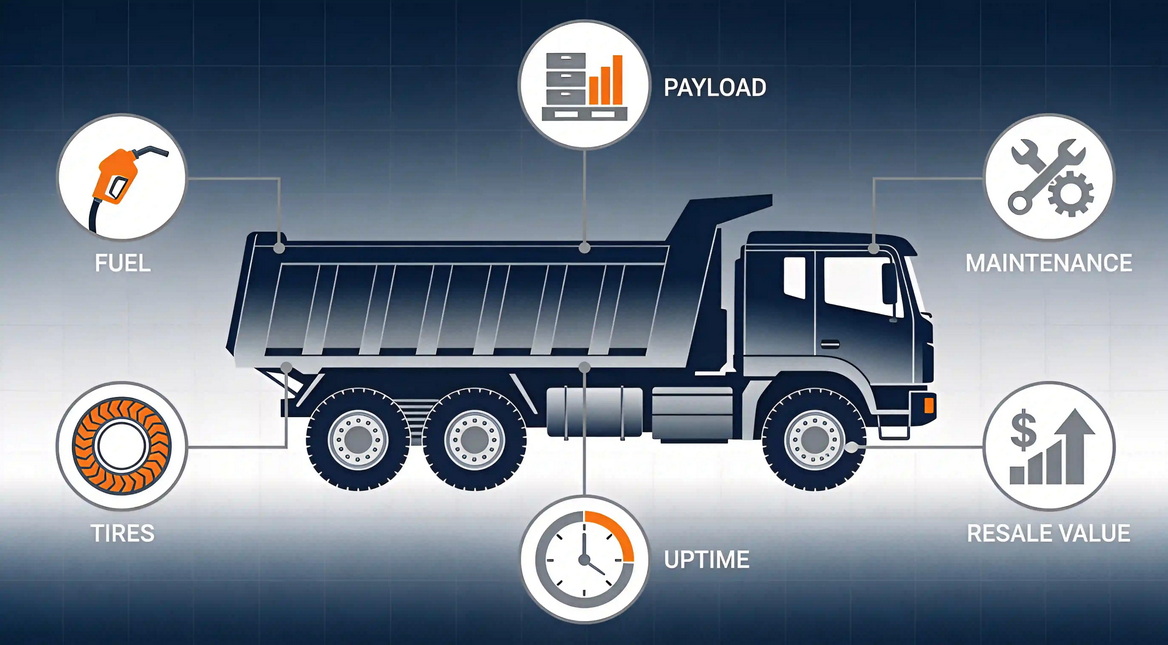
Fleet managers should avoid judging vehicle performance only by purchase cost or fuel consumption. A more useful metric is the cost required to move each ton of material.
Daily operating cost may include:
- Fuel, electricity, or battery-swapping expense
- Driver wages and benefits
- Maintenance and repair allowance
- Tire and brake wear
- Insurance and permits
- Finance payments or depreciation
- Tolls and route charges
- Estimated downtime cost
- Site waiting time and dispatch inefficiency
A truck with a higher purchase price may still produce better financial results if it carries a suitable legal payload, completes more trips each day, consumes less energy, and remains available for work.
For example, a truck used on steep quarry roads may require a stronger engine, appropriate transmission ratio, reinforced suspension, and durable tires. Choosing an underpowered or lightly configured vehicle may reduce the purchase price, but it can increase fuel consumption, wear, safety risk, and downtime.
Every dump truck should be specified around the customer's operating environment. A vehicle designed for city construction debris may not be suitable for a quarry, mining site, asphalt plant, or long-distance aggregate route.
Before requesting a quotation, buyers should define the following requirements.
- Type of material: sand, gravel, soil, ore, coal, demolition waste, asphalt, or agricultural products
- Material density and moisture level
- Average route distance and daily trip count
- Road surface: paved road, mixed road, unpaved site, quarry road, or mining route
- Road gradient, turning radius, traffic congestion, and weather conditions
- Local axle-load, emissions, registration, and safety requirements
- Available fuel, charging, maintenance, and service infrastructure
A vehicle hauling lightweight but bulky material may need a larger cargo body. A truck carrying dense aggregate may need a reinforced body, stronger suspension, carefully matched axle capacity, and a configuration that remains within local legal weight limits.
The dump body affects payload capacity, loading efficiency, maintenance needs, and vehicle stability. It should be treated as a critical operating component.
Consider the following options:
- Standard steel bodies for general construction materials and daily hauling
- Reinforced steel bodies for rock, gravel, quarry work, and abrasive materials
- Wear-resistant liners for repeated loading of high-abrasion cargo
- Higher sidewalls for lower-density but high-volume materials
- Strengthened tailgates and hinges for frequent unloading cycles
- Optimized hydraulic lifting systems for stable, controlled dumping
The correct body should match both the material and the loading method. Excavator loading, wheel-loader loading, conveyor loading, and batch-plant loading can create different impact forces and operational demands.
Fuel is often one of the largest daily expenses for a conventional dump truck fleet. For electric or hybrid commercial vehicles, energy cost, battery management, charging time, and route planning become equally important.
The goal is not simply to select the smallest engine or the largest battery. The goal is to select a powertrain that performs efficiently under real working conditions.
A proper vehicle assessment should include:
1. Expected payload and gross vehicle weight
2. Average distance per route
3. Typical road gradient and surface condition
4. Daily operating hours and idle time
5. Required engine power and torque
6. Transmission type and axle ratio
7. Fuel, charging, or battery-swapping availability
8. Local emissions and noise requirements
A short-distance construction route with frequent stops has different requirements from a long-distance highway route. A quarry vehicle carrying heavy material uphill has different demands from a truck operating on level urban roads.
Correct engine power, gearbox selection, axle ratio, tire choice, and driving habits can all influence daily energy consumption.
New energy dump trucks can be suitable for predictable routes, particularly where daily operating distance is controlled and charging or battery-swapping facilities are available. They may be especially practical for closed-site operations, short-haul construction routes, mine-to-plant transport, port operations, and municipal projects.
Before choosing an electric dump truck, consider:
- Daily mileage and number of trips
- Terrain, road gradient, and payload requirements
- Battery capacity under loaded conditions
- Charging speed and charging-site capacity
- Depot electricity availability
- Battery warranty and maintenance support
- Local operating restrictions and emissions policies
- Access to trained technicians and high-voltage service equipment
Electric vehicles should be selected based on a clear route analysis. A practical solution must support productivity, energy access, payload needs, and long-term maintenance planning.
A dump truck generates value only when it is operating safely and productively. Unplanned downtime can delay projects, interrupt deliveries, increase labor costs, and damage customer relationships.
Preventive maintenance is usually less expensive than emergency repair.

Before placing an order, buyers should confirm the following details with the supplier:
- Vehicle warranty coverage and claim process
- Service intervals for the engine, transmission, axles, brakes, and hydraulic system
- Spare-parts availability and expected delivery time
- Recommended initial spare-parts package
- Technical documents and maintenance manuals in English
- Remote diagnostic support where applicable
- Driver and technician training materials
- Component brand information for key systems
- Support process for overseas customers
For fleets operating far from an authorized service location, an initial parts package can reduce repair delays. This package may include filters, belts, seals, brake components, hoses, lamps, sensors, and other frequently replaced items.
Drivers should inspect the truck before each shift. A consistent inspection routine can identify small problems before they become costly failures.
A daily checklist should include:
- Tire pressure, tread condition, cuts, and visible damage
- Brake response, lights, mirrors, horn, and dashboard warnings
- Engine oil, coolant, and hydraulic-fluid levels
- Hydraulic hoses, lifting cylinder, and visible leakage
- Tailgate locks, body hinges, and body-lifting mechanisms
- Wheel nuts, suspension components, and axle condition
- Cargo-body cleanliness and material buildup
- Load balance and securement condition
- Route clearance risks, including low bridges and overhead obstacles
Increasing payload productivity does not mean overloading the truck. Overloading can create major safety, legal, and financial risks.
A truck that exceeds legal weight limits may experience faster tire wear, reduced brake performance, frame stress, higher fuel consumption, and increased rollover risk. It may also face fines, route restrictions, insurance complications, and reduced resale value.
The better approach is to improve legal payload utilization.
- Select body volume according to material density
- Match axle configuration to local legal load limits
- Train loading-equipment operators to distribute material evenly
- Avoid carrying excess material beyond permitted weight
- Use onboard weighing or loading controls when available
Even load distribution is essential. Uneven loading can affect braking, steering, tire wear, suspension stress, and vehicle stability during dumping.
Heavy material should be positioned carefully within the body. Drivers should also confirm that the load is stable before leaving the loading area, especially when working on uneven ground or using high-sided bodies.
Telematics can help operators understand how vehicles are actually being used. Instead of relying only on fuel receipts or driver feedback, fleet managers can review operating data and identify practical improvement opportunities.
Useful data points include:
| Fleet Metric | What It Can Reveal | Possible Improvement |
|---|---|---|
| Fuel or energy use | Route efficiency and operating habits | Improve routing and reduce waste |
| Idle time | Unnecessary energy consumption | Introduce idling limits |
| Harsh braking | Driver behavior and component wear | Provide targeted driver training |
| Excessive speed | Safety risk and fuel use | Set alerts and safety policies |
| Vehicle utilization | Underused or overworked assets | Improve dispatch planning |
| Maintenance alerts | Early mechanical warnings | Schedule service before failure |
| Cycle time | Loading, unloading, or traffic bottlenecks | Improve site coordination |
Telematics does not replace experienced fleet management. It gives managers more reliable information for identifying fuel waste, slow routes, excessive idle time, unsafe driving patterns, and maintenance risks.
1. Week One: Record fuel or electricity use, payload, trip count, idle time, maintenance events, and downtime.
2. Week Two: Identify the three largest avoidable cost drivers by vehicle, driver, or route.
3. Week Three: Introduce one targeted improvement, such as route adjustments, driver coaching, or tighter maintenance scheduling.
4. Week Four: Compare the new results with the baseline and continue the improvements that reduce cost or improve safety.
Small operational changes can create meaningful savings when applied consistently across an entire fleet.
International buyers should use a structured evaluation process when sourcing dump trucks from China. A clear technical discussion before production helps reduce misunderstandings and ensures the vehicle is suitable for local operation.

Ask the supplier these questions:
1. Which chassis, engine, transmission, axle, and hydraulic-system brands are included?
2. Can the vehicle be configured for my material type, payload, terrain, and road conditions?
3. What quality inspections are completed before shipment?
4. Can you provide technical drawings, dimensions, weight data, and component lists?
5. What warranty support is available for overseas customers?
6. Which spare parts should be included in the first shipment?
7. Are operation manuals and maintenance documents available in English?
8. What export packaging and shipping terms are available?
9. Can the vehicle support telematics or fleet-management systems?
10. Which new energy vehicle configuration is suitable for my route and local infrastructure?
A supplier should be able to explain not only vehicle specifications, but also the reasons behind the recommended configuration.
The most effective way to reduce dump truck operating costs is to make the right decisions before the vehicle enters service. Select the vehicle around the job, calculate total ownership cost, maintain legal payload compliance, protect the hydraulic and braking systems, train drivers, and use operating data to improve each route.
A reliable dump truck should support the business for years—not only during the first months after delivery.
KeyChain can help buyers evaluate dump truck, heavy-duty truck, bus, and new energy vehicle configurations based on payload requirements, route conditions, local regulations, energy access, and maintenance needs. Share your project requirements with our team to develop a practical vehicle and export solution for your market.
The most important factor is whether the vehicle matches your real operating conditions. Buyers should assess material type, legal payload, terrain, daily route distance, maintenance capability, road conditions, and local regulations before selecting a model.
Match the engine and transmission to the job, reduce unnecessary idling, maintain correct tire pressure, avoid overloading, follow preventive maintenance schedules, optimize routes, and train drivers to accelerate and brake smoothly.
An electric dump truck can be suitable for predictable short-haul operations with reliable charging or battery-swapping access. Buyers should evaluate payload, terrain, route distance, energy infrastructure, charging time, and local service support before purchase.
Common starter parts include filters, belts, seals, lamps, sensors, brake-service components, hydraulic-service items, and other routine maintenance parts. The final package should depend on the truck specification, operating intensity, and local service availability.
Add the vehicle purchase or finance cost, fuel or electricity, maintenance, tires, insurance, driver cost, permits, taxes, downtime, and expected resale value. Then compare the result with productive tons moved or revenue generated during the operating period.
1. Penske. "Save Money on Your Move with Penske Truck Rentalhttps://www.gopenske.com/blog/rental/save-money-on-your-move-with-penske-truck-rental/
2. Penske. "5 Safety Tips for Driving a Moving Truckhttps://www.gopenske.com/news/5-safety-tips-for-driving-a-moving-truck/
3. Extra Space Storage. "Best Ways to Pack a Moving Truckhttps://www.extraspace.com/moving/guides/packing/how-to-pack-a-moving-truck/
4. Procore. "Construction Procurement: A Guide to Purchasing & Logisticshttps://www.procore.com/library/construction-procurement
5. Transportation Research Board. "Total Cost of Ownership for Heavy Trucks in China: Battery Electric and Fuel Cell Vehicleshttps://trid.trb.org/View/1894361
6. Future Market Insights. "Electric Construction Dump Trucks Markethttps://www.futuremarketinsights.com/reports/electric-construction-dump-trucks-market


