
Views: 222 Author: Keychain Venture Publish Time: 2026-05-19 Origin: Site


Choosing between gas and diesel shuttle buses represents one of the most critical decisions for fleet operators, transportation companies, and organizations seeking reliable passenger transport solutions. As a supplier specializing in high-quality second-hand buses and commercial vehicles, I've witnessed firsthand how this decision impacts operational costs, performance, and long-term fleet sustainability across diverse markets from China to international destinations.
The fundamental distinction between these powertrains extends far beyond simple fuel type—it encompasses engine architecture, maintenance requirements, total cost of ownership, and operational capabilities that directly affect your bottom line. This guide draws from industry data, real-world fleet performance metrics, and expert insights to help you make an informed decision aligned with your specific operational requirements.
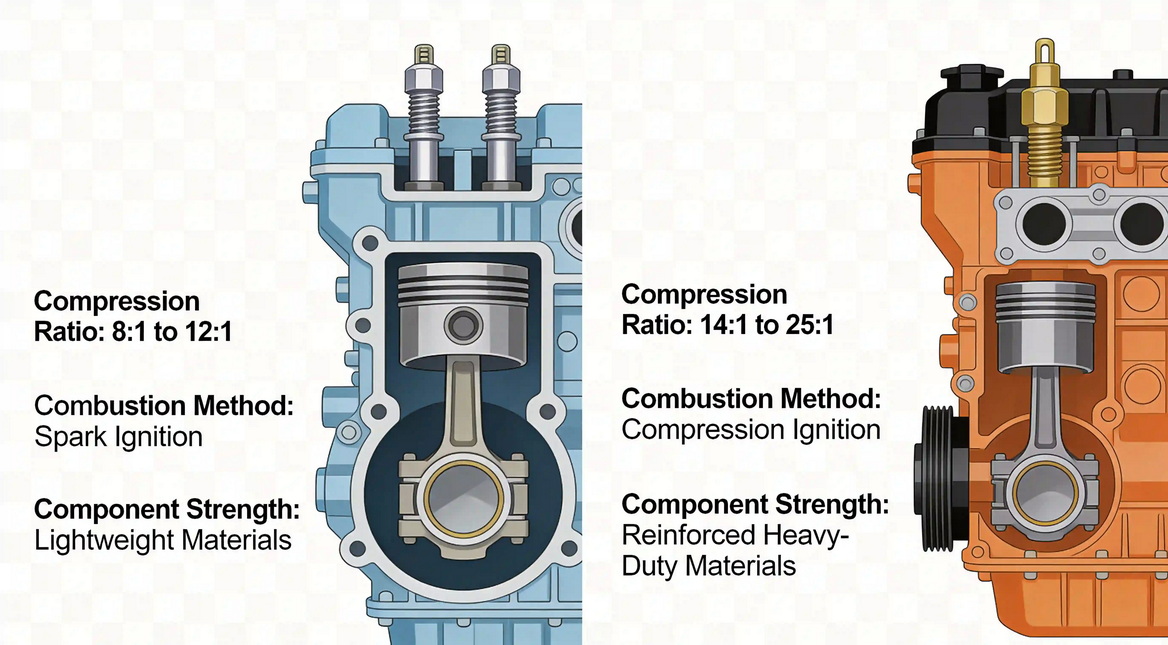
Gas engines operate using spark ignition systems where air and fuel mix in the combustion chamber before being ignited by spark plugs. This design results in fewer moving parts, simpler engine architecture, and generally lower manufacturing costs. The combustion process burns fuel at a faster rate, producing higher horsepower output ideal for lighter loads and shorter routes.
Diesel engines utilize compression ignition, where air is compressed to extremely high temperatures before fuel injection occurs, causing spontaneous combustion without spark plugs. This fundamental difference creates higher compression ratios (typically 14:1 to 25:1 compared to gas engines' 8:1 to 12:1), resulting in superior torque output and fuel efficiency. Diesel engines feature reinforced components—heavier crankshafts, stronger pistons, and robust cylinder heads—designed to withstand the intense pressures generated during compression ignition.
Gas engines typically deliver higher horsepower, making them excellent for achieving faster acceleration and higher top speeds with lighter passenger loads. For shuttle operations involving short-distance urban routes with frequent stops and moderate passenger capacity (15-25 passengers), gas engines provide responsive performance and smooth operation.
Diesel engines excel in torque production—the rotational force that determines pulling power and load-carrying capacity. This advantage becomes crucial when operating in challenging conditions: hilly terrain, fully loaded passenger configurations (35+ passengers), or routes requiring sustained performance under heavy loads. Based on industry data from bus sales professionals, diesel engines provide 30-40% more torque than comparable gas engines, translating to superior performance when hauling heavy loads over extended distances.
Gas-powered shuttles suit operations including hotel airport transfers with 10-20 passengers, church shuttles operating within 50-mile radius, corporate campus transportation with light to moderate passenger loads, and community transit services in relatively flat urban environments.
Diesel-powered shuttles excel in regional transportation covering 100+ miles daily, tour bus operations through mountainous regions, high-capacity public transit with 30-40 passengers, and fleet vehicles expected to exceed 30,000 miles annually.
Diesel engines demonstrate 20-30% better fuel efficiency than gasoline counterparts due to higher energy density in diesel fuel and more efficient combustion processes. Modern clean-diesel shuttle buses achieve approximately 9.45 miles per gallon on average, representing a 1-3 MPG improvement over older diesel models and 60-70% better fuel economy than gasoline-powered buses of similar size.
According to transportation industry data from 2024-2025, a diesel shuttle bus can travel approximately 510 miles on a standard fuel tank compared to only 270 miles for gasoline buses with equivalent tank capacity. This extended range reduces refueling frequency—a significant operational advantage for long-route operations and remote service areas.
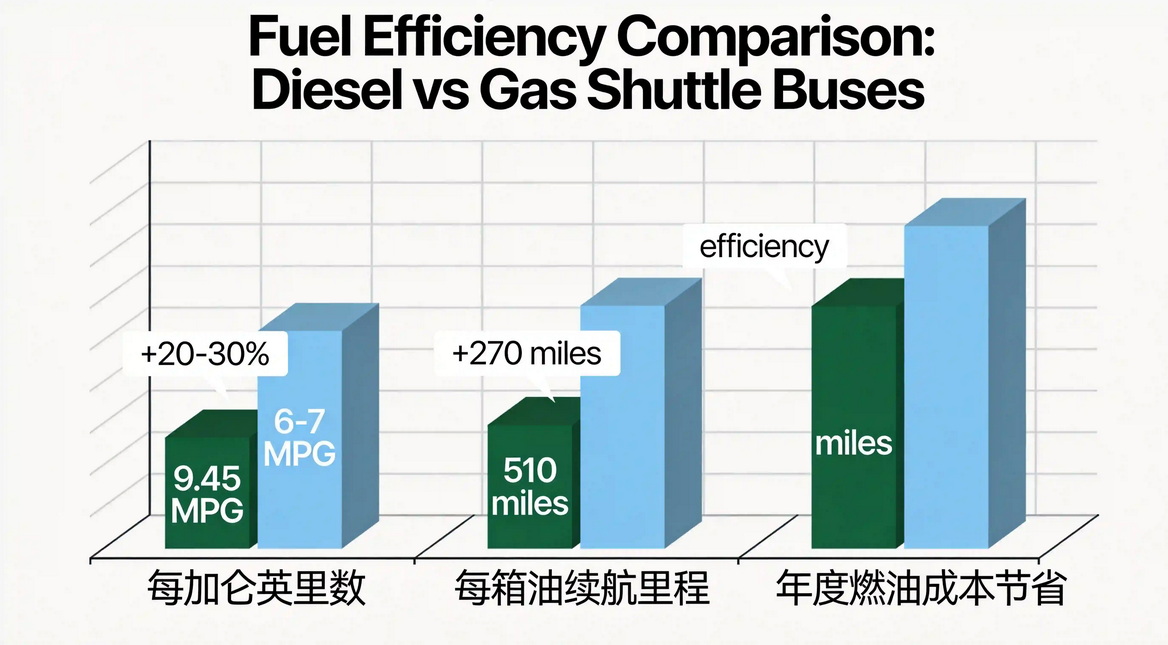
Recent 2026 cost analysis reveals diesel fuel efficiency creates substantial per-mile savings despite higher fuel prices at the pump. While diesel currently costs approximately $1.00-1.50 more per gallon than gasoline in most markets, the superior fuel economy results in lower cost per mile for operations exceeding 30,000 annual miles. Fleet operators report that diesel's fuel efficiency advantage becomes economically significant when buses operate high-mileage routes or spend considerable time idling—common scenarios in public transit and shuttle services.
Comprehensive maintenance cost analysis from fleet management data reveals notable differences:
| Service Item | Gas Engine Annual Cost | Diesel Engine Annual Cost |
|---|---|---|
| Oil Changes (4x annually) | $360 | $550 |
| Air Filters | $40 | $75 |
| Fuel Filters | $65 | $125 |
| Tire Rotations (2x) | $100 | $150 |
| A/C Service | $95 | $100 |
| Brake Inspection/Replacement | $450 | $500 |
| Miscellaneous | $200 | $200 |
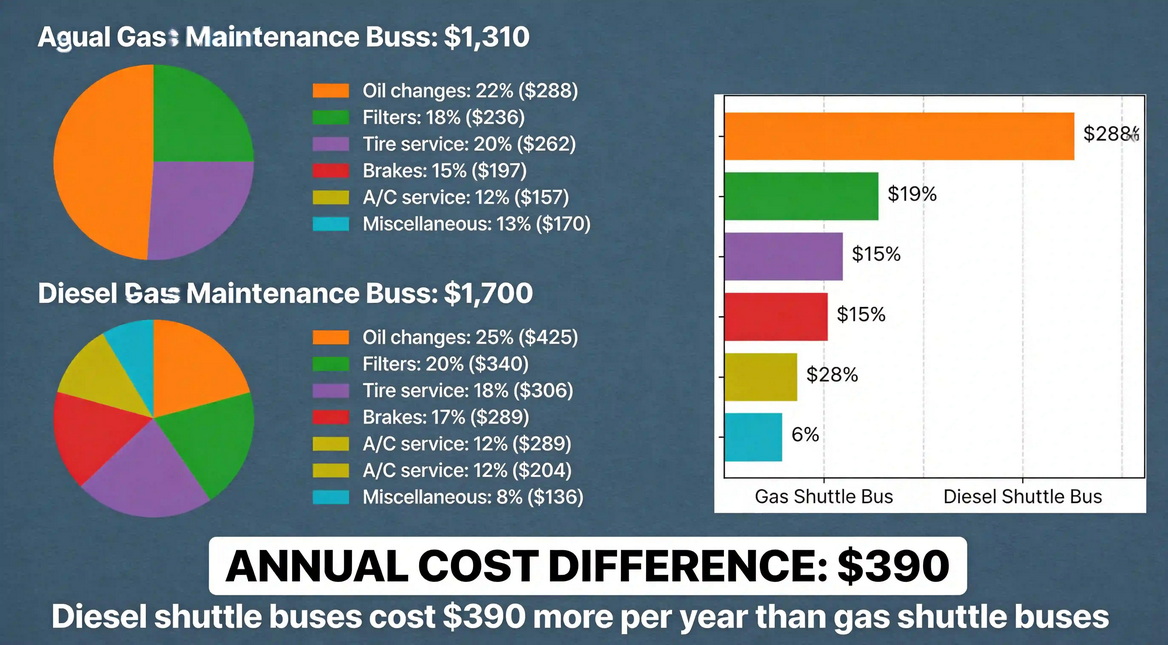
| Total Annual Cost | $1,310 | $1,700 |
Diesel engines require larger oil capacities (typically 12+ quarts versus 6-8 quarts for gas engines), specialized fuel filters to separate water contamination, and Diesel Exhaust Fluid (DEF) for emissions control systems. These factors contribute to approximately $390 higher annual maintenance costs for diesel buses.
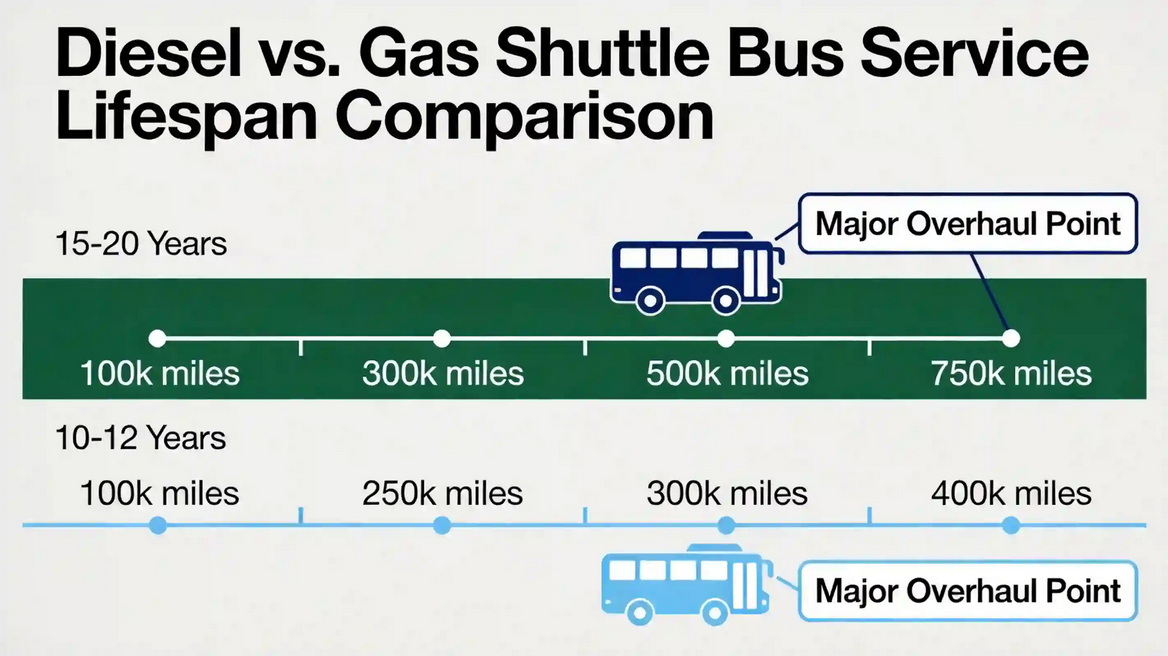
Diesel engines demonstrate superior longevity, with reinforced components designed to withstand higher compression forces. Heavy loads create significantly less strain on diesel engines compared to gas engines operating at similar capacity, resulting in extended service life. Fleet operators commonly report diesel buses achieving 500,000-750,000 miles before major overhauls, compared to 250,000-400,000 miles for gasoline engines in comparable service.
While individual diesel repairs and parts cost more than gas engine maintenance, the reduced frequency of major repairs over the vehicle's lifespan typically results in lower total maintenance expenditure.
Modern diesel engines equipped with advanced emissions control systems—including diesel particulate filters (DPF), selective catalytic reduction (SCR), and DEF injection—produce significantly fewer harmful emissions than older diesel models and many gasoline engines. These technologies reduce particulate matter by up to 90% and nitrogen oxide (NOx) emissions by 80-90% compared to pre-2010 diesel engines.
Gas engines generate lower particulate emissions naturally but produce higher carbon dioxide (CO₂) output per mile due to increased fuel consumption. For environmentally conscious operators, diesel's superior fuel efficiency translates to reduced overall carbon footprint despite marginally higher NOx emissions.
Gasoline engines operate more quietly than diesel engines—an important consideration for noise-sensitive applications such as airport shuttles, hotel transportation, retirement community services, and residential area operations. Diesel engines produce characteristic combustion noise, though modern sound insulation technologies and engine refinements have significantly reduced cabin noise levels in contemporary diesel shuttle buses.
Diesel shuttle buses typically command 15-25% higher purchase prices than comparable gasoline models due to more robust engine construction, advanced emissions systems, and enhanced drivetrain components. For second-hand bus buyers, this premium persists but diminishes with vehicle age—diesel buses often retain value better due to perceived durability and longer remaining service life.
The 30,000 annual miles threshold represents the critical decision point where diesel's fuel efficiency and durability advantages offset higher initial costs. Fleet operators exceeding this mileage realize fuel savings of $4,000-7,000 annually depending on route profiles and fuel prices, recovering the diesel premium within 3-5 years while benefiting from extended engine life.
For operations below 20,000 annual miles, gasoline shuttles often present better total cost of ownership due to lower purchase prices, reduced maintenance complexity, and minimal fuel cost differential on lower-mileage applications.
The shuttle bus market is experiencing transformation as electric bus adoption accelerates globally. The electric bus market, valued at $42.73 billion in 2026, is projected to reach $105.12 billion by 2035, expanding at 9.42% CAGR as cities prioritize emission reduction and sustainable mobility.
Electric shuttle buses offer compelling operational advantages including fuel costs of $0.28 per mile compared to $0.59 for diesel and dramatically reduced maintenance costs of $0.55/mile versus $1.53/mile for diesel. However, higher upfront costs, charging infrastructure requirements, and range limitations (typically 150-250 miles) currently restrict electric buses to specific operational profiles.
For second-hand bus markets, electric vehicles represent emerging opportunities as early-adoption fleets cycle vehicles into secondary markets, though battery degradation and replacement costs require careful evaluation.
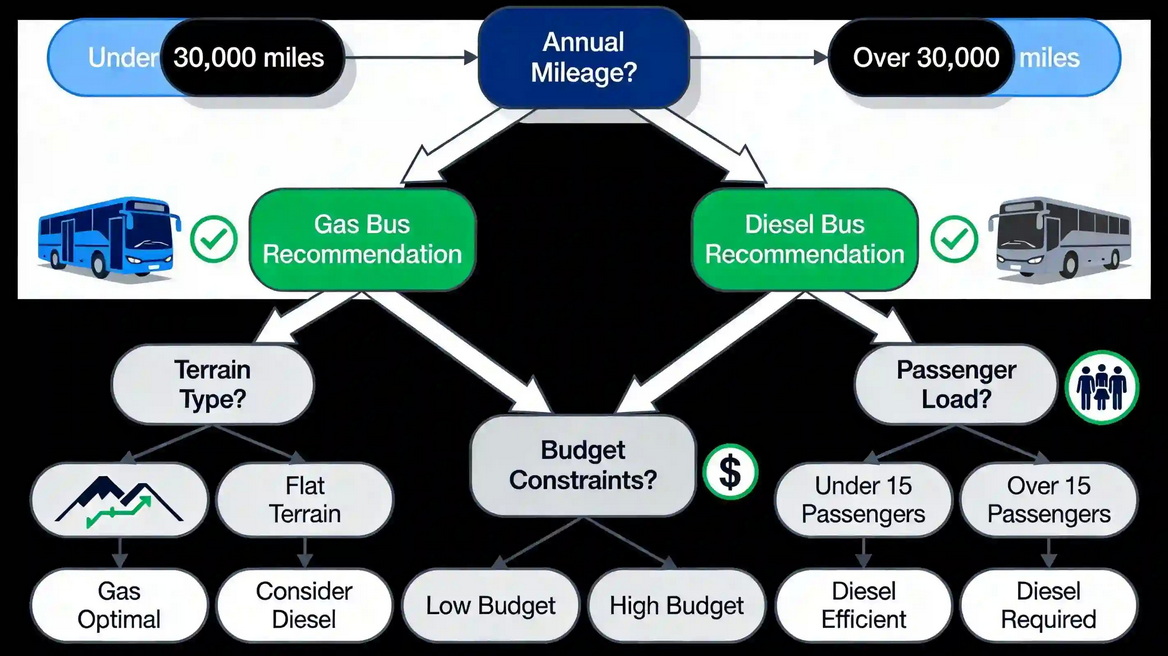
- Short to medium routes under 100 miles daily with light to moderate passenger loads
- Urban shuttle services operating in relatively flat terrain with frequent stops
- Budget-conscious operations with annual mileage below 20,000 miles
- Noise-sensitive applications requiring quieter operation
- Lower initial capital investment scenarios where upfront costs are prioritized
- High-mileage operations exceeding 30,000 annual miles
- Long-distance routes over 100 miles with sustained highway operation
- Heavy passenger loads regularly approaching maximum capacity
- Challenging terrain including hilly or mountainous regions
- Maximum durability requirements for vehicles expected to serve 15+ years
When selecting between gas and diesel shuttle buses, systematically evaluate these critical factors:
1. Route characteristics—daily mileage, terrain profile, and typical passenger loads directly determine which engine type delivers optimal performance and efficiency
2. Operational schedule—frequency of stops, idling time, and route duration influence fuel consumption patterns and engine stress
3. Budget constraints—balance initial purchase price against long-term operational costs including fuel, maintenance, and expected vehicle lifespan
4. Environmental priorities—assess emissions requirements, noise restrictions, and corporate sustainability commitments
5. Maintenance capabilities—consider available mechanical expertise and service infrastructure for diesel-specific systems versus simpler gas engine maintenance
6. Fuel availability—evaluate local fuel pricing trends, station accessibility along routes, and supply reliability
As a supplier with extensive experience in second-hand bus markets, I've observed that well-maintained diesel shuttle buses consistently outperform gasoline counterparts in resale value retention and remaining service life potential. China's commercial bus exports, which exceeded 35,000 units in 2023 including growing numbers of refurbished second-hand models, demonstrate the global demand for durable, high-quality diesel coach and shuttle buses that meet international operational standards.
Contact us to get more information!
Diesel shuttle buses commonly achieve 500,000-750,000 miles before requiring major engine overhauls, compared to 250,000-400,000 miles for gasoline engines in similar service applications. With proper maintenance, diesel buses often provide 15-20 years of reliable service versus 10-12 years for gas buses in high-mileage fleet operations.
Yes, for high-mileage operations exceeding 30,000 annual miles, diesel remains cost-effective despite higher per-gallon fuel prices. The 20-30% fuel efficiency advantage and superior durability result in lower cost per mile and reduced total cost of ownership over the vehicle's lifespan, offsetting the fuel price differential.
Diesel shuttle buses have higher initial purchase prices (15-25% premium over gas), increased annual maintenance costs (approximately $390 more), more complex emissions systems requiring DEF fluid, and louder engine operation. Additionally, diesel repairs and specialized parts typically cost more than gas engine equivalents.
Most modern diesel engines accept biodiesel blends up to B20 (20% biodiesel, 80% petroleum diesel) without modifications, though warranty coverage varies by manufacturer. Higher biodiesel concentrations may require fuel system modifications and more frequent filter changes. Always consult your specific engine manufacturer's recommendations before using alternative fuels.
Quality refurbished diesel buses from reputable exporters often provide superior long-term value compared to new gas buses for high-mileage applications. The inherent durability of diesel engines means a well-maintained 3-5 year old diesel shuttle with 150,000-200,000 miles can deliver another 300,000-500,000 miles of service at significantly lower initial cost than new gas alternatives, making them attractive for budget-conscious operators with high-mileage routes.
1. Las Vegas Bus Sales. (2024). "Comparing Gas and Diesel-Engine Buses." https://www.lasvegasbussales.com/comparing-gas-and-diesel-engine-buses/
2. Carpenter Bus Sales. (2025). "Gas vs. Diesel: Choosing Shuttle Power." https://www.carpenterbus.com/blog/transportation-fleet/gas-vs-diesel-choosing-shuttle-power/
3. Carpenter Bus Sales. (2015). "Annual Mini Bus Maintenance Costs." https://www.carpenterbus.com/senior-care-bus-articles/annual-mini-bus-maintenance-costs/
4. Nations Bus Sales. (2023). "The Differences Between Gas And Diesel Shuttle Buses." https://nationsbus.com/the-differences-between-gas-and-diesel-shuttle-buses/
5. Nations Bus Sales. (2023). "Comparing the Fuel Efficiency of Different Shuttle Bus Models." https://nationsbus.com/comparing-the-fuel-efficiency-of-different-shuttle-bus-models/
6. School Transportation News. (2021). "Real-world Results: Newer Diesel Buses Are Proving They Are in a League of Their Own." https://stnonline.com/partner-updates/real-world-results-newer-diesel-buses-are-proving-they-are-in-a-league-of-their-own/
7. Business Research Insights. (2025). "Electric bus Market Size | Industry Trends [2026-2035]." https://www.businessresearchinsights.com/market-reports/electric-bus-market-125109
8. BusCMMS. (2026). "Electric Buses Are Too Expensive – Debunked with 2026 Data." https://buscmms.com/blog/electric-buses-too-expensive-debunked-2026
9. SayCan Trading. (2025). "Used Buses from China: A Smart and Cost-Effective Transportation Solution for Global Buyers." https://saycan.com.cn/used-buses-from-china-a-smart-and-cost-effective-transportation-solution-for-global-buyers/
10. Nature. (2025). "Evaluating costs and operations of public bus fleet electrification." https://www.nature.com/articles/s44333-025-00030-y


