
Views: 223 Author: Keychain Venture Publish Time: 2026-09-05 Origin: Site


Content Menu
● Why the Ford Mondeo Still Matters
● Ford Mondeo Generations at a Glance
● Ford Mondeo Mk1: A New Beginning for Ford Family Cars
>> What the Mk1 Mondeo Teaches Modern Manufacturers
● Ford Mondeo Mk2: Better Design, Safer Driving, and More Equipment
>> Motorsport and Brand Confidence
● Ford Mondeo Mk3: Comfort, Space, and Long-Distance Efficiency
>> From Fuel Efficiency to Total Cost of Ownership
● Ford Mondeo Mk4: Higher Safety and More Refined Technology
>> Safety Is More Than Crash Protection
● Ford Mondeo Mk5: Hybrid Power and a Changing Market
>> Hybrid and Battery-Electric Vehicles Compared
● Why Ford Mondeo Production Ended in Europe
● What the Mondeo Legacy Means for New Energy Vehicles
>> Build Vehicles Around Real Operating Conditions
>> Make Technical Information Easy to Understand
>> Treat After-Sales Support as Part of the Product
● New Energy Vehicle Buyer Checklist
>> What year did the Ford Mondeo first launch?
>> When did Ford stop producing the Mondeo in Europe?
>> How many generations of the Ford Mondeo were produced?
>> Was the Ford Mondeo available as a hybrid?
>> Why did the Ford Mondeo become popular?
For almost three decades, the Ford Mondeo was one of Europe's most recognizable large family cars. It earned its reputation through a practical combination of comfort, driving stability, useful interior space, safety development, and a broad choice of petrol, diesel, and hybrid powertrains.
The Mondeo was never designed to be an exotic performance car or a luxury flagship. Its appeal came from something more valuable: it worked well in everyday life. Families used it for holidays and school runs. Sales professionals relied on it for long motorway journeys. Fleet managers selected it because it could balance operating costs, driver comfort, and practical performance.
Although European Mondeo production ended in 2022, its story remains relevant. The transport industry is now moving through another major change: the transition from conventional internal-combustion vehicles toward new energy vehicles, electric buses, battery-electric trucks, hybrid commercial vehicles, and smarter fleet solutions.
For vehicle suppliers, exporters, operators, and fleet buyers, the Mondeo's evolution offers an important lesson. A successful vehicle is not defined by one headline feature. It must deliver a complete operating solution that includes safety, comfort, energy efficiency, reliability, maintainability, and long-term value.
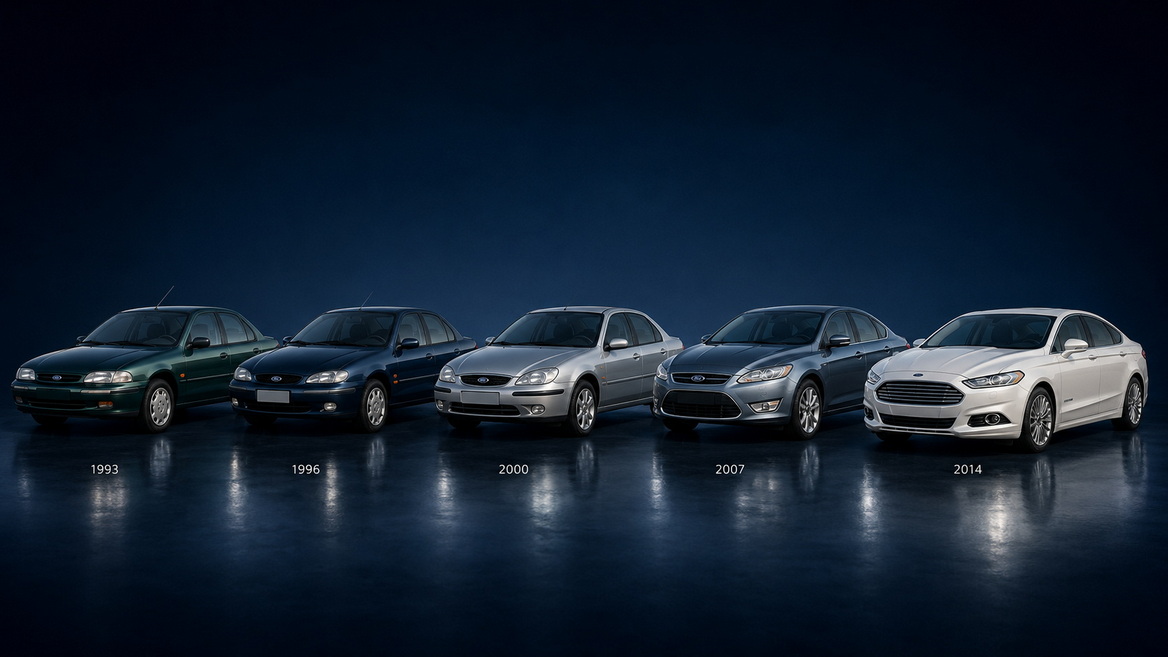
The Ford Mondeo was introduced in 1993 as the replacement for the Ford Sierra. At the time, it represented a major shift in Ford's approach to the family-car market. Buyers were beginning to expect more than a simple, affordable vehicle. They wanted improved safety, better comfort, lower running costs, stronger handling, and technology that made daily driving easier.
The Mondeo responded to those expectations. Over its lifespan, it developed from a practical mainstream car into a refined long-distance vehicle with more advanced driver-assistance features, stronger safety systems, and hybrid technology.
Across its generations, the Mondeo introduced or expanded the use of features such as:
- Anti-lock braking systems
- Driver and passenger airbags
- Traction control
- Electronic stability systems
- Cruise control
- Satellite navigation
- Bluetooth connectivity
- Blind-spot warning
- Lane-departure warning
- Adaptive cruise control
- Hybrid powertrain technology
The Mondeo also became an important cultural symbol in the United Kingdom. During the 1990s, the phrase "Mondeo Man" became associated with working and middle-income buyers who wanted practical success, family stability, and accessible quality.
That image reflected the Mondeo's position in the market. It was not just a car for one type of driver. It could serve private owners, business users, families, and high-mileage professionals.
The vehicle's long production run proves how important this balanced approach was. However, the same market that helped make the Mondeo successful eventually changed. Buyers increasingly moved toward SUVs and crossovers, while demand for traditional saloons, hatchbacks, and estate cars declined.
| Generation | Production Period | Main Development | Industry Importance |
|---|---|---|---|
| Ford Mondeo Mk1 | 1993–1996 | Replaced the Ford Sierra and adopted front-wheel drive | Set a new standard for Ford family cars through safety, handling, and practicality |
| Ford Mondeo Mk2 | 1996–2000 | Major exterior redesign and improved safety equipment | Strengthened the Mondeo’s visual identity and mainstream technology offering |
| Ford Mondeo Mk3 | 2000–2007 | Larger body, greater refinement, and strong diesel options | Became a popular long-distance vehicle for business users and fleets |
| Ford Mondeo Mk4 | 2007–2014 | More premium design and advanced driver-assistance systems | Raised expectations for comfort, safety, and perceived quality |
| Ford Mondeo Mk5 | 2014–2022 in Europe | More technology, better cabin quality, and hybrid availability | Showed the transition from traditional combustion engines toward electrification |
The first-generation Ford Mondeo arrived in the early 1990s as a replacement for the Ford Sierra. This was a significant moment for Ford because the Mondeo introduced a more modern platform and a clearer focus on everyday usability.
One of the biggest engineering changes was the switch to front-wheel drive. This helped Ford create a vehicle with more predictable handling and a packaging layout better suited to modern family-car expectations.
The Mondeo was available in several body styles, including saloon, hatchback, and estate versions. This gave buyers flexibility. A family might choose the estate for luggage capacity, while a business driver might prefer the hatchback or saloon for a more conventional appearance.
The first Mondeo also offered features that were increasingly important at the time:
- Air conditioning
- Cruise control
- Trip computers
- Heated windscreen technology
- Driver and passenger airbags
- Side airbags on selected versions
- Traction control on higher-specification models
- Improved cabin space and seating comfort
Ford understood that a family car had to do more than transport people from one place to another. It had to work in different driving environments, including city traffic, school runs, motorways, country roads, and long-distance family travel.
The first Mondeo proves that vehicle buyers respond to complete usability. A car can have strong performance figures, but if it is uncomfortable, difficult to maintain, poorly configured, or expensive to operate, its long-term appeal will be limited.
The same lesson applies to modern electric buses and heavy trucks.
A new energy commercial vehicle should be evaluated through the full operating experience:
- Driver visibility and ergonomics
- Passenger comfort and accessibility
- Real-world energy consumption
- Vehicle reliability
- Battery safety
- Maintenance access
- Spare-parts availability
- Charging compatibility
- Fleet-management support
- Total cost of ownership
For a bus operator or logistics company, the battery capacity alone is not enough. The vehicle must be capable of completing its daily work safely, efficiently, and consistently.
The 1996 update is commonly known as the Ford Mondeo Mk2. Although it retained much of the original engineering foundation, Ford gave the model a more distinctive appearance and added important safety and technology improvements.
The front and rear styling were redesigned with new lights, bumpers, wings, bonnet panels, and a more recognizable grille. The result was a vehicle that looked more modern and more competitive against European rivals.
Ford also improved occupant protection. The Mk2 received stronger side-impact structures, upgraded head restraints, improved seatbelt systems, and a larger driver airbag. These developments reflected the growing importance of crash safety in vehicle purchasing decisions.
Technology also became more visible during this period. Satellite navigation started to appear in higher-specification cars. Early systems were basic compared with modern touchscreen displays, but they represented a major change in how drivers interacted with their vehicles.
The Mk2 generation also introduced more performance-focused variants. The Mondeo ST24 used a 2.5-litre V6 petrol engine and appealed to drivers who wanted stronger acceleration without moving to a dedicated sports car.
The Ford Mondeo also became familiar to motorsport fans through the British Touring Car Championship. Ford competed with the Mondeo during the 1990s and achieved a championship-winning result in 2000.
Motorsport can be valuable for manufacturers because it demonstrates technical confidence. It can show how a company approaches handling, braking, chassis balance, durability, and data-driven development.
For new energy vehicle manufacturers, the modern equivalent is not always racing. It may be a demanding real-world demonstration program.
Examples include:
- Operating electric buses in high-temperature urban environments
- Testing heavy trucks on mountainous roads
- Demonstrating battery stability during winter operations
- Running commercial vehicles under full-load conditions
- Showing charging performance at logistics depots
- Publishing fleet uptime and energy-consumption data
- Demonstrating safety systems in controlled testing environments
A manufacturer earns long-term trust when it can show that its products work outside the showroom.
Launched in 2000, the Ford Mondeo Mk3 was larger, more refined, and more ambitious than its predecessors. It was designed to compete more directly with established European family and business vehicles.
The Mk3 offered increased cabin space, improved ride quality, stronger perceived quality, and a more mature driving experience. It became especially popular among fleet drivers and business users who regularly travelled long distances.
Ford also expanded the Mondeo's safety equipment. Depending on the version, the vehicle could include front airbags, side airbags, curtain airbags, seatbelt pretensioners, load limiters, and improved rear-seatbelt protection.
This generation was particularly important because of the growing popularity of diesel engines. The 2.0-litre TDCi diesel options delivered a practical balance between performance and fuel economy. For high-mileage users, this made the Mondeo an attractive choice.
The Mk3 showed that customers were increasingly thinking beyond the purchase price. They were considering fuel consumption, comfort, maintenance needs, resale value, and the overall cost of using a vehicle over several years.
This shift in buyer thinking has become even more important in the new energy vehicle market.
For electric buses, battery-electric heavy trucks, hybrid trucks, and other commercial NEVs, the key question should not be:
> "What is the advertised driving range?"
The more useful question is:
> "How will this vehicle perform and what will it cost throughout its operating life?"
A professional fleet assessment should include the following factors:
1. Daily operating distance and expected route length.
2. Passenger capacity or payload and its influence on energy use.
3. Road conditions, including traffic, hills, temperature, and surface quality.
4. Charging infrastructure at depots, terminals, warehouses, or customer sites.
5. Charging time and how it fits with driver shifts and route schedules.
6. Battery warranty terms and expected battery performance over time.
7. Maintenance requirements compared with diesel or petrol alternatives.
8. Spare-parts supply and technical support in the destination market.
9. Vehicle uptime and the cost of unexpected downtime.
10. Residual value and long-term asset planning.
For fleet operators, a lower purchase price does not always mean a lower total cost. A well-matched vehicle with dependable support, correct charging planning, and lower energy use may create better long-term value.
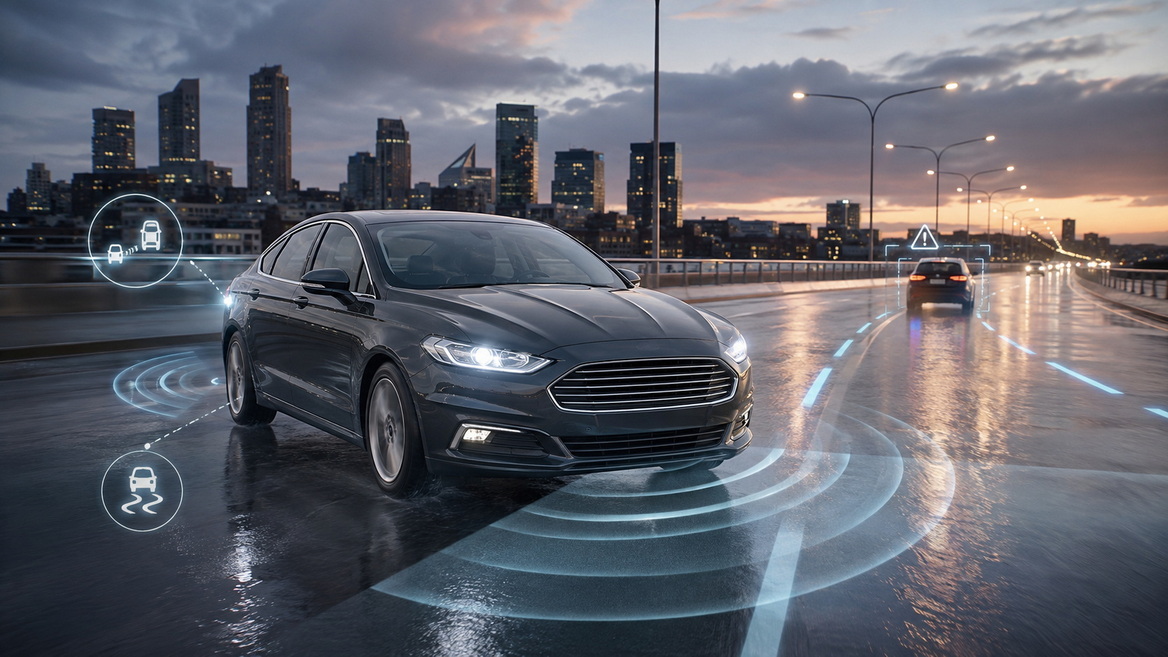
The fourth-generation Ford Mondeo was introduced in 2007. It marked a major step forward in design, interior quality, safety technology, and driving refinement.
Ford gave the vehicle a more confident appearance through its "Kinetic Design" language. The styling created a more dynamic and premium image, helping the Mondeo compete in a market where buyers were beginning to expect higher-quality cabins and more advanced equipment.
The Mk4 was offered in several trim levels, including Edge, Zetec, Titanium, Titanium X, and Titanium X Sport. These choices allowed customers to select a model based on budget, comfort preferences, technology requirements, or performance expectations.
Safety became one of the strongest parts of the Mondeo's identity. The Mk4 achieved a five-star adult occupant protection result in European safety testing, helping Ford reinforce the model's reputation as a family and business vehicle designed around occupant protection.
Available technology could include:
- Electronic stability control
- Traction control
- Blind-spot monitoring
- Lane-departure warning
- Adaptive speed control
- Automatic headlights
- Automatic wipers
- Bluetooth connectivity
- Parking assistance
- Improved navigation systems
The Mk4 also continued the Mondeo's strong diesel reputation. Its diesel engines were popular with drivers who covered high annual mileages and wanted a comfortable car for motorway travel.
For modern buses and heavy trucks, safety is no longer limited to airbags, crash structures, and braking systems. It must be considered as a complete operating system.
A well-equipped new energy commercial vehicle may require:
- Electronic stability control
- Anti-lock braking systems
- Traction control
- Forward-collision warning
- Automatic emergency braking
- Lane-departure warning
- Blind-spot monitoring
- Driver fatigue monitoring
- Tyre-pressure monitoring
- 360-degree camera systems
- High-voltage system protection
- Battery thermal-management systems
- Emergency isolation systems
- Fire detection and suppression solutions where appropriate
For buses, passenger safety must also include low-floor access, wheelchair areas, anti-slip flooring, emergency exits, handrails, internal lighting, safe door systems, and good visibility for the driver.
For heavy trucks, the priorities may include braking stability under load, blind-spot management, cab visibility, driver comfort, fatigue reduction, cargo protection, and route-specific energy management.
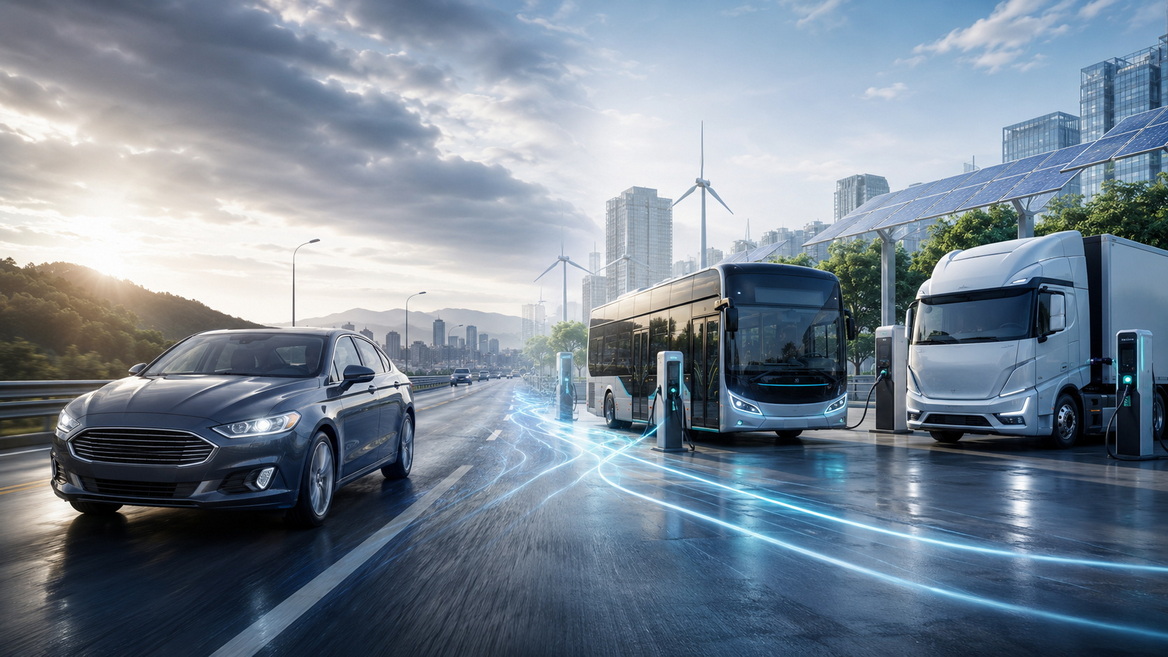
The fifth-generation Ford Mondeo arrived in Europe in 2014. It offered a more modern interior, improved infotainment, a stronger emphasis on premium comfort, and additional technology features.
The most significant development was the arrival of the Ford Mondeo Hybrid.
The hybrid version combined a petrol engine, an electric motor, a lithium-ion battery, and an electronically controlled transmission system. It was designed to reduce fuel consumption and emissions while retaining the long-distance comfort expected from a Mondeo.
Later versions included an estate hybrid, giving users greater luggage capacity and more practical flexibility. This was especially important for families, business users, and drivers who needed space without moving into an SUV.
The hybrid Mondeo represented a transitional stage in vehicle electrification. It showed that drivers wanted improved efficiency but were not always ready to depend entirely on charging infrastructure.
| Factor | Hybrid Vehicle | Battery-Electric Vehicle |
|---|---|---|
| Main energy source | Petrol and electricity | Electricity only |
| Tailpipe emissions | Reduced but still present | Zero while driving |
| Charging requirement | Limited or optional depending on system | Essential for daily operation |
| Best operating environment | Mixed routes and transitional fleets | Predictable routes with reliable charging access |
| Maintenance needs | Includes engine-related maintenance | Fewer drivetrain components but requires high-voltage expertise |
| Energy planning | Similar to conventional vehicles | Requires charging, route, payload, and dwell-time planning |
| Suitable users | Drivers seeking efficiency with familiar refuelling | Fleets ready for planned electrified operations |
Hybrid technology can help reduce fuel use, especially in urban driving and stop-start traffic. However, it still depends on conventional fuel and still produces tailpipe emissions.
Battery-electric vehicles take a further step by removing tailpipe emissions during operation. They are especially suitable for routes with predictable distances, depot charging, planned schedules, and stable energy-management requirements.
For example, a city bus operating the same route every day may be well suited to battery-electric technology. A heavy-duty truck operating irregular long-distance routes may require more detailed planning, higher-capacity battery systems, charging partnerships, or a phased transition strategy.
Ford announced that Mondeo production in Europe would end in 2022. The decision reflected changing vehicle demand rather than a lack of engineering progress.
SUVs and crossovers became more popular because many buyers preferred their higher seating position, perceived road presence, flexible interiors, and lifestyle-oriented image. As a result, traditional large family cars faced declining demand.
The Mondeo's end in Europe was part of a broader industry transformation. Vehicle markets are influenced by changing consumer expectations, emissions regulations, fuel and energy costs, urbanization, safety standards, and new technologies.
Today, the commercial transport industry is facing a similar transformation.
Key developments include:
- Growing adoption of electric buses in urban transport
- Increased testing of battery-electric delivery trucks
- Development of electric heavy-duty trucks for regional logistics
- Stronger emissions regulations in many markets
- More investment in charging infrastructure
- Greater focus on fleet energy management
- Higher demand for connected vehicle systems
- Increased attention to sustainability reporting
- More interest in battery recycling and lifecycle management
The Ford Mondeo's history shows that vehicle manufacturers must evolve before the market forces them to do so. The companies that adapt their technology, product planning, support systems, and customer communication are more likely to remain competitive.

The Ford Mondeo became successful because it developed in line with customer needs. It improved safety when safety became more important. It expanded diesel efficiency when high-mileage drivers wanted lower fuel costs. It added technology when buyers expected greater convenience. It introduced hybrid power as the market began moving toward electrification.
New energy vehicle manufacturers can apply the same approach.
A city transit operator, airport shuttle company, school-bus provider, mining business, construction contractor, warehouse operator, and cross-border logistics fleet do not have the same requirements.
Vehicle selection should consider:
- Route distance
- Terrain
- Passenger or cargo load
- Climate conditions
- Charging availability
- Local energy pricing
- Government regulations
- Driver experience
- Maintenance capability
- Import and certification requirements
A battery-electric bus designed for short urban routes may not be the correct choice for long-distance intercity transportation. A heavy electric truck designed for port operations may not suit a mountainous long-haul logistics route without careful planning.
The correct vehicle is the vehicle that matches the actual duty cycle.
Commercial buyers need clear and practical information. They should not have to interpret technical claims without context.
A professional vehicle supplier should explain:
- Real-world driving range
- Battery capacity and usable battery energy
- Charging type and charging time
- Battery thermal-management strategy
- Vehicle payload capacity
- Passenger capacity
- Safety specifications
- Maintenance intervals
- Warranty coverage
- Spare-parts support
- Remote diagnostics
- Driver and technician training
- Emergency-response procedures
Transparent communication creates trust and helps customers make better procurement decisions.
For overseas buyers, delivery is not the end of the transaction. It is the beginning of the vehicle's working life.
A reliable support system should include:
- Clear technical manuals
- Spare-parts planning
- Remote troubleshooting
- Driver training
- Maintenance training
- Vehicle inspection procedures
- Warranty communication
- Configuration records
- Export documentation support
- Responsive technical assistance
For a fleet operator, a vehicle that cannot be repaired quickly can become a financial risk. Long-term support is therefore part of the total vehicle solution.
Before purchasing or importing a new energy bus, electric truck, hybrid truck, or other commercial NEV, buyers should evaluate the following points carefully.
1. What is the vehicle's expected daily operating distance?
2. How will passenger volume or cargo payload affect energy consumption?
3. What road conditions will the vehicle face?
4. Is charging available at depots, terminals, warehouses, or other operating locations?
5. How much charging time is available between shifts or routes?
6. What battery warranty, degradation policy, and thermal-management system are included?
7. Which safety systems are standard, and which are optional?
8. Can the supplier provide spare parts, manuals, training, and remote technical support?
9. Does the vehicle comply with destination-market certification and import requirements?
10. What is the estimated total cost of ownership over five to eight years?
11. What driver-training and technician-training requirements should be included?
12. How will the fleet manage emergency procedures involving high-voltage systems?
A careful procurement process reduces uncertainty. It also helps buyers avoid selecting a vehicle based only on purchase price, battery size, or advertised range.
The Ford Mondeo evolved from a practical 1990s family car into a safer, more refined, more efficient, and eventually hybrid-equipped vehicle. Its European production may have ended, but its legacy remains valuable.
The Mondeo showed that long-term vehicle success depends on understanding how people actually use vehicles. Comfort matters. Safety matters. Cost matters. Technology matters. Reliability matters. Support matters.
The same principles now shape the future of new energy buses, heavy trucks, and commercial fleet vehicles.
For companies planning an electric or hybrid fleet transition, the best solution is not simply the newest vehicle or the largest battery. The best solution is the vehicle configuration that matches the route, load, climate, charging conditions, safety requirements, and long-term operating goals.
KeyChain provides high-performance buses, heavy trucks, and new energy vehicle solutions for domestic and international customers. By combining vehicle configuration expertise, export experience, practical fleet understanding, and professional support, KeyChain helps customers identify transport solutions that are built for real operating conditions.
The Ford Mondeo was first launched in 1993. It replaced the Ford Sierra and introduced a more modern front-wheel-drive platform for Ford's large family-car range.
Ford ended Mondeo production in Europe in 2022. The decision followed declining demand for traditional large family cars and increasing consumer preference for SUVs and crossovers.
The Ford Mondeo was produced across five major generations in Europe. Each generation introduced updates in design, safety, comfort, technology, engine efficiency, and electrification.
Yes. The fifth-generation Ford Mondeo was available with a hybrid powertrain that combined a petrol engine, electric motor, lithium-ion battery, and electronically controlled transmission system.
The Ford Mondeo became popular because it offered practical space, comfortable long-distance driving, a choice of body styles, good handling, competitive safety features, and a wide range of petrol and diesel engines.
1. Evans Halshaw. "The Evolution of the Ford Mondeo."
[https://www.evanshalshaw.com/blog/the-evolution-of-the-ford-mondeo/]
2. Euro NCAP. "Ford Mondeo Safety Assessment."
[https://www.euroncap.com/assessments/ford/mondeo/0793/]
3. Ford Press Release. "New Ford Mondeo Achieves Five-Star Euro NCAP Rating."
[https://www.fordpress.be/content/old/news-2011_pdf_26-09-2007_mondeo_euroncap_eng.pdf]
4. Top Gear. "Sad Times: The Ford Mondeo Is Dead."
[https://www.topgear.com/car-news/sad-times-ford-mondeo-dead]
5. DrivingElectric. "Ford Mondeo Saloon 2.0 Hybrid Titanium Edition 4dr Auto."
[https://www.drivingelectric.com/ford/mondeo/prices-specs/88278/2.0-hybrid-titanium-edition-4dr-auto]
6. Carwow. "Ford Mondeo Estate Hybrid Review and Prices."
[https://www.carwow.co.uk/ford/mondeo-estate-hybrid]
7. NetCarShow. "Ford Mondeo Estate (2005)."


