
Views: 239 Author: Keychain Venture Publish Time: 2026-08-10 Origin: Site


Content Menu
● What Is an Anti-Lock Braking System?
● How ABS Works in Heavy Trucks and Buses
● Why ABS Is Important for Buses
● Why ABS Matters for Dump Trucks
>> ABS Considerations for Dump Trucks
>> Brake Blending in Electric Vehicles
● What Does the ABS Warning Light Mean?
● Common ABS Problems in Commercial Vehicles
● ABS Maintenance Checklist for Fleet Operators
● ABS, EBS, ESC and AEB: What Is the Difference?
● How to Choose a Commercial Vehicle with ABS
● Summary
>> Does ABS make a heavy truck stop faster?
>> Can a truck still be driven when the ABS light is on?
>> Do electric buses need ABS?
>> What is the difference between ABS and EBS?
>> Why is ABS important for dump trucks?
An Anti-Lock Braking System (ABS) is one of the most important active safety systems in a modern bus, heavy truck, dump truck, or New Energy Vehicle. It is designed to reduce wheel lock during severe braking, helping the driver maintain steering control when road conditions or vehicle loads become challenging.
For fleet operators, distributors, contractors, and transport companies, ABS is not simply a technical item on a vehicle specification sheet. It affects braking stability, driver confidence, tyre wear, maintenance planning, fleet uptime, and overall operational safety.
In commercial transport, vehicles often operate under demanding conditions. A bus may carry standing passengers in busy urban traffic. A dump truck may travel on loose gravel, muddy construction sites, or steep slopes. An electric truck may need to coordinate regenerative braking with conventional friction braking. In each case, the braking system must respond predictably.
ABS helps the driver keep control during hard braking. However, it cannot replace safe driving, proper tyre maintenance, correct loading, suitable following distance, or professional driver training.
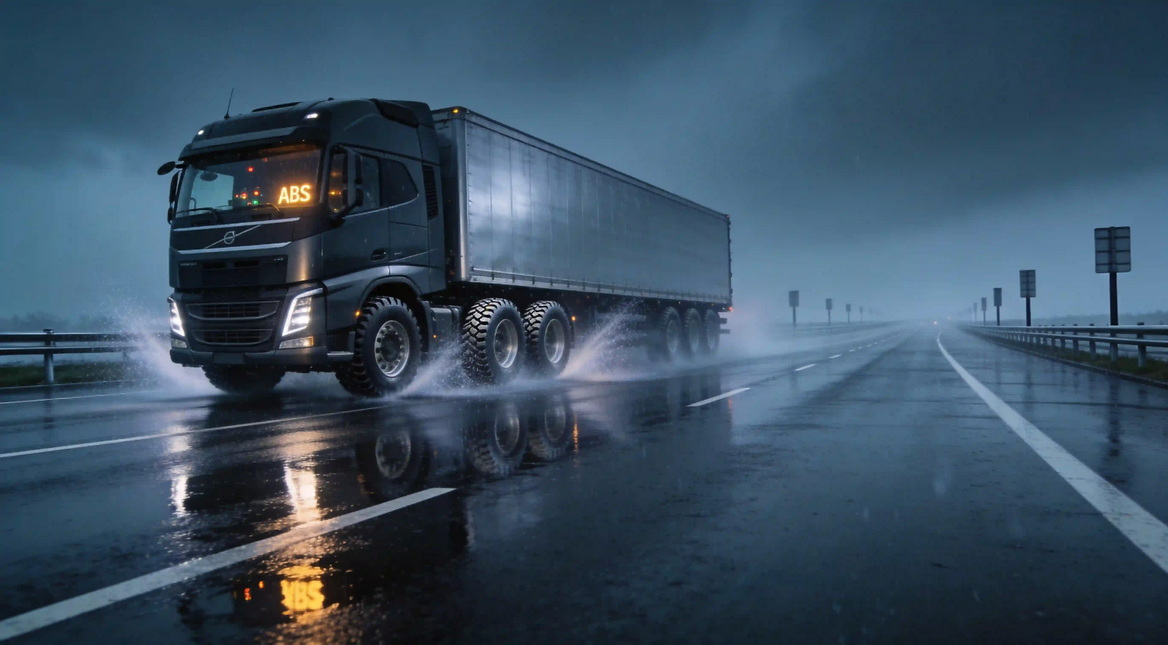
ABS stands for Anti-Lock Braking System. It is an electronically controlled system that helps prevent one or more wheels from locking when the driver brakes suddenly or aggressively.
When a wheel locks, it stops rotating and begins sliding across the road surface. A sliding tyre can lose much of its ability to steer, particularly on wet, icy, sandy, muddy, or uneven roads. This can make it difficult for the driver to avoid an obstacle or keep the vehicle travelling in the intended direction.
ABS detects when a wheel is slowing down too quickly and is close to locking. It then adjusts the braking pressure at that wheel. The system can reduce, hold, and reapply brake pressure repeatedly during a braking event.
The main purpose is not always to produce the shortest possible stopping distance on every road surface. The primary purpose is to help preserve vehicle stability and steering control while applying strong braking force.
For commercial vehicles, ABS can help reduce the risks associated with:
- Wheel lock during emergency braking
- Loss of steering control
- Skidding on wet or low-grip roads
- Trailer swing-out in articulated vehicles
- Jackknifing risk in tractor-trailer combinations
- Instability caused by uneven cargo loading
- Loss of control on loose-site surfaces
A commercial vehicle ABS system monitors wheel speed continuously. If the system identifies that a wheel may lock, it intervenes before the tyre loses too much traction.
The ABS process typically follows these steps:
1. Wheel-speed sensors measure the rotational speed of each monitored wheel.
2. The electronic control unit, or ECU, receives and compares those signals.
3. The ECU detects whether a wheel is slowing down more rapidly than expected.
4. The ECU sends a command to an ABS modulator valve.
5. The valve adjusts air pressure or hydraulic pressure to the brake at the affected wheel.
6. The wheel regains rotation and traction.
7. The system repeats this process as needed during braking.
This process can happen many times per second. The driver may feel a pulsing sensation through the brake pedal in some vehicles, while heavy-duty air-brake systems may produce rapid mechanical or air-related sounds during ABS activation.
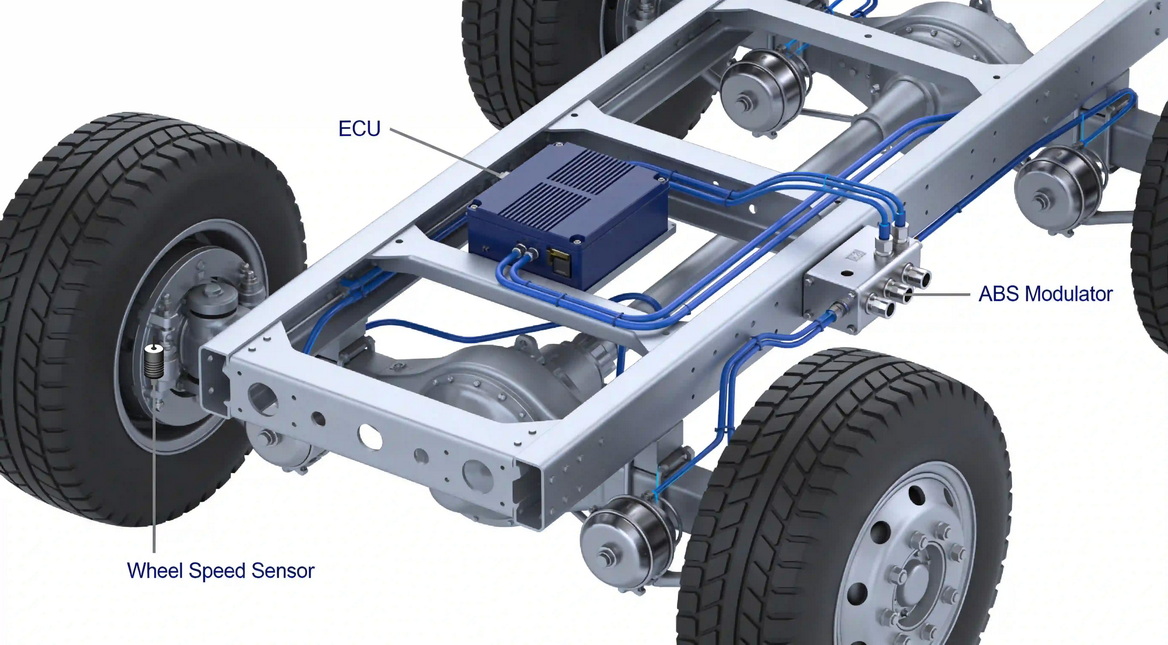
| Component | Function | Importance |
|---|---|---|
| Wheel-speed sensors | Monitor wheel rotation | Detect possible wheel lock |
| ECU | Analyzes wheel-speed signals | Determines when ABS intervention is required |
| ABS modulator valve | Adjusts brake pressure | Helps prevent wheel lock at individual wheels |
| Wiring harnesses and connectors | Carry sensor and control signals | Must withstand vibration, water, corrosion, and impact |
| ABS warning light | Alerts the driver to a detected fault | Supports daily vehicle inspection and fault reporting |
Commercial vehicles may use different ABS configurations, such as 4S/4M, 6S/4M, or 6S/6M. These terms refer to the number of wheel-speed sensors and modulator valves installed on the vehicle.
The correct system configuration depends on vehicle type, axle arrangement, brake design, intended application, and local-market requirements.
Buses and coaches operate in environments where braking stability matters not only for the driver, but also for passengers.
A city bus may stop frequently in traffic, encounter pedestrians, make sharp turns, and travel on rain-soaked roads. A coach may operate at higher speeds on highways with luggage, passengers, and changing road gradients. In both situations, maintaining control during emergency braking is essential.
ABS can provide several practical benefits for bus operators:
- Improved steering control during sudden braking
- Reduced risk of wheel lock on wet urban roads
- Better stability when braking while avoiding obstacles
- Greater confidence for drivers in changing traffic conditions
- A stronger foundation for wider vehicle-stability systems
- More predictable braking performance with varying passenger loads
For passenger transport operators, ABS should be evaluated together with other key safety features, including electronic stability control, traction control, tyre-pressure monitoring, braking-system diagnostics, driver-assistance technologies, and high-quality tyre selection.
Dump trucks operate under very different conditions from road buses and long-haul trucks. They may work on gravel, dirt, mud, quarry roads, construction sites, mining routes, and slopes with constantly changing traction levels.
In addition, payload affects braking behavior. A fully loaded dump truck has greater momentum than an empty truck, and its center of gravity can change depending on cargo type, body design, and load distribution.
A dump truck ABS system should be evaluated according to actual operating conditions rather than only highway driving requirements.
Important considerations include:
- Loose gravel, dirt, and sand surfaces
- Wet or muddy construction sites
- Steep uphill and downhill routes
- Frequent start-stop hauling cycles
- Changing vehicle weight between loaded and unloaded trips
- High vibration exposure
- Risk of sensor and wiring damage from debris
- Brake heat during repeated downhill braking
Some heavy-duty vehicles may offer an off-road ABS mode. Depending on the system design, this mode can modify normal ABS behavior for loose surfaces. It is important to confirm whether this function is available, how it operates, and when it should be used.
A buyer should never assume that every dump truck includes off-road braking settings. The vehicle supplier should clearly explain the installed braking configuration, driver operating guidance, and maintenance requirements.
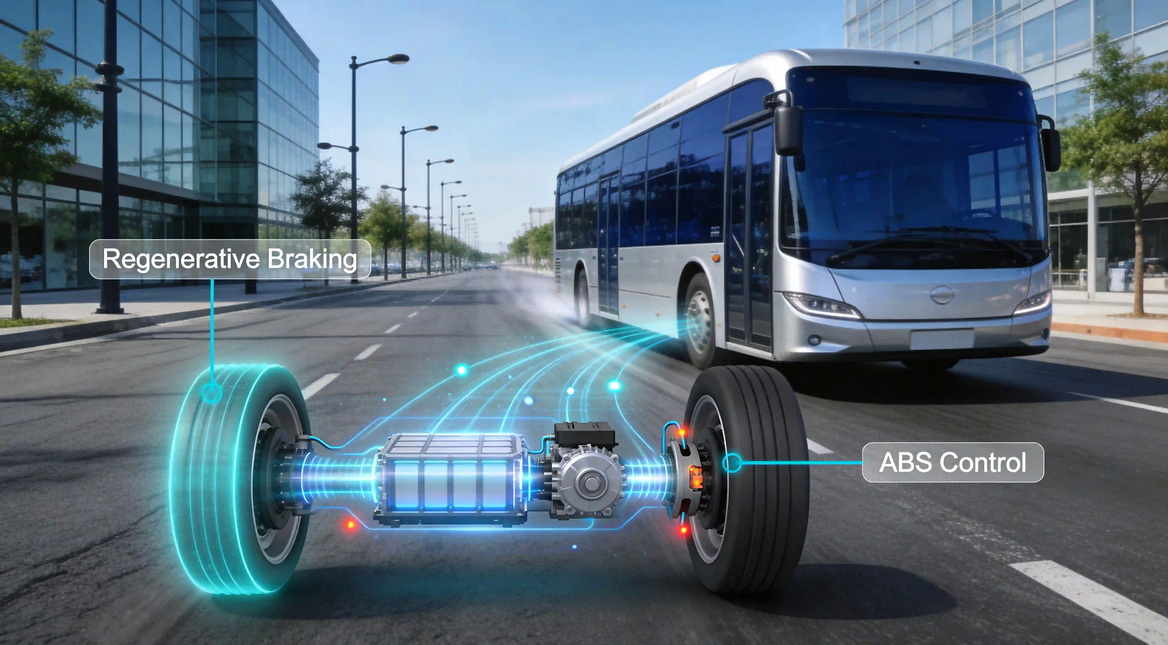
ABS remains essential in electric buses, electric trucks, and other New Energy Vehicles. However, electric vehicles introduce an additional braking element: regenerative braking.
Regenerative braking uses the electric motor to slow the vehicle while recovering part of its kinetic energy. Instead of converting all braking energy into heat through friction brakes, the vehicle can send some energy back to the battery.
This can improve energy efficiency and help reduce friction-brake wear during normal driving. However, it also means that the vehicle must coordinate multiple braking forces.
Electric commercial vehicles must manage the relationship between:
- Regenerative braking torque from the electric motor
- Conventional friction braking from disc or drum brakes
- ABS operation under low-grip conditions
- Vehicle weight and payload
- Road surface conditions
- Battery state and thermal conditions
- Motor capability at different speeds
This coordination is often called brake blending.
During normal deceleration, the vehicle may use regenerative braking as much as possible. During an emergency braking event, the system must react quickly if wheel lock becomes likely. ABS intervention may require regenerative braking torque to be reduced or adjusted while friction braking is controlled at individual wheels.
For this reason, buyers of electric buses and electric trucks should consider more than driving range and battery capacity. They should also understand the vehicle's braking-control system, diagnostic capability, component support, and maintenance procedures.
The ABS warning light is usually yellow or amber and displays the letters ABS. It normally illuminates briefly when the vehicle starts, then turns off after the system completes its self-check.
If the warning light remains on, appears during driving, or does not illuminate during start-up, the system should be inspected according to the manufacturer's maintenance procedure.
In trucks and buses, the ABS warning lamp is commonly located on the dashboard. Trailers may also have an external ABS warning lamp near the rear side-marker area.
If the ABS warning light remains on:
1. Record when the warning light appeared.
2. Check whether other brake-system or stability-control warning lights are active.
3. Inform the fleet supervisor or maintenance department.
4. Follow the vehicle operating manual and company safety procedure.
5. Arrange diagnosis using appropriate service tools.
6. Do not ignore repeated or intermittent warning lights.
In many cases, the standard service brakes may still operate when the ABS warning light is on. However, anti-lock functionality may not be available, and braking performance may be less stable in an emergency. The vehicle should not be treated as fully fault-free.
If the ABS warning occurs together with air-pressure loss, a red brake warning, unusual brake feel, poor braking response, or visible leakage, stop operating the vehicle and follow emergency procedures.
Commercial vehicles experience vibration, heat, water exposure, road debris, and long operating hours. These conditions can affect ABS components and electrical connections.
Common ABS-related issues include:
- Damaged wheel-speed sensors
- Contaminated or incorrectly positioned sensors
- Corroded, loose, stretched, or broken wiring
- Damaged connectors caused by water ingress
- Faulty modulator valves
- ECU power or grounding problems
- Sensor-ring or tone-wheel damage
- Incorrect tyre sizes across an axle
- Trailer electrical-connection faults
- Impact damage from stones, debris, or off-road operation
- Intermittent electrical faults caused by vibration
A warning light should not be cleared without identifying the underlying issue. Replacing parts based only on assumptions can create unnecessary cost and may fail to solve the problem.
Proper diagnosis should include fault-code reading, visual inspection, wiring checks, sensor measurement, and verification of brake-system operation.
ABS is part of a wider brake and vehicle-control system. Its reliability depends on correct maintenance of sensors, wiring, tyres, brakes, air lines, electrical systems, and wheel-end components.
Use the following checklist during pre-trip inspections and scheduled maintenance.
- Confirm that the ABS warning light performs its normal start-up self-check
- Check visible sensor cables and connectors for damage or corrosion
- Inspect wiring routes for abrasion, loose clips, and contact with moving parts
- Inspect air hoses, brake lines, and fittings for leakage or physical damage
- Verify that tyres are correctly sized, inflated, and matched as required
- Review diagnostic codes using approved equipment
- Inspect brake pads, linings, rotors, drums, and brake chambers during service
- Check wheel-end components and sensor mounting positions
- Inspect trailer electrical connections before combination-vehicle operation
- Keep detailed maintenance records for recurring ABS faults
- Train drivers to report warning lights as soon as they appear
Heavy-duty brake work should be completed by qualified personnel using suitable tools, protective equipment, and manufacturer-approved procedures.
ABS is often mentioned with other safety systems. While these technologies may work together, they perform different functions.
| System | Main Purpose | Typical Function |
|---|---|---|
| ABS | Prevent wheel lock | Adjusts brake pressure to preserve steering control |
| EBS | Electronically manages braking response | Improves braking coordination and response speed |
| ESC | Supports vehicle stability | May apply selective braking and reduce engine torque |
| Traction control | Limits wheel spin during acceleration | Applies brake force or reduces drive torque |
| AEB | Helps reduce frontal-collision risk | Uses sensors to warn the driver and may apply braking |
For fleet buyers, these systems should be reviewed as a complete safety package. ABS provides an important foundation, but safe vehicle operation also depends on tyres, suspension, brake condition, load distribution, driver behavior, route conditions, and preventive maintenance.
When sourcing a bus, heavy truck, dump truck, or New Energy Vehicle, buyers should ask detailed questions about the braking system.
Important questions include:
- Which ABS supplier and braking-system configuration are fitted?
- Does the vehicle use air brakes, hydraulic brakes, or an electro-pneumatic system?
- Which axles and wheels are monitored by the ABS system?
- Is off-road ABS available for dump-truck applications?
- How is regenerative braking coordinated with ABS in electric vehicles?
- Which diagnostic tools and fault-code information are included?
- Are replacement sensors, valves, ECUs, and wiring harnesses available?
- Can the supplier provide English manuals, wiring diagrams, and parts lists?
- What braking-system training is available for local service teams?
- Which compliance documents and vehicle certifications apply to the destination market?
- What warranty coverage is provided for braking-system components?
The best commercial vehicle is not always the one with the longest equipment list. It is the one with a braking configuration, service plan, spare-parts supply, and technical support structure suited to the real operating environment.
An anti-lock braking system is a critical safety feature for buses, heavy trucks, dump trucks, and New Energy Vehicles. It helps prevent wheel lock, supports steering control, and improves stability during demanding braking situations.
For commercial operators, ABS should be considered alongside brake maintenance, tyre management, vehicle stability systems, payload control, driver training, and local service support. For electric commercial vehicles, the interaction between ABS and regenerative braking also deserves careful attention.
KeyChain supports customers seeking high-quality buses, dump trucks, heavy-duty trucks, and New Energy Vehicles for domestic and international markets. Share your vehicle application, operating environment, payload requirements, and destination market with our team to identify a suitable commercial-vehicle solution.
Not necessarily. ABS is primarily designed to help prevent wheel lock and preserve steering control. Actual stopping distance depends on vehicle speed, payload, tyre condition, road surface, brake condition, weather, and driver response.
The standard service brakes may still function, but the anti-lock function may be unavailable or limited. The fault should be reported immediately and diagnosed by qualified technicians.
Yes. Electric buses require ABS to help maintain stability during hard braking. Their systems must also coordinate regenerative braking with conventional friction braking.
ABS prevents wheel lock by controlling brake pressure. EBS is a broader electronically controlled braking system that can improve braking response and coordinate with additional safety technologies.
Dump trucks may travel on loose surfaces, steep slopes, and uneven terrain while carrying changing loads. ABS can help reduce wheel lock and improve controllability during difficult braking events.
1. Evans Halshaw. Guide to Anti-lock Braking Systems (ABS)https://www.evanshalshaw.com/blog/guide-to-abs/
2. Commercial Vehicle Safety Alliance. Anti-Lock Braking Systemshttps://cvsa.org/programs/operation-airbrake/anti-lock-braking-systems/
3. ZF/WABCO. Anti-Lock Braking System for Trucks, Tractors and Buses: Maintenance Manualhttps://www.zf.com/products/media/automotive/cv/literature_downloads_wna/truck_solutions/abs_maintenance_manuals_/mm30_web.pdf
4. Bosch Mobility. Antilock Braking Systemhttps://www.bosch-mobility.com/en/solutions/driving-safety/antilock-braking-system/
5. SAE International. Integrated Regenerative Braking System and Anti-Lock Brake System for Hybrid and Battery Electric Vehicleshttps://saemobilus.sae.org/articles/integrated-regenerative-braking-system-anti-lock-braking-system-hybrid-electric-vehicles-battery-electric-vehicles-2020-01-0846


