
Views: 222 Author: Keychain Venture Publish Time: 2026-06-24 Origin: Site


Content Menu
● What Preventive Maintenance Really Means for Fleet Operators
● Why Preventive Maintenance Drives Compliance and Reliability
>> Safety and regulatory compliance
● The NEV Shift: Why Preventive Maintenance Matters Even More Now
● Key Differences: PM for NEVs vs Diesel Fleets
>> Components that change with NEVs
>> Components that stay familiar
● How Industry Leaders Structure Their Preventive Maintenance Programs
>> 1. Define clear maintenance intervals
>> 2. Standardize checklists and workflows
>> 3. Digitize inspections and data capture
● A Practical Preventive Maintenance Framework for NEV Fleets
>> Core Preventive Maintenance Checklist (NEV Buses & Heavy Trucks)
● Example Fleet PM Schedule for Mixed NEV and Diesel Assets
● Building a Data‑Driven PM Culture (Not Just a Workshop Schedule)
● Specific NEV Maintenance Priorities: Batteries, Brakes, and Tires
>> Battery systems and charging behavior
>> Regenerative and mechanical braking
>> Tires for heavy NEV applications
● How KeyChain Supports Preventive Maintenance for International NEV Fleets
● Call to Action: Turn Your NEV Fleet into a Reliable, Compliant Asset
● Frequently Asked Questions (FAQ)
>> 1. Do electric buses really need less preventive maintenance than diesel buses?
>> 2. How often should I perform high‑voltage system inspections on NEV trucks?
>> 3. What data should I track to improve my preventive maintenance program?
>> 4. How does preventive maintenance support regulatory compliance?
>> 5. What should I ask a supplier like KeyChain before purchasing NEV buses or trucks?
As a fleet operator, I have learned that preventive maintenance is not a cost center – it is the main profit lever and risk shield for any modern bus or heavy‑truck fleet, especially in the era of New Energy Vehicles (NEVs). From China's rapidly growing zero‑emission bus and truck market to global long‑haul fleets, the operators who win on uptime, safety, and compliance are the ones who turn preventive maintenance into a disciplined, data‑driven system.

For NEV and conventional diesel fleets, preventive maintenance (PM) means proactively servicing vehicles on a time‑, mileage‑, or usage‑based schedule to catch issues long before they become road failures. It goes far beyond oil changes; a mature PM program covers inspections, diagnostics, component replacements, and documentation throughout the vehicle lifecycle.
In practice, that means:
- Scheduled inspections based on OEM guidance, telematics data, and operating conditions
- Systematic checks on safety‑critical systems: brakes, tires, steering, lights, chassis
- Predictive diagnostics on high‑value components like batteries, drivetrains, and HV cables for NEVs
- Documented reports to support audits, warranties, and resale value
From my experience working with operators in passenger bus and heavy‑truck applications, the fleets that treat PM as a core process – not a one‑off workshop task – consistently achieve lower total cost per kilometer and fewer compliance issues.
Regulators and customers increasingly expect documented, repeatable maintenance processes, not ad‑hoc workshop fixes. For heavy vehicles, a structured PM program directly supports:
- Adherence to brake, tire, and lighting standards
- Completion and traceability of federal and local inspections
- Better inspection scores and fewer audit findings or roadside violations
Industry data shows that fleets with standardized PM checklists and digital enforcement can cut unexpected component failures by up to 85%, which directly improves compliance metrics and reduces incident risk.
For bus and truck fleets, uptime is the real product you sell. Well‑designed PM delivers:
- Reduced unplanned breakdowns and roadside calls
- Longer service life for engines, batteries, and driveline components
- Higher on‑time performance and customer satisfaction
In our NEV bus and heavy‑truck projects at KeyChain, operators who adopted a strict PM schedule for batteries, cooling systems, and brake components saw a clear drop in emergency repairs during peak seasons within 6–12 months. (Internal project observation, aligned with industry PM findings.)
China's zero‑emission truck and bus market reached more than 230,000 units sold in 2024, and city buses are already close to 100% electrified. That scale changes the maintenance conversation: NEV fleets cannot afford ad‑hoc, diesel‑style maintenance thinking.
Key trends that matter for your PM strategy:
- Battery electric technology dominates the zero‑emission market for medium and heavy trucks, while fuel‑cell vehicles remain niche but growing. - Top manufacturers (XCMG, SANY, FAW, Shacman, Yutong and others) are scaling production, which raises expectations on consistent after‑sales support and service networks. - Battery swapping is gaining traction in heavy‑duty segments like mining, steel, and port logistics, demanding new inspection routines for packs, connectors, and swap stations.
In this environment, a robust preventive maintenance program is not optional – it is how you protect your NEV investment, your brand, and your contracts.
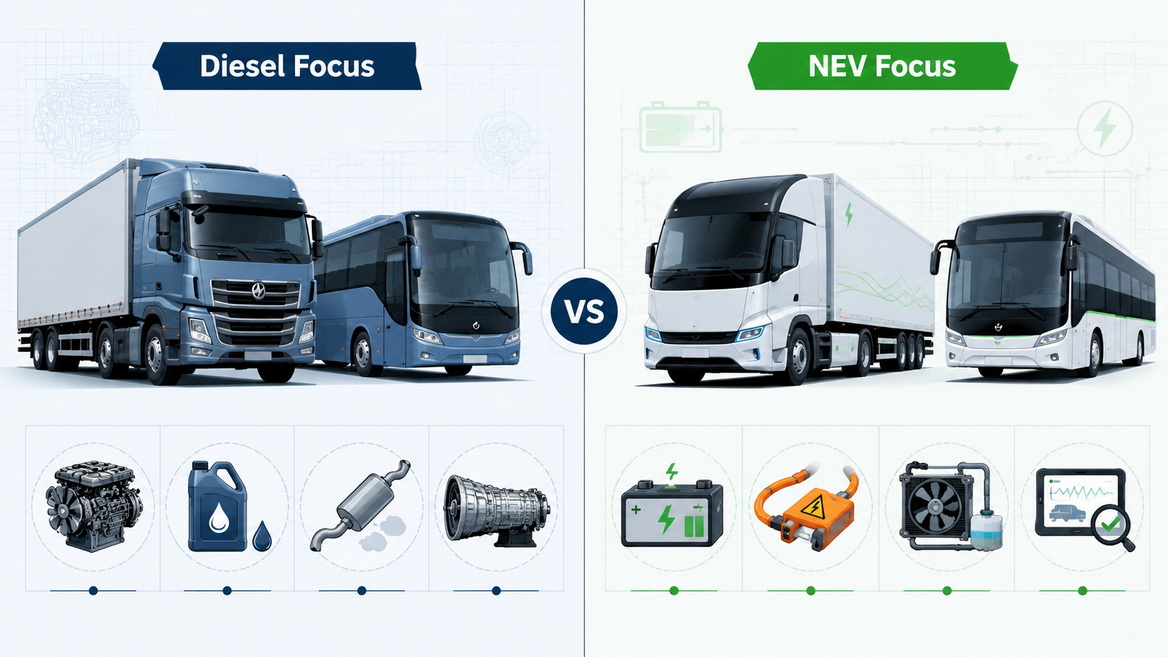
While NEVs generally have fewer moving parts and often lower routine maintenance needs, they introduce new high‑value, high‑voltage components that must be managed with discipline.
- Traction battery systems: State of health, cooling performance, insulation resistance
- Power electronics and cables: Inverters, DC‑DC converters, charging inlets
- Regenerative braking systems: Brake balance, fluid condition, mechanical backup systems
- High‑voltage safety: Isolation checks, interlock integrity, PPE and procedures
Even electric buses still need regular attention to mechanical systems: brakes, power steering, HVAC, suspensions, tires, and bodywork. Operators sometimes underestimate these "old" systems on new vehicles, which can quietly erode safety and ride quality if they are not covered in the PM plan.
Drawing on both traditional fleet practice and NEV‑specific experience, most high‑performing fleets follow similar principles.
- Combine OEM recommendations with your real‑world usage (city vs highway, climate, payloads). - Use both time‑based (e. g., every 3 months) and usage‑based thresholds (e. g., every 10,000 km or charge cycles). - For NEVs, align high‑voltage and battery checks with seasonal temperature changes and heavy‑duty duty cycles.
- Create tiered checklists (A, B, C services) with increasing depth of inspection. - Ensure every technician has the same reference for what to inspect, how to measure, and how to document.
- For multi‑depot operations, enforce uniform standards to avoid "maintenance islands."
- Use mobile or in‑cab apps to record inspection results, photos, and fault codes.
- Connect telematics data (e. g., fault codes, battery data, harsh events) to your PM planning system.
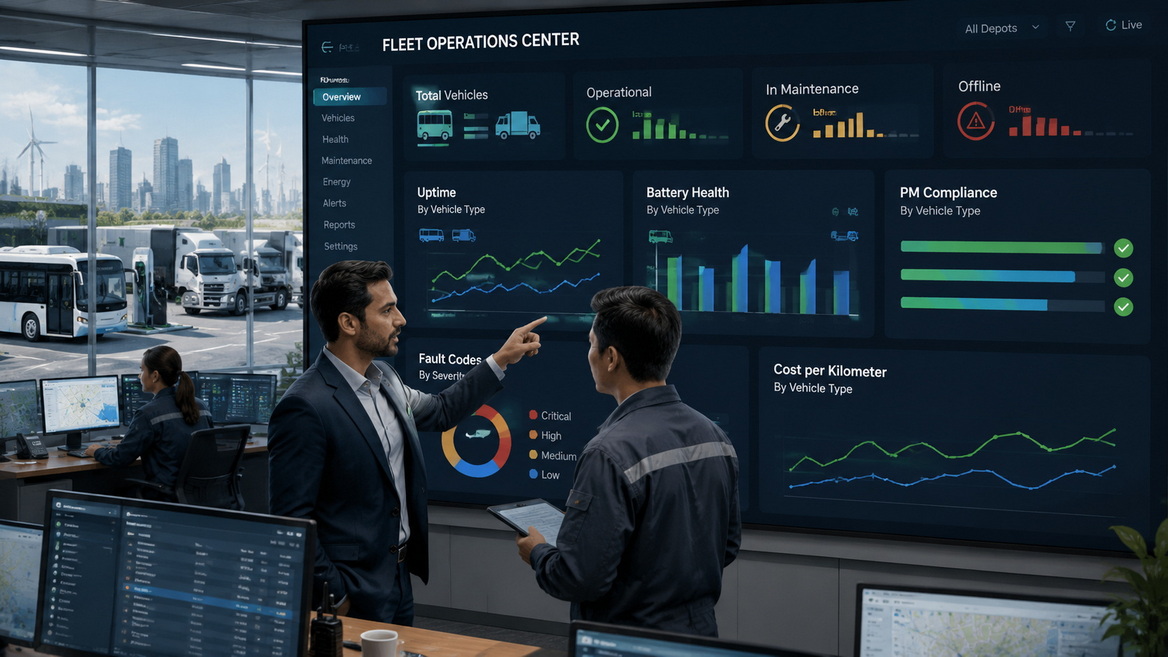
- Build dashboards for uptime, defect trends, and cost per kilometer, and review them monthly.
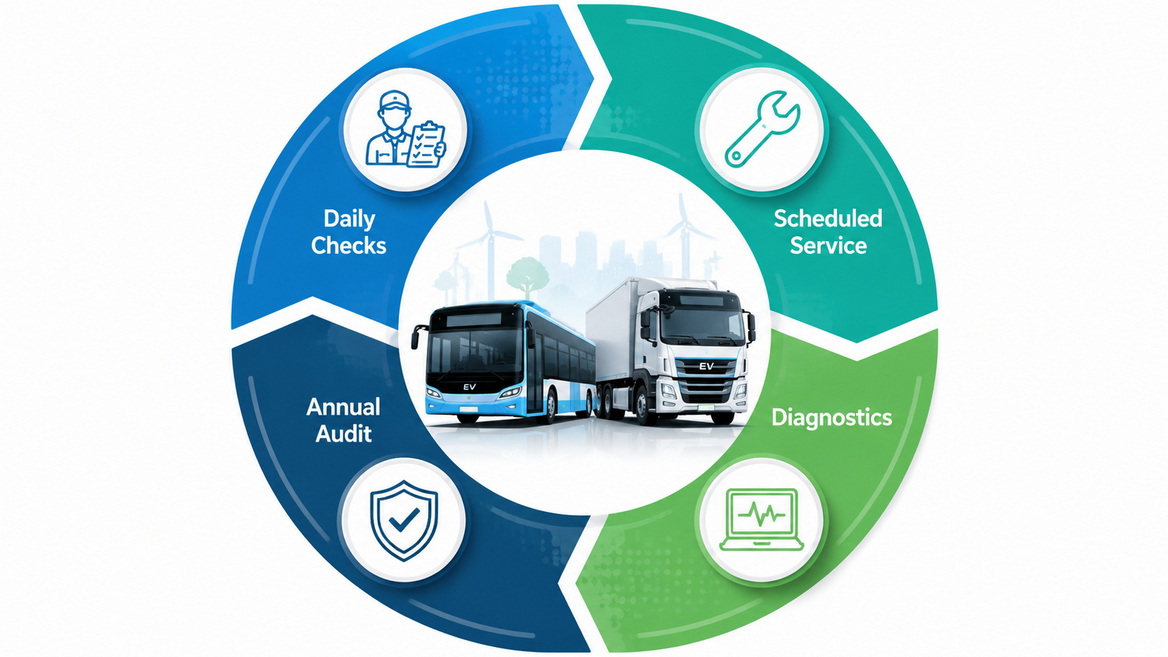
Below is a high‑level PM framework we often recommend to operators of electric buses and heavy trucks importing from China or expanding domestic fleets.
Daily / Pre‑trip checks (driver‑focused) - Exterior damage and door operation
- Tires: visual check, inflation warning indicators
- Lights, mirrors, horn, wipers
- Dashboard warnings and HV fault indicators
- Basic brake feel and regenerative braking response
Every 5,000–10,000 km or monthly (workshop) - Brake pads/shoes, discs/drums, fluid level and condition
- Suspension, steering joints, and chassis fasteners
- Tires: tread depth, uneven wear, alignment and balancing
- Cooling systems (battery and motor): coolant level, leaks, pump operation
- HVAC performance (critical for passenger comfort in buses)
Every 20,000–40,000 km or quarterly/bi‑annually - Detailed HV cable and connector inspection (visual and torque checks where specified)
- Insulation resistance tests following OEM safety procedures
- Battery pack physical inspection: enclosure, mountings, signs of overheating or damage
- Power electronics: inverters, DC‑DC converters, junction boxes, wiring harnesses
- Full chassis inspection and torque verification for structural fasteners
Annually or at OEM‑defined milestones - Comprehensive diagnostic scan and firmware update checks
- Detailed state‑of‑health analysis of traction batteries
- Structural corrosion inspection (especially in coastal or harsh climates)
- Full brake system audit, including parking and emergency brake systems
You can adjust the following example to your own route density and usage patterns.
| Fleet segment | Typical interval baseline |
|---|---|
| Urban electric buses | Daily checks; workshop every 8,000–10,000 km; annual deep inspection thomasbuiltbuses+1 |
| Intercity electric coaches | Daily checks; workshop every 15,000 km; seasonal HV audits heavyvehicleinspection+1 |
| Electric heavy‑duty trucks | Daily checks; workshop every 10,000–12,000 km; quarterly battery/drive checks heavyvehicleinspection+1 |
| Legacy diesel trucks/buses | Daily checks; workshop every 8,000–15,000 km; emissions‑related checks aligned with local standards heavyvehicleinspection+1 |
The strongest fleets I work with share a common trait: maintenance is treated as a cross‑functional discipline, not "something the shop handles in the background."
Key cultural practices:
- Management commits to clear uptime and safety KPIs and reviews them routinely. - Drivers are trained to identify early warning signs and log them in a system, not on paper scraps.
- Mechanics are encouraged to flag recurring issues that may signal design flaws, operating misuse, or vendor quality problems. - Maintenance data is used to refine routes, driving behavior training, and even procurement standards.
World Bank guidance on bus maintenance emphasizes management ownership, data collection, random quality audits, and periodic retraining of mechanics, all of which align closely with what we see in successful NEV fleets today.
NEV fleets live or die by battery performance and lifecycle.
Best‑practice elements include:
- Consistent charging strategies that avoid unnecessary 100% fast‑charging when not needed
- Monitoring of charge/discharge patterns and temperature to detect early degradation
- Scheduled inspections of connectors, cooling systems, and pack mounting hardware
- Regular updates to battery management system (BMS) firmware where applicable
For long‑distance routes, many fleet experts recommend charging fully before departure and running the battery down to a planned depth before recharging, as part of a controlled battery‑care strategy.
Regenerative braking reduces wear on mechanical brakes but does not eliminate the need for maintenance.
Your PM program should:
- Inspect calipers, pads, and drums for stuck or uneven operation
- Check hoses and lines for cracks, moisture, and corrosion
- Replace brake fluid at OEM‑specified intervals to prevent moisture‑related corrosion
NEVs often carry heavy battery packs and deliver high torque, which can accelerate tire wear if not managed.
Add to your PM checklist:
- Use tires rated for EV applications where available
- Check alignment and balancing regularly to avoid uneven wear
- Monitor pressure daily, especially on heavy urban routes and port logistics operations
As a China‑based supplier and exporter of high‑quality NEV buses and heavy trucks, KeyChain designs our export offering around maintenance reality, not just vehicle specifications.
We work with fleet customers to:
- Match vehicles and powertrains to route profiles and local climate
- Provide OEM‑aligned preventive maintenance templates for both NEV and conventional drivetrains
- Share training materials for workshop staff and drivers on high‑voltage safety and best practices
- Coordinate with local partners to build service and parts supply capacity over the full lifecycle
By aligning our vehicle delivery with a structured PM plan, we help operators achieve predictable uptime, control total cost of ownership, and stay compliant with evolving zero‑emission regulations in their markets.
If you operate or plan to operate electric buses, coaches, or heavy‑duty trucks, now is the time to convert preventive maintenance from an informal routine into a documented, data‑driven system.
At KeyChain, our team can help you:
- Select NEV bus and truck configurations aligned with your routes
- Build or refine your preventive maintenance schedule and checklists
- Train staff on NEV‑specific maintenance and safety
Get in touch with KeyChain's fleet specialists today to discuss how we can help you design and implement a preventive maintenance strategy that keeps your NEV buses and heavy trucks compliant, reliable, and profitable over the long term.
Electric buses have fewer moving parts and no engine oil or exhaust after‑treatment, so some maintenance tasks are reduced, but they still require disciplined inspections of batteries, high‑voltage systems, brakes, and tires. A strong PM program remains essential for safety and uptime.
Most fleets align HV inspections with major service intervals (for example, every 20,000–40,000 km or quarterly), following OEM guidelines and local regulations. Additional inspections are recommended after collisions, severe weather events, or repeated fault codes.
Track mileage, fault codes, battery health and temperature patterns, breakdown incidents, repair times, and cost per kilometer, then review trends monthly. Combining telematics data with workshop records helps you refine intervals and identify components that need design or vendor changes.
Documented PM records demonstrate that vehicles are inspected and maintained to required standards, which supports audits, reduces roadside violations, and can lower insurance and legal risk. Structured checklists also reduce the chance of missing critical safety items during inspections.
Ask for detailed maintenance schedules, training materials, recommended tools, parts availability plans, and telematics integration options. Clarify how they support warranty claims and how their PM recommendations align with your local regulations and operating conditions.
1. Penske. "Preventive Maintenance Drives Fleet Compliance and Reliability."
https://www.gopenske.com/blog/lease/preventive-maintenance-drives-fleet-compliance-and-reliability/
2. International Council on Clean Transportation (ICCT). "China's zero‑emission truck and bus market reaches historic high of 230,000 units sold in 2024."
3. AUTOsist. "Preventative Maintenance Guide for Fleet Operations."
https://autosist.com/resources/guides/preventative-maintenance-guide/
4. TrakNova. "Fleet Preventive Maintenance: Checklist & KPIs for Managers." https://www.traknova.com/blog/fleet-preventive-maintenance-checklist-kpis-for-managers
5. Heavy Vehicle Inspection / FMCSA‑focused resource. "Preventive Maintenance Guide."
https://heavyvehicleinspection.com/article/preventive-maintenance-guide
6. World Bank. "Management and Maintenance of Bus Fleets – Guide Note."
https://documents1.worldbank.org/curated/en/212101468153295444/
7. Thomas Built Buses. "Your New Electric Bus: EV Service & Maintenance."
https://thomasbuiltbuses.com/resources/articles/your-new-electric-bus-ev-service-maintenance/
8. RTA Fleet. "Fleet Maintenance Protocols to Maximize EV Life."


