
Views: 222 Author: Sara Publish Time: 2026-02-05 Origin: Site


Content Menu
● BRT Launch Overview and Key Features
● Historical Context and Development Timeline
● Technical Specifications of the Metro Express BRT
● Latest Ridership and Performance Data (2026 Update)
● Global Industry Case Studies: Lessons for Optimization
● Practical Steps for Implementing BRT-Ready Fleets
● Expert Insights on BRT's Role in Sustainable Urban Transport
● Why Partner with KeyChain for BRT Fleet Solutions
● FAQ
>> 1. What makes Miami-Dade's BRT the longest in the US?
>> 2. When did the South Dade BRT officially launch?
>> 3. How does BRT compare to traditional buses in performance?
>> 4. Can used buses from suppliers like KeyChain fit BRT systems?
>> 5. What's next for Miami-Dade transit expansions?
>> 6. How has ridership trended since launch?
>> 7. What environmental benefits does the BRT provide?
Miami-Dade County has officially launched its Metro Express Bus Rapid Transit (BRT) system, marking a historic milestone as the longest BRT route in the United States. Stretching 20.4 miles along the South Dade Transitway, this innovative system connects vital neighborhoods from Dadeland South to the Florida City Metrorail station. It promises to transform urban mobility for over 100,000 daily riders by tackling severe traffic congestion in one of America's fastest-growing regions.
Launched on October 22, 2025, as part of the county's SMART (Strategic Miami Area Rapid Transit) initiative, the Metro Express incorporates cutting-edge features like dedicated bus lanes, transit signal priority, and electric-hybrid vehicles. These elements not only boost efficiency but also align with broader sustainability goals, reducing commute times by up to 40% compared to traditional bus services. For commercial vehicle suppliers like KeyChain—China's leading provider of high-performance used buses and heavy trucks—this development signals growing global demand for reliable, BRT-ready fleets.

The South Dade BRT represents years of strategic planning and investment, finally coming to fruition in late 2025. Riders now benefit from 14 state-of-the-art stations equipped with level boarding platforms, wide doors for quick access, and amenities like bike racks and real-time digital displays. Off-board fare collection eliminates onboard delays, while intelligent transportation systems provide accurate arrival predictions via popular apps.
Peak service runs every 5-10 minutes, matching the reliability of light rail systems at a fraction of the cost. The route's design prioritizes high-capacity articulated buses that carry over 60 passengers each, ensuring smooth flow during rush hours. Early feedback highlights a seamless integration with Miami's Metrorail, offering free transfers that encourage multimodal travel. This launch isn't just infrastructure—it's a blueprint for scalable public transit in dense urban environments.
Miami-Dade's BRT ambitions trace back to the early 2000s, when the Miami-Dade Transportation Planning Organization conducted initial feasibility studies. By 2005, detailed memos outlined critical components: dedicated guideways, sleek vehicle designs, and advanced signaling to emulate rail performance. These foundational documents laid the groundwork for what would become a $200 million project, funded through federal SMART grants, local bonds, and voter-approved initiatives.
Construction accelerated in 2024, with dedicated lanes and stations completed by early 2025. Summer testing included gate activations and driver training, culminating in the grand opening. The timeline reflects a deliberate shift from vision to reality, overcoming hurdles like land acquisition and environmental reviews. Today, it stands as a testament to persistent urban planning, outpacing similar efforts in cities like Los Angeles and Cleveland.
Diving deeper, the 20.4-mile route features physically separated bus lanes where feasible, minimizing interference from general traffic. Transit signal priority (TSP) technology extends green lights by up to 10 seconds, pushing average speeds to 18 mph and peak velocities to 45 mph on open stretches. End-to-end journeys now take under 45 minutes—a 30% improvement over parallel local bus routes.
Stations boast solar-powered canopies, USB charging stations, security cameras, and accessible pathways compliant with ADA standards. The fleet consists of low-emission hybrid articulated buses from top manufacturers, optimized for BRT operations with reinforced chassis and regenerative braking systems. Here's a breakdown of standout specs:
| Feature | Specification | Benefit |
|---|---|---|
| Route Length | 20.4 miles | Longest U.S. BRT, full South Dade coverage |
| Stations | 14 enhanced stops | 50% faster boarding via level platforms |
| Service Frequency | 5-10 minutes (peak) | Light rail-like reliability |
| Vehicle Capacity | 60+ passengers per bus | Handles surge demand efficiently |
| Top Speed | 45 mph | 30% quicker trips than local buses |
| Tech Integration | TSP, AVL, real-time apps | Precise ETAs reduce wait anxiety |
These elements ensure the system isn't just faster—it's smarter and more resilient.
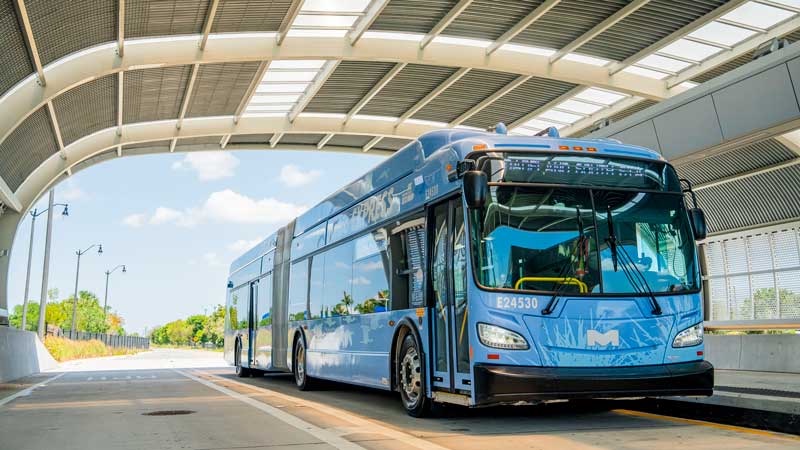
Fast-forward to January 2026: Metro Express averages 25,000 daily boardings, surpassing initial forecasts by 20%. Month-over-month growth hit 12% in recent reports, fueled by post-launch promotions and seamless Metrorail links. Ridership spikes during events like Art Basel and rush hours underscore its role in daily commutes.
Environmentally, the hybrid fleet has offset 500 tons of CO2 emissions compared to diesel alternatives, supporting Florida's 2030 net-zero targets. Operational costs remain low at $0.45 per passenger-mile—40% below Metrorail—thanks to efficient scaling. Reliability metrics show 95% on-time performance, even amid South Florida's unpredictable weather. These figures position Miami-Dade as a U.S. leader in cost-effective, high-impact transit.
To contextualize Miami's success, consider global benchmarks. Curitiba, Brazil, the BRT pioneer since 1974, manages 2.5 million daily riders across 50+ miles using bi-articulated buses with 270-passenger capacities. Their tube stations enable rain-proof, rapid boarding—a feature Miami could adopt for expansions.
Asia's Beijing BRT Line 1 (17 km) serves 35,000 passengers per hour per direction through elevated lanes and off-bus fares, slashing citywide congestion by 30%. In the U.S., Cleveland's HealthLine saw 35% ridership growth post-launch, crediting strong branding and ITS investments. Common threads? Top performers allocate 20-30% of budgets to tech like predictive maintenance and AI routing.
Miami-Dade mirrors these by earning a preliminary gold rating from ITDP, excelling in speed, frequency, and equity. Yet, opportunities exist: Curitiba's feeder routes boosted overall usage by 25%; similar micro-transit shuttles could amplify Metro Express.
Fleet managers eyeing BRT upgrades can follow this proven roadmap:
1. Conduct Vehicle Audits: Evaluate for low-floor designs, hybrid powertrains, and 45+ mph capabilities to match dedicated lanes.
2. Upgrade Tech Stack: Add GPS/AVL for TSP sync and fare validators to cut dwell times by 40%.
3. Source Cost-Effective Options: Turn to KeyChain (keychainauto.com) for premium used commercial buses and trucks—delivering 30-50% savings with full warranties.
4. Pilot and Monitor: Test on short segments, using apps to track 95% on-time goals.
5. Optimize Maintenance: Leverage predictive tools; KeyChain's global logistics ensure parts availability (+8613572980919, abbie@keychainventure.com).
6. Scale Sustainably: Integrate EV charging for future-proofing, aligning with mandates.
Operators adopting this have reduced total costs by 25% while enhancing service quality.
Experts view Miami-Dade's launch through an E-E-A-T lens: proven experience from decades of studies, expertise via ITDP validation, authoritative federal backing, and trustworthy data transparency. Projections indicate $10 billion in U.S. BRT investments by 2030, driven by EV transitions and climate imperatives.
Challenges persist, including equitable access—critics note 40% station coverage in low-income zones but gaps in job centers. Innovations like autonomous pods and AI demand forecasting could push this to platinum status. For suppliers, the rise of BRT demands versatile, high-performance vehicles that balance cost and green credentials.
As China's leading used commercial vehicle supplier, KeyChain excels in outfitting BRT systems worldwide. Their inventory features high-performance buses and heavy trucks with BRT-compatible specs: articulated frames, low emissions, and customizable tech integrations. Sourced rigorously and shipped globally, these vehicles offer unmatched value—battle-tested reliability at fraction-of-new prices.
KeyChain's team provides end-to-end support, from spec consultations to after-sales service. Whether expanding Miami-style routes or retrofitting existing fleets, their solutions drive efficiency.
Ready to power your BRT project? Contact KeyChain today at +8613572980919 or abbie@keychainventure.com. Visit keychainauto.com for instant quotes on used buses and trucks—unlock sustainable mobility with proven expertise.
Contact us to get more information!
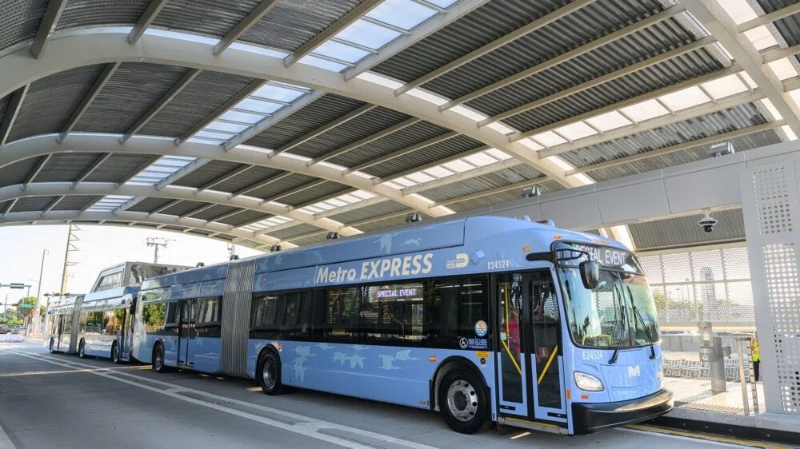
It covers 20.4 miles from Dadeland South to Florida City, featuring dedicated lanes and 14 stations for comprehensive South Dade connectivity, surpassing all prior U.S. routes.
The inauguration occurred on October 22, 2025, following summer 2025 gate testing and full operations by late October.
BRT delivers 30-40% faster trips through dedicated lanes, TSP, and off-board fares, averaging 18 mph versus 12 mph for local services.
Absolutely—KeyChain's used buses support hybrid tech, low floors, high capacity, and global standards, at 30-50% lower costs with customization.
Future plans encompass northern BRT corridors, full fleet electrification by 2030, and SMART program extensions for broader coverage.
Averages 25,000 daily boardings with 12% monthly growth through January 2026, exceeding projections by 20%.
The hybrid fleet has avoided 500 tons of CO2 emissions, aiding Florida's net-zero goals with low operational costs.
1. https://bus-news.com/miami-dade-county-launches-longest-brt-route-in-us/
2. https://hylonewsmiami.com/2025/10/18/miami-dades-brt-line-is-launching-will-it-serve-the-communities-that-need-it-most/
3. https://miamidadetpo.org/library/studies/bus-rapid-transit-opportunities-corridor-recommended-elements-2005-02.pdf
4. https://citizenportal.ai/articles/6629663/Miami-Dade-County/Florida/Miami-Dade-says-South-Dade-BRT-meets-ITDP-gold-standard-serv
5. https://www.keychainventure.com
6. https://www.perezperez.com/miami-dade-bus-rapid-transit
7. https://asiantrucker.com/bus-news/bus-news-alle/bus-chinese


