
Views: 222 Author: Keychain Venture Publish Time: 2026-06-07 Origin: Site


Content Menu
● Understanding hybrid Motability cars
● Types of hybrid on the Motability Scheme
>> Full/self‑charging hybrid (HEV)
● Top 10 hybrid Motability cars (expert overview)
● Hyundai TUCSON – the balanced family SUV
● BYD SEAL U – Chinese plug‑in innovation
● Ford Kuga – tech‑rich family crossover
● Peugeot 308 – efficient, stylish hatch and estate
● Renault Clio E‑Tech – efficient city specialist
● Kia Niro – user‑friendly everyday hybrid
● MG3 Hybrid+ – budget‑conscious practicality
● Peugeot 3008 – premium PHEV family SUV
● Renault Captur E‑Tech – stylish compact crossover
● Ford Grand Tourneo Connect – MPV flexibility with EV range
● Running costs, charging and real‑world usability
● How NEV buses and trucks fit in – KeyChain's perspective
● Choosing the right hybrid Motability car
● Call to action – from Motability to NEV fleets
● Frequently asked questions (FAQ)
>> 1. Do I need a home charger to benefit from a hybrid Motability car?
>> 2. Are plug‑in hybrids really cheaper to run than petrol cars?
>> 3. How long will hybrid technology remain relevant given the rise of full EVs?
>> 4. Can hybrid Motability cars tow caravans or small trailers?
>> 5. How do new energy buses and trucks compare to hybrid cars in technology?
The best hybrid Motability cars today combine low running costs, smooth electrified driving and practical everyday usability, and they sit in a rapidly evolving market shaped by new energy vehicles and plug‑in technology. From my perspective as an industry observer working with Chinese NEV exporters like KeyChain, hybrid Motability customers now benefit from a wider choice than ever, from compact hatchbacks to large MPVs, many with genuine electric‑only range.
In this updated expert guide, I will:
- Explain how hybrid Motability cars work and who they suit best
- Deep‑dive into 10 of the best hybrid Motability cars featured by Evans Halshaw, adding more context, pros and cons, and user‑focused insights
- Introduce fresh sections on running costs, charging strategy and future‑proofing, drawing on global NEV trends and export data
- Show where Chinese new energy manufacturers and suppliers like KeyChain fit into this landscape, especially for fleet and bus buyers
Along the way I'll highlight where to use visuals, data tables and CTAs to maximise UX and SEO performance.
Hybrid Motability cars combine a combustion engine with at least one electric motor and a battery, enabling them to drive more efficiently than a purely petrol or diesel car. Depending on the hybrid type, the battery can be charged either by the engine and braking (self‑charging) or by plugging into an external charger (PHEV).
From a Motability user's perspective, hybrids offer:
- Lower emissions and better fuel economy than traditional petrol or diesel cars, especially in stop‑start town driving.
- A familiar driving feel with no range anxiety, because the engine is always there when the battery is depleted.
- Access to many body styles (small hatchbacks, compact SUVs, MPVs) and advance payments at different budgets, depending on model and trim.
For fleet operators and public transport buyers, this same technology underpins many new energy buses and heavy trucks, where plug‑in hybrids and range‑extended EVs are used to reduce fuel bills and urban emissions.
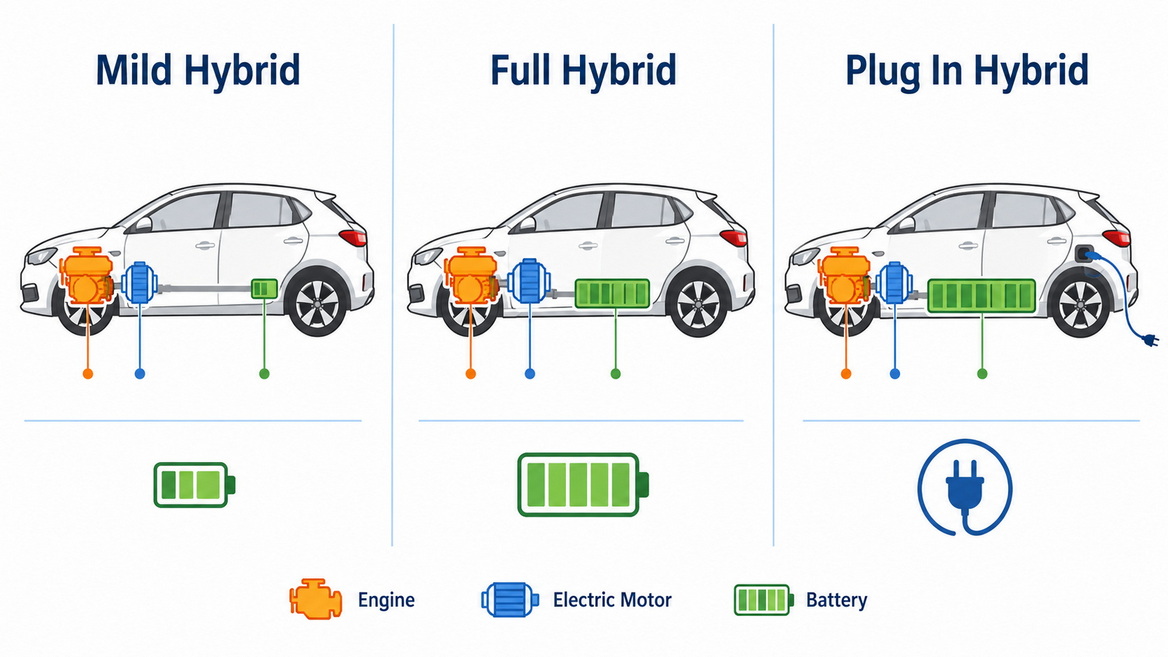
From an engineering and UX perspective, Motability hybrids fall into three broad categories.
Mild hybrids use a small electric motor to assist the engine rather than drive the wheels on their own. These systems offer modest efficiency gains, smoother stop‑start operation and slightly improved performance, but they do not provide electric‑only driving.
Full hybrids can move the car using the electric motor alone at low speeds, particularly in city traffic, before the engine joins in. They never need to be plugged in, as the battery is charged by the engine and regenerative braking, making them ideal for Motability customers who cannot install home chargers or don't want to think about public charging.
Plug‑in hybrids have larger batteries and more powerful motors, supporting meaningful electric‑only ranges typically between 30 and 80 miles. When charged regularly, they can cover most daily journeys on electricity alone, while still relying on the engine for long trips.
From a usability perspective, PHEVs work best if you:
1. Have off‑street parking or reliable access to workplace/public chargers.
2. Are disciplined about plugging in most days.
3. Want to balance zero‑emission commuting with long‑distance flexibility.
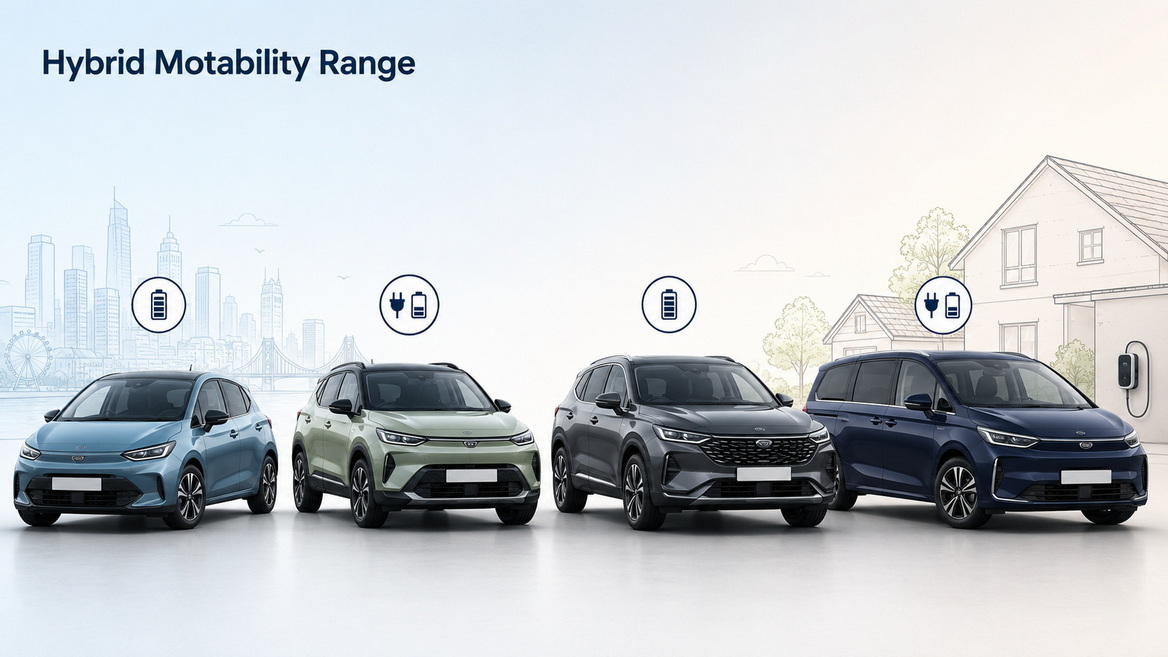
The original Evans Halshaw article highlights 10 hybrid Motability models covering hatchbacks, SUVs and a flexible MPV. Below is an enhanced overview with user‑centric pros, cons and context.
| Model | Hybrid type | Key strengths (expert view) |
|---|---|---|
| Hyundai TUCSON | Full hybrid / PHEV | Strong all‑round SUV, good range and safety tech. |
| BYD SEAL U | PHEV | Long electric range, modern Chinese NEV tech. |
| Ford Kuga | Full hybrid / PHEV | Family‑friendly, refined and practical. |
| Peugeot 308 | PHEV | Stylish, efficient, tech‑rich hatch/estate. |
| Renault Clio E‑Tech | Full hybrid | Super‑efficient city car, easy to live with. |
| Kia Niro | Full hybrid / PHEV | Compact SUV, very user‑friendly. |
| MG3 Hybrid+ | Full hybrid | Budget‑friendly hatch with decent space. |
| Peugeot 3008 | PHEV | Premium‑feeling SUV with strong EV range. |
| Renault Captur E‑Tech | Full hybrid | Stylish, efficient compact crossover. |
| Ford Grand Tourneo | PHEV | MPV practicality and up to 73 miles EV range. |
The Hyundai TUCSON is offered on the Motability Scheme as both a full hybrid and a plug‑in hybrid, giving users a clear choice between convenience and maximum EV miles. The PHEV version delivers an electric range of up to 43 miles, enough for many daily commutes and errands without burning fuel.
From a UX standpoint:
- High seating and wide‑opening doors make access easy for users with limited mobility.
- A roomy boot supports everyday gear, shopping and mobility equipment.
- Even entry‑level trims include a 12.3‑inch infotainment screen, climate control and advanced safety tech such as Lane Keeping Assist and Autonomous Emergency Braking.
For Motability customers who expect mixed driving (city and motorway) and want a modern, comfortable SUV with strong safety credentials, the TUCSON is a compelling option.
The BYD SEAL U is one of the more recent PHEV additions to the Motability Scheme, and it showcases how far Chinese NEV engineering has come. With an electric range of up to 78 miles, it delivers one of the longest EV‑only distances in its class.
Key user‑centric points:
- A bright interior with large doors and a flat rear floor improves entry, exit and rear legroom.
- The 425‑litre boot offers practical depth and width for mobility aids or larger items.
- Even base trims offer large infotainment screens, climate control and driver assistance systems, matching European rivals on equipment.
From an export perspective, Chinese brands like BYD are playing a major role in global NEV growth: by 2025, Chinese EV exports had risen to around 2.5 million vehicles, with new‑energy vehicles making up more than half of China's auto exports by April 2026. For Motability customers, this translates into more choice and better value as competition intensifies.
The Ford Kuga remains a popular Motability choice because it balances space, comfort and technology. Available as both a full hybrid and a PHEV, it offers up to 41 miles of electric driving in its plug‑in form before the petrol engine steps in.
User‑oriented advantages include:
- A high driving position and wide‑opening doors for easier access.
- Seating for five adults and up to 536 litres of boot space, enough for mobility equipment or bulky items.
- Ford's SYNC infotainment system, adaptive cruise control and comprehensive safety features even at lower trims.
For Motability drivers who value familiar brand support, strong dealer networks and mature tech, the Kuga remains a safe bet.
The Peugeot 308 PHEV stands out for its combination of elegant design, high‑tech interior and practical body options. Its electric‑only range of up to 49 miles enables many short journeys to be completed with zero tailpipe emissions when charged regularly.
Practical highlights:
- A 361‑litre boot in the hatchback, expanding to 1,271 litres with seats folded; the estate version offers 467 litres rising to 1,483 litres.
- Peugeot's i‑Cockpit layout, featuring a compact steering wheel and digital driver display, comes as standard.
- Even entry models include climate control, touchscreen infotainment and a robust safety suite.
This is a smart choice for Motability users who want a more compact footprint than an SUV but still need versatile cargo space and modern tech.
The Renault Clio E‑Tech full hybrid brings traditional Clio strengths (compact size, agility, affordability) together with impressive efficiency of up to 67.3mpg (WLTP). Because it's a self‑charging hybrid, there is no need to plug in, which reduces complexity for users.
UX and comfort advantages include:
- Smooth, quiet operation in urban driving, as the car can run on electric power at low speeds.
- Standard tech such as Apple CarPlay, Android Auto and a 9.3‑inch touchscreen.
- A familiar, proven platform that many drivers find easy to adapt to.
For Motability customers whose journeys are mainly short city or suburban trips, the Clio E‑Tech offers a blend of low fuel bills, compact size and modern connectivity.
The Kia Niro is designed for drivers who want a compact SUV with simple ergonomics and low running costs. Available as both a full hybrid and a PHEV with up to 40 miles of electric‑only range, it can be tailored to different charging habits.
Key usability features:
- Slightly raised seating position and wide‑opening doors for easier access.
- A practical boot that accommodates shopping, pushchairs or mobility aids without awkward lifting.
- Standard features such as Apple CarPlay, Android Auto, climate control and a comprehensive safety package.
For many Motability users, especially those who share the car with family members, the Niro's clear controls and predictable driving feel make it a low‑stress choice.
The MG3 Hybrid+ brings full‑hybrid technology into the smaller hatchback segment at a relatively low cost. With fuel economy around 64mpg, it appeals to budget‑focused drivers who still want modern efficiency.
Key points:
- A 293‑litre boot that expands to 983 litres with the rear seats down, enough for everyday needs.
- A self‑charging hybrid system that switches automatically between petrol and electric power.
- Straightforward controls, clear infotainment and the essential safety features required for peace of mind.
This is a good fit for Motability users who prioritise low advance payments and simple ownership, and who drive mostly in and around town.
The Peugeot 3008 PHEV is aimed at drivers who want style, comfort and a more premium cabin. Its plug‑in system delivers up to 55 miles of electric‑only range, enabling most local trips to be made without fuel when charged properly.
Advantages from both comfort and performance lenses:
- A 588‑litre boot and generous passenger space, with some versions offering an automatic tailgate.
- Combined petrol‑electric output of around 222bhp, delivering strong yet smooth performance.
- Standard kit that includes a clear infotainment display, dual‑zone climate control and advanced driver assistance systems.
This model suits Motability customers looking for a more upmarket feel without giving up practicality or electric usability.
The Renault Captur E‑Tech Hybrid delivers a smooth full‑hybrid drive with combined fuel economy of up to 60.1mpg. Like other full hybrids, it does not need to be plugged in, making it easy to run for users without charging access.
Feature highlights:
- A stylish body with a comfortable, efficient powertrain.
- Standard equipment such as rear parking sensors, hands‑free key card and advanced multimedia.
- Higher trims (esprit Alpine) adding features like adaptive cruise control, two‑tone paint and heated steering wheel.
For Motability drivers who want a fashionable yet functional compact crossover, the Captur is a well‑rounded option.
The Ford Grand Tourneo Connect PHEV stands out because it combines MPV practicality with plug‑in electric capability. With an electric‑only range of up to 73 miles, it offers one of the highest EV ranges among Motability PHEVs.
From an accessibility and usability perspective:
- Huge sliding side doors and a tall roofline support easy access and generous headroom.
- Flexible seating for up to seven people or a large flat load area when seats are folded.
- Standard features such as a user‑friendly infotainment system, climate control and multiple driver‑assistance systems.
This is particularly attractive for Motability users who regularly carry multiple passengers or mobility equipment, or who use their vehicle in a multi‑role way (family, work, transport).
Even among Motability customers, running costs and charging convenience are often the deciding factors when choosing between full hybrids and PHEVs.
Key considerations:
- Fuel economy: Full hybrids like the Renault Clio E‑Tech and Captur E‑Tech can achieve over 60mpg, especially in mixed city driving.
- Electric‑only range: PHEVs such as the BYD SEAL U and Ford Grand Tourneo Connect deliver between 70–80 miles of EV range, which significantly reduces fuel use if you charge consistently.
- Charging time: Many PHEVs can be fully charged in around two hours on a home wallbox and often reach 80 percent in less than an hour on faster public chargers.
For many users, a pragmatic strategy is to:
1. Use EV mode for daily urban driving.
2. Let the car operate in hybrid mode for long trips.
3. Monitor energy usage via the infotainment system to refine habits over time.
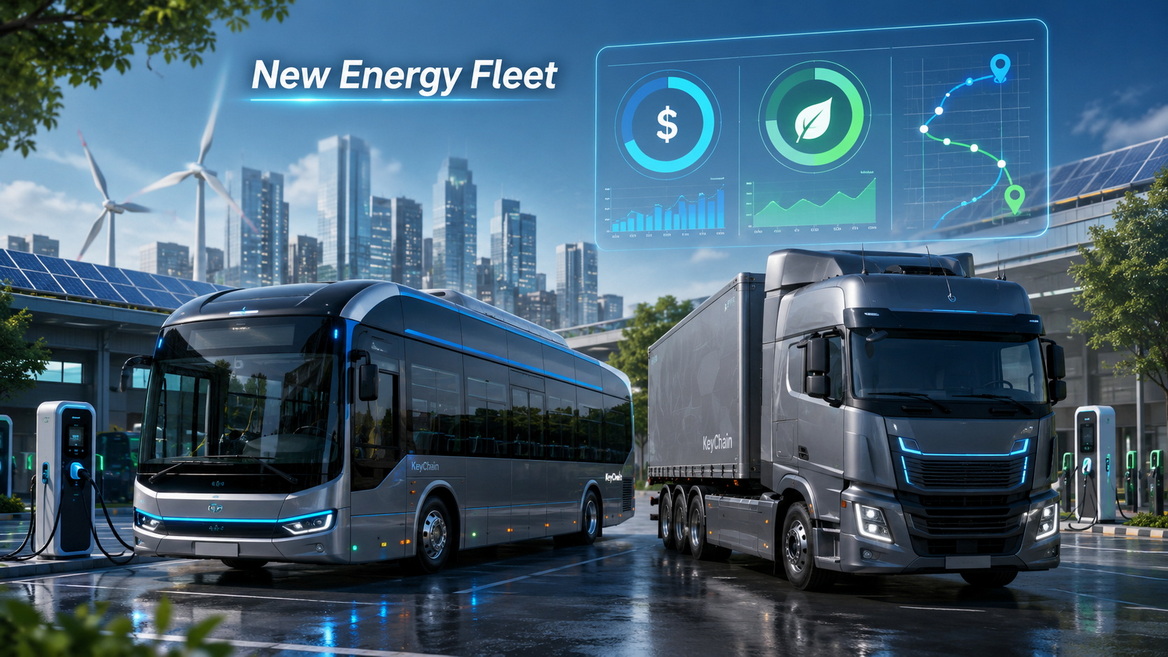
While this article focuses on Motability passenger cars, the same electrification trends strongly influence buses and heavy trucks, especially in Europe, Latin America and Asia. Chinese new energy vehicle exports have grown rapidly, with EV exports increasing by over 1,000 percent between 2018 and 2023, reaching nearly 1.6 million units and making China one of the top global exporters.
As a Chinese supplier and exporter of new energy buses, heavy‑duty trucks and commercial NEVs, KeyChain leverages this ecosystem to:
- Provide high‑performance, low‑emission bus and truck solutions tailored to fleet and public transport operators.
- Offer plug‑in hybrid and pure‑electric platforms that mirror the technology found in advanced PHEV passenger cars, but optimised for payload and duty cycles.
- Support international buyers with export, after‑sales and custom configuration services, aligning with evolving emissions regulations and urban low‑emission zones.
For fleet managers already familiar with hybrid Motability cars in their personal lives, migrating to NEV buses and heavy trucks is often a natural next step, as the operational logic—charging, route planning, regenerative braking—is similar, just scaled up.
From both a consumer and expert perspective, your ideal hybrid Motability car depends on a few core factors.
1. Daily driving pattern
- Mostly short urban trips: self‑charging hybrids like the Clio E‑Tech, Captur E‑Tech or MG3 Hybrid+ keep usage simple.
- Mixed city and longer journeys with home charging: PHEVs like the Hyundai TUCSON, Peugeot 308, Peugeot 3008 or BYD SEAL U unlock maximum savings.
2. Space and accessibility needs
- Need easy access and load space for mobility aids: SUVs like the Kia Niro, Hyundai TUCSON and the Ford Kuga are strong candidates.
- Need seven seats or maximum cargo flexibility: the Ford Grand Tourneo Connect stands out.
3. Technology and comfort expectations
- Prioritise advanced safety and infotainment: Peugeot's i‑Cockpit, Ford's SYNC and Hyundai's large infotainment systems all deliver strong experiences.
- Prefer a more premium feel: the Peugeot 3008 and certain trims of the Kuga and TUCSON offer higher‑end interiors.
If you are a Motability customer, the next logical step after reading this guide is to book a test drive of at least two different hybrid types (full hybrid vs PHEV) to feel the difference in real‑world driving.
For fleet, public transport or B2B buyers interested in scaling the same technology to buses and heavy trucks, you can:
- Explore how Chinese NEV platforms from suppliers like KeyChain can be tailored to your routes, payload needs and local regulations.
- Request TCO (total cost of ownership) comparisons between diesel, hybrid and full‑electric buses or trucks based on your operating profile.
Contact our specialist team to compare Motability‑style hybrid benefits with full‑scale bus and truck solutions from KeyChain's new energy portfolio.
You do not need a home charger for full/self‑charging hybrids, as they recharge through the engine and regenerative braking. Plug‑in hybrids deliver their best fuel savings with regular charging, ideally via a home wallbox or workplace charging point.
When charged consistently and used primarily on short to medium journeys, plug‑in hybrids can significantly cut fuel use and running costs compared with equivalent petrol models. However, if you rarely plug them in, they behave more like heavier petrol cars and the cost advantage shrinks.
Global NEV trends show rapid growth in both hybrids and full EVs, with Chinese exports and European adoption rising in parallel. Hybrids are likely to remain a key transition technology for drivers who lack reliable charging or who regularly travel long distances.
Some hybrid SUVs such as the Hyundai TUCSON and Ford Kuga offer competitive towing capacities, but limits vary by powertrain and trim. Always check the specific braked towing capacity and confirm with your dealer or Motability specialist before committing.
New energy buses and heavy trucks often use similar components—electric motors, high‑capacity batteries and plug‑in charging systems—but are engineered for higher payload and duty cycles. For fleet operators, the main differences are in charging infrastructure, route planning and total cost of ownership, which require more detailed analysis.


