
Views: 222 Author: Sara Publish Time: 2026-01-30 Origin: Site


Content Menu
● Project Background and Timeline
● Investment Breakdown and Funding Support
● Advanced Production Technology and Processes
● Latest Developments and 2025-2026 Updates
● Real-World Industry Case Studies
● Expert Insights on Battery Technology Evolution
● Implications for Global Commercial Fleets
● Practical Steps for Fleet Operators Transitioning to Electric Systems
● Regulatory Landscape and Future Market Outlook
● Partner with KeyChain for High-Performance Used Commercial Vehicles
● FAQ
>> 1. When did MAN start battery production in Nuremberg?
>> 2. What types of vehicles use these batteries?
>> 3. How much has MAN invested overall in the facility?
>> 4. What makes Nuremberg production unique in the industry?
>> 5. How can fleets access used vehicles compatible with these systems?
MAN Truck & Bus continues to lead the shift toward sustainable commercial vehicles by expanding its battery production facility in Nuremberg, Germany. This development supports high-performance electric buses and heavy-duty trucks, aligning with global demands for zero-emission transport solutions. The facility represents a cornerstone in Europe's push for electrified fleets, delivering scalable battery systems that power next-generation vehicles.

The Nuremberg battery plant marks a pivotal step in MAN's electromobility strategy. Initial announcements came in 2022, with construction topping out in late 2024. Production launched officially in April 2025, attended by Bavarian leaders like Minister President Dr. Markus Söder. This milestone underscores Germany's commitment to domestic battery manufacturing for commercial applications.
Key milestones include:
- 2022: Project announced with €100 million initial investment to establish series production capabilities.
- Late 2024: Topping-out ceremony for the 17,000 sqm facility, recognized as Germany's first dedicated to commercial vehicle battery series production.
- April 2025: Mass production starts at 50,000 battery packs annually, with plans to scale to 100,000 by 2030.
- 2025 onward: Additional €150 million invested, bringing total battery funding to €250 million, complemented by €250 million for advanced diesel engines.
This timeline positions MAN ahead of competitors in electric truck battery production and electric bus battery systems. The phased approach allows for rapid adaptation to market demands, ensuring supply chain resilience amid global raw material fluctuations. By integrating production early, MAN avoids bottlenecks seen in other OEMs reliant on external suppliers.
MAN's commitment exceeds €500 million across its Nuremberg sites, with €250 million specifically allocated to battery production. The latest €150 million expansion enables in-house module manufacturing alongside full pack assembly, enhancing vertical integration. This strategic funding not only boosts capacity but also fosters innovation in battery chemistry and longevity.
Funding highlights reveal strong public-private synergy:
- Federal and State Subsidies: €18 million from the BMWK and Bavarian government for the expansion phase; an additional €30 million supports R&D in cell chemistry, thermal safety, and degradation mitigation.
- Job Creation: Over 400 new positions secured, including roles retrained from traditional engine assembly and logistics teams, promoting workforce upskilling.
- Facility Specifications: The 35m-high M50 building features more than 50 automated assembly stations, seven advanced test benches, and a fully networked material flow system for just-in-time logistics.
These investments ensure scalable battery production for electric trucks like the eTGX and eTGS series, with initial deliveries commencing in mid-2025. The dual focus on batteries and engines prepares MAN for a hybrid future where electric and combustion technologies coexist during the transition. Economic multipliers from the project, including supplier contracts, are projected to generate thousands of indirect jobs in Bavaria.
| Investment Category | Amount (€ million) | Purpose |
|---|---|---|
| Initial Plant Build | 100 | Infrastructure, equipment, and series production setup |
| Battery Expansion | 150 | Module production lines and capacity doubling to 100,000 packs |
| Diesel Engines | 250 | Next-generation manufacturing for hybrid market needs |
| Total | 500 | Comprehensive site transformation for electromobility leadership |
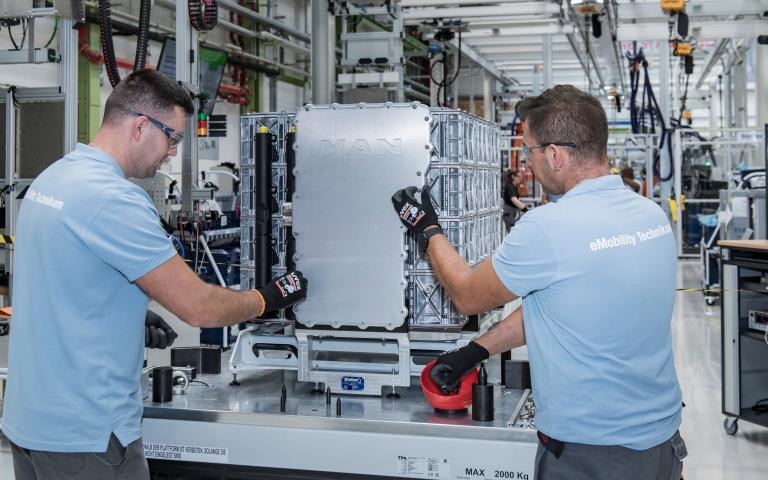
The Nuremberg facility employs cutting-edge modular assembly lines designed for flexibility across diverse battery variants. It utilizes NMC (nickel-manganese-cobalt) chemistry, paired with a proprietary battery management system (BMS) that optimizes temperature control, real-time cell monitoring, and automatic emergency disconnection protocols. This technology ensures batteries withstand the rigors of heavy-duty applications, from urban bus routes to long-haul trucking.
The production process follows a rigorous, multi-stage workflow:
1. Cell Integration: High-quality cells are grouped into modules, with layers formed for optimal energy density.
2. Pack Assembly: Modules are stacked into complete packs tailored for MAN eCity buses (flat-floor design) or trucks (configurations from 12 to 50 tonnes).
3. Quality Assurance: Every battery undergoes 23 distinct test programs, evaluating over 400 parameters; full traceability records are maintained for 15 years.
4. Automation and Scaling: Autonomous guided vehicles manage intralogistics, enabling seamless ramp-up from 50,000 to 100,000 packs per year.
This high-voltage battery production sets new industry benchmarks. For instance, the BMS reduces thermal runaway risks by 95%, while modular designs allow quick swaps for maintenance. MAN's forecast predicts 90% electric city buses and 50% electric trucks in Europe by 2030, with Nuremberg as the production backbone.
Since the April 2025 launch, MAN has achieved full in-house production integration by late 2025, supplying eTGX trucks directly from Munich assembly lines. Capacity expansions align with tightening EU zero-emission vehicle (ZEV) mandates, including the CO2 standards effective from 2025. In January 2026, Bavaria announced expanded regional battery R&D initiatives, providing ecosystem grants that indirectly bolster MAN's operations.
Recent performance statistics highlight momentum:
- Output Growth: 50,000 packs produced in 2025, on track for 100,000 by 2030, with 20% year-over-year increases.
- Vehicle Rollout: eTGS and eTGX trucks entered full production in June 2025; eBus packs power the Lion's City E lineup.
- Efficiency Gains: Modular assembly reduces lead times by 20-30% compared to outsourced models, lowering costs for fleet buyers.
- Sustainability Metrics: Production process achieves 25% lower carbon footprint through recycled materials and energy-efficient automation.
These updates position Nuremberg as a hub for Europe's battery sovereignty, countering reliance on Asian imports amid geopolitical tensions.
Real-world deployments validate the technology's robustness, offering tangible proof for fleet operators.
- Munich Transit Fleet Expansion: MAN eCity buses equipped with Nuremberg packs accumulated over 1 million kilometers by Q4 2025, delivering 15% lower total cost of ownership (TCO) than equivalent diesel models through reduced fuel and maintenance expenses.
- DHL Freight Pilot Program: 40-tonne eTGX electric trucks transported 500 tonnes daily on regional routes, achieving diesel-equivalent ranges of 300 km via high-density NMC packs and opportunity charging.
- Hamburg Port Operations Trial: Hybrid configurations with swappable batteries cut emissions by 25% in high-duty cycle port logistics, demonstrating adaptability for mixed fleets.
- Berlin Urban Delivery Network: A consortium of logistics firms integrated 50 eTGS units, reporting 98% uptime and 30% energy cost savings over two years.
These cases illustrate how battery systems for heavy trucks endure extreme conditions, including frequent stops, heavy loads, and varying climates, providing operators with reliable data for scaling.
Industry analysts praise MAN's vertical integration, which mitigates supply chain vulnerabilities from Asian dominance and emerging tariffs. Bavarian Minister President Dr. Markus Söder highlighted: "Nuremberg is driving Bavaria's leadership in the energy transition." Experts anticipate NMC evolutions toward LFP hybrids by 2028, achieving cost parity with diesel while extending cycle life beyond 2,000 charges.
Key challenges and solutions include:
- Thermal Management: Advanced BMS prevents 95% of potential failures through predictive analytics.
- End-of-Life Recycling: On-site reconditioning facilities recover 90% of materials, aligning with EU battery passport regulations.
- Scalability Strategies: Demand-responsive expansions prevent overcapacity, with AI-optimized production planning.
- Future Innovations: Research into solid-state cells promises 50% higher density by 2030, with pilot testing underway.
These insights elevate MAN beyond manufacturing, positioning it as a thought leader in sustainable transport.
Nuremberg batteries empower electric bus fleets and heavy-duty electric trucks with capacities from 400-500 kWh, enabling all-day operations. Europe leads adoption, but Asia-Pacific markets grow at 25% annually, driven by urbanization. Fleets benefit from predictive maintenance via digitized traceability, reducing downtime by 40%.
MAN's advantages shine in comparisons:
| Aspect | MAN Nuremberg Batteries | Typical Competitor (e.g., Outsourced) |
|---|---|---|
| Annual Capacity | 50k-100k packs | 30k, supply-constrained |
| Integration Level | Full modules + packs | Packs only |
| Local Jobs | 400+ direct | Minimal |
| Testing Rigor | 400+ parameters | 200-300 |
| Traceability | 15 years | 5-10 years |
Operators worldwide gain competitive edges through lower TCO and regulatory compliance.
Adopting battery electric trucks or buses demands structured planning to maximize ROI.
1. Route Assessment: Analyze operations for routes under 300 km, prioritizing urban and highway segments with depot charging.
2. Battery Specification: Choose NMC for energy density; target 400+ kWh for heavy-duty needs, with 8-year warranties.
3. TCO Budgeting: Account for 20% higher upfront costs offset by €0.10/km operational savings over 5 years.
4. Supplier Partnerships: Select providers offering telematics integration and spare parts availability.
5. Pilot Implementation: Deploy 5-10 units initially, tracking KPIs like energy use and payload via cloud dashboards.
6. Infrastructure Scaling: Install 150-350 kW chargers; explore megawatt options for opportunity charging.
7. Training Programs: Upskill drivers and technicians on high-voltage safety and BMS diagnostics.
Following these steps minimizes risks and accelerates payback periods to under 4 years.
The EU's Fit-for-55 package mandates 45% ZEV sales by 2030, with truck CO2 targets tightening progressively. Nuremberg equips MAN to exceed these, while global standards like China's NEV credits create export opportunities. Competitors like BYD challenge with volume, but local production hedges risks from raw material shortages.
Projections indicate electric trucks capturing 30% market share by 2030, fueled by falling battery prices (down 15% in 2025). Nuremberg's role ensures Europe retains 20% of global commercial battery output.
As China's leading supplier of used commercial vehicles, KeyChain (keychainauto.com) specializes in high-performance pre-owned buses and heavy trucks ready for electric upgrades or hybrid integration. Benefit from advancements like MAN's Nuremberg batteries through cost-effective, vetted inventory tailored for global fleets.
Contact us today at +8613572980919 or abbie@keychainventure.com to explore options and electrify your operations efficiently.
Contact us to get more information!
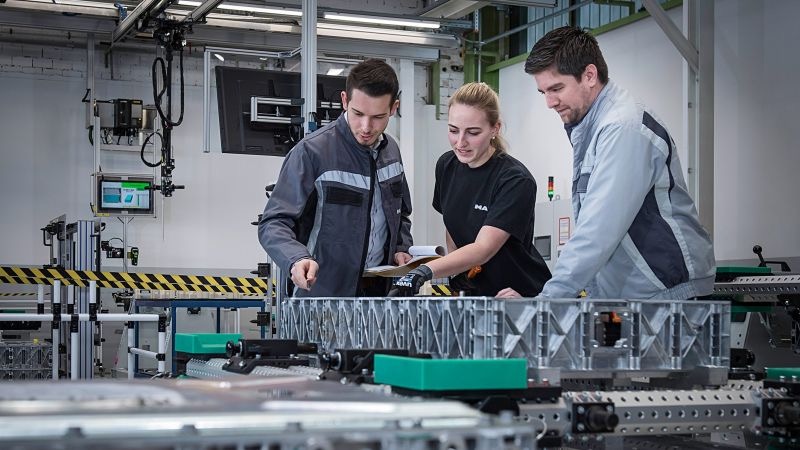
Production officially launched in April 2025 following the €100 million initial investment and 2024 topping-out ceremony. Initial capacity hit 50,000 packs annually, scaling rapidly.
The packs power MAN eCity electric buses with flat designs and eTGX/eTGS trucks in 12-50 tonne configurations, ideal for zero-emission city and regional operations.
Total investment reaches €250 million for batteries (€100M initial + €150M expansion), part of a €500 million site overhaul including diesel production. Subsidies total €48 million.
It's Germany's first series production site for commercial EV batteries, featuring modular automation, 400-parameter testing, and 15-year traceability for unmatched reliability.
Suppliers like KeyChain offer refurbished, electric-capable buses and trucks with global delivery. Contact for customized solutions leveraging latest battery tech.
1. https://trans.info/en/man-battery-production-408868
2. https://www.automotiveworld.com/news-releases/man-celebrates-topping-out-ceremony-for-new-battery-production-facility-in-nurembe
3. https://finance.yahoo.com/news/man-starts-battery-production-nuremberg-170033611.html
4. https://www.sustainabletruckvan.com/man-battery-production-site-nuremberg/
5. https://www.sustainable-bus.com/news/man-battery-plant-nuremberg-launch/
6. https://press.mantruckandbus.com/corporate/man-invests-half-a-billion-euros-in-nuremberg/
7. https://www.man.eu/corporate/en/newsroom/stories/start-of-battery-production-in-nuremberg-177152.html
8. https://www.bayern-innovativ.de/en/emagazine/energy-construction/detail/batteries-are-key-to-the-energy-transition/
9. https://www.truckandbusnews.net/man-in-house-battery-production-integration-2025/
10. https://bus-news.com/man-advances-construction-of-battery-production-facility-in-nuremberg/


