
Views: 222 Author: Sara Publish Time: 2026-01-19 Origin: Site


Content Menu
● Overview: What is the Ford Expedition?
● Generation 1 (1997–2002): The Original Full-Size SUV
>> Powertrain and Driving Characteristics
● Generation 2 (2003–2006): Major Chassis and Interior Upgrade
>> New Suspension and Driving Improvements
>> Exterior and Interior Refinements
● Generation 3 (2007–2017): Refinement, Safety, and EcoBoost Transition
>> Design and Interior Configuration
>> Powertrain Evolution: From V8 to EcoBoost
>> 2015 Facelift and Technology Upgrades
● Generation 4 (2018–2022): Lightweight Structure, Advanced Tech, and Modern Comfort
>> Trims, Interior, and Technology
>> EcoBoost Power and Performance
● Quick Comparison: Ford Expedition Generations at a Glance
● Practical Buying Tips for Used Ford Expedition (1997–2022)
● Expert Insights: How the Expedition Stayed Competitive
● How a Professional Exporter Can Help You Source Used Ford Expeditions
● Call to Action: Source Your Ford Expedition Today
● FAQ
>> 1. Which Ford Expedition generation is most suitable for family use?
>> 2. Are EcoBoost V6 Expeditions better than older V8 models?
>> 3. How important is the Expedition Max version?
>> 4. Is the first-generation Expedition still a good buy today?
>> 5. What should fleet or business buyers focus on when choosing an Expedition?
The Ford Expedition is one of the longest-standing full-size SUVs in the U.S. market, evolving from a rugged family hauler in the late 1990s to a highly refined, technology-packed three-row SUV by 2022. This guide walks through every generation from 1997 to 2022, highlighting major model-year differences, performance upgrades, design changes, and features to help shoppers understand which Expedition best fits their needs.
Whether you are comparing first-generation V8 models or considering a later EcoBoost-powered version, understanding these changes can make it easier to choose a reliable used Expedition at the right price.

The Ford Expedition is a full-size, body-on-frame SUV introduced for the 1997 model year as the successor to the Ford Bronco. It shares a platform with the Ford F-150 pickup, giving it strong towing capability, generous interior space, and truck-like durability.
Key characteristics across the generations include:
- Three-row seating on most models (two-row on some early configurations)
- Available rear-wheel drive or four-wheel drive
- Strong V8 power in earlier generations and efficient EcoBoost V6 power in later models
- High towing capacity suitable for trailers, boats, or campers
This combination of space, capability, and comfort made the Expedition a popular choice for families, fleets, and outdoor enthusiasts.
The first-generation Expedition (1997–2002) introduced Ford's first five-door, full-size SUV, replacing the three-door Bronco. Its styling closely followed the F-150 of the time, with a boxy body, large grille, and upright stance designed for practicality and off-road confidence.
Inside, early Expeditions typically offered:
- Two-row, five-seat layout standard, with an optional third row upping capacity to eight
- Captain's chairs in the first row, a bench in the second row, and an optional bench in the third row
- Cloth upholstery standard, with leather available on higher trims
- Available dual-zone climate control, power moonroof, heated mirrors, and upgraded audio systems
First-generation models used V8 engines derived from Ford's truck lineup. Powertrains commonly included:
- 4.6-liter V8
- 5.4-liter V8
These engines provided solid torque and towing strength, although fuel economy was modest by modern standards. Ride quality leaned toward truck-like firmness, but the Expedition delivered the robust capability buyers expected from a large SUV of that era.
- Buyers seeking a lower-cost used full-size SUV
- Drivers prioritizing simplicity and proven V8 power
- Owners who do not mind older interior tech and higher fuel consumption
The second-generation Expedition arrived for the 2003 model year with a significant mechanical update: a four-wheel independent long-travel suspension. At the time, this setup was unusual in such a large SUV and was designed to improve ride comfort, handling stability, and off-road capability compared with the solid rear axle of many competitors.
Benefits of this change included:
- Smoother ride over rough surfaces
- More car-like handling for such a large vehicle
- Better wheel articulation for light off-roading
Styling remained clearly related to the F-150 but with sharper details and updated lighting. Designer changes included a revised grille, headlights, and tail lamps, while the body maintained the tall SUV profile.
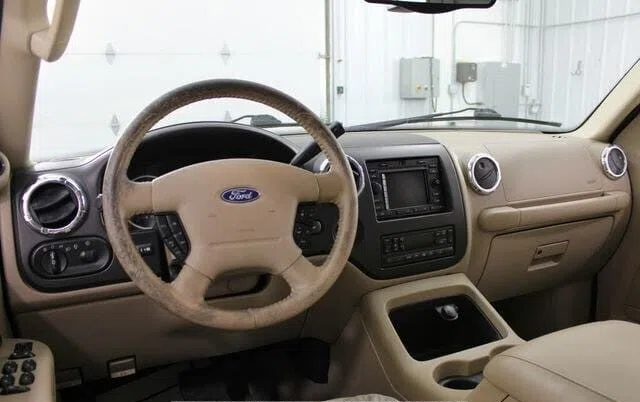
Inside, three-row seating became standard, and Ford focused on improving usability:
- All-new fold-flat third row (manual, with optional PowerFold power-folding system)
- Reduced need to remove seats to expand cargo space
- Available wood-grain trim and leather upholstery on higher trims
The second generation retained similar V8 engine sizes but with power and torque improvements:
- 4.6-liter V8 rated around 232 hp and 291 lb-ft
- 5.4-liter V8 rated around 260 hp and 350 lb-ft
These upgrades helped the Expedition keep pace with growing expectations for performance, towing, and highway merging capability.
The third-generation Expedition, introduced for the 2007 model year, continued to share much of its architecture with the F-150 but brought a more modern design language. Ford adopted its signature three "hollow-bar" grille and more sculpted bodywork, along with sleeker headlamps and updated mirrors with integrated turn signals.
Key interior characteristics included:
- Standard three-row seating with an 8-seat 2-3-3 layout
- Optional second-row captain's chairs, creating a 7-seat configuration with easier access to the third row
- Large cargo volume: about 526 L with all seats up, 1557 L with the third row folded, and 3066 L with both second and third rows folded flat
These dimensions made the Expedition competitive among the largest family SUVs for both passenger comfort and cargo-carrying flexibility.
For much of this generation, Ford offered a 5.4-liter Triton V8 producing around 300 hp and 365 lb-ft of torque, paired with a 6-speed automatic transmission. Rear-wheel drive came standard, with four-wheel drive widely available.
In 2015, Ford introduced a major powertrain shift: the 3.5-liter twin-turbocharged EcoBoost V6 became the only available engine. This modern engine produced approximately 365 hp and 420 lb-ft of torque, offering:
- Stronger low-end torque for towing and acceleration
- Improved fuel efficiency compared with the outgoing V8
- Smoother power delivery thanks to turbocharging and advanced valve timing
This change laid the foundation for the powertrains used in the next generation.
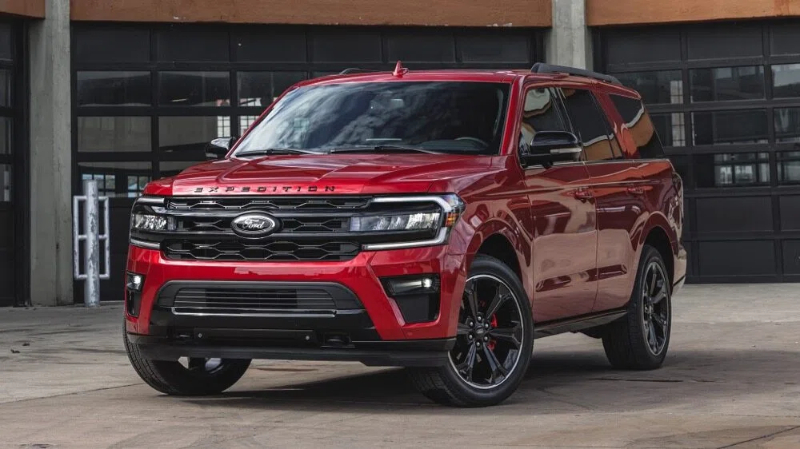
The 2015 refresh brought a more contemporary front end with:
- New three-bar grille with step-stacked bars
- Thinner headlamps
- Revised front bumper with a larger lower air intake and chrome accents
- Updated fog lamps and other trim details
Alongside styling tweaks, Ford also improved interior technology, including infotainment, connectivity, and available driver-assistance features, making later third-generation models notably more appealing to tech-focused buyers.
The fourth-generation Expedition debuted as a 2018 model, using a new platform with extensive aluminum body panels similar to the F-150, aimed at reducing weight and improving efficiency. The design became more upscale and aerodynamic, while still emphasizing the SUV's size and capability.
Available body styles include:
- Standard-wheelbase Expedition
- Long-wheelbase Expedition Max, offering additional cargo space behind the third row
This generation also became more competitive in the global full-size SUV segment, appealing to families, executives, and fleet buyers alike.
Typical trims in this era include XLT, Limited, and Platinum, with various appearance packages and wheel options depending on the market and model year. Inside, the Expedition focused on comfort and digital technology:
- High-quality materials and more refined cabin design
- Large infotainment displays with smartphone integration
- Advanced driver-assistance systems such as adaptive cruise control, lane-keeping assistance, and blind-spot monitoring (availability varies by year and trim)
- Multiple USB ports, power outlets, and rear-seat entertainment options on some trims
Seating remained highly flexible, with spacious second and third rows suitable for adults, especially in the Expedition Max.
Fourth-generation Expeditions use the 3.5-liter twin-turbo EcoBoost V6 as standard. In early years of this generation, typical outputs were around 375 hp and 470 lb-ft of torque, paired with a 10-speed automatic transmission. Higher trims and specific packages could offer slightly higher power ratings, especially in performance-oriented or towing-focused variants.
Benefits of this setup include:
- Strong acceleration despite the vehicle's size
- High towing capacities that rival or exceed many V8 competitors
- Improved fuel economy compared with earlier V8 Expeditions
For shoppers focused on a balance of power, comfort, and efficiency, the 2018–2022 Expedition models represent the most refined and capable versions in this 1997–2022 span.
Below is a simplified look at how key aspects have evolved by generation.
| Generation | Model Years | Main Engines | Key Features | Ideal For |
|---|---|---|---|---|
| Gen 1 | 1997–2002 | 4.6L & 5.4L V8 | First five-door full-size SUV, basic interior, truck-like ride | Budget buyers needing simple V8 power |
| Gen 2 | 2003–2006 | 4.6L & 5.4L V8 | Independent rear suspension, fold-flat third row, better comfort | Families wanting more comfort and cargo flexibility |
| Gen 3 | 2007–2017 | 5.4L V8 → 3.5L EcoBoost V6 | Updated styling, more safety, EcoBoost efficiency in later years | Buyers balancing power with improved efficiency |
| Gen 4 | 2018–2022 | 3.5L EcoBoost V6 | Aluminum-intensive body, advanced tech, high towing, modern cabin | Families and fleets needing maximum space, tech, and refinement |
When shopping for a used Expedition, focusing on model-year differences can help you find the best combination of price, reliability, and features. Consider these practical steps:
1. Define your budget and generation
- Earlier generations (Gen 1–2) tend to be more affordable but offer older safety and infotainment features.
- Gen 3 and especially Gen 4 cost more but deliver better comfort, technology, and efficiency.
2. Assess your towing and passenger needs
- Regular Expeditions are adequate for most families, while Expedition Max is best if you need maximum cargo space behind the third row.
- Check the specific towing package, axle ratio, and cooling equipment if you plan to tow frequently.
3. Check maintenance records
- Look for documented oil changes, transmission service, and any repairs to suspension or 4WD components.
- Later EcoBoost engines benefit from consistent maintenance with the recommended oil and intervals.
4. Inspect common wear points
- Suspension bushings, brakes, and tires can wear more quickly on heavy vehicles.
- Interior electronics (infotainment, power seats, rear climate controls) should be tested thoroughly during a pre-purchase inspection.
5. Consider total cost of ownership
- Fuel, insurance, tires, and maintenance costs are higher than for compact SUVs.
- A well-maintained Expedition, however, can provide long service life and strong resale value in many markets.
From 1997 to 2022, the Expedition faced strong competition from other full-size SUVs but remained relevant through targeted engineering updates. Several key strategies stand out:
- Continuous powertrain modernization: Transitioning from traditional V8s to the 3.5-liter EcoBoost V6 delivered more torque and better fuel economy without sacrificing towing capability.
- Improved ride and comfort: The early adoption of an independent rear suspension in the second generation gave the Expedition a ride and handling advantage over some rivals with solid-axle setups.
- Technology and safety upgrades: Over time, additions such as advanced driver-assistance systems, improved infotainment, and higher-quality interiors kept the Expedition aligned with evolving customer expectations.
These changes help explain why the Expedition remains a strong choice on the used market for large families, commercial fleets, and long-distance travelers alike.
Sourcing large SUVs like the Ford Expedition across borders presents challenges for many international buyers, including vehicle condition verification, model selection, logistics, and after-sales support. Partnering with an experienced commercial and used vehicle supplier significantly reduces procurement risks and saves time.
As China's leading supplier of used commercial vehicles, KeyChain (keychainauto.com) specializes in providing high-performance buses and heavy-duty truck systems to global clients. We can also assist in selecting, procuring, and exporting Ford Expeditions or similar vehicles based on your needs. Our professional team helps with:
- Matching suitable model years and configurations to your use case (e.g., passenger transport, tourism, corporate fleets)
- Vehicle condition assessments, documentation reviews, and export preparation
- Customized shipping plans from China or other supply points to your destination port
If you are equipping projects or fleets with 7-8 seat large SUVs, this service enhances procurement efficiency and vehicle value.
Ready to source used Ford Expeditions or other commercial vehicles in bulk? Contact KeyChain for expert guidance on selecting the right model year and configuration for your fleet:
- Company: KeyChain
- Website: keychainauto.com
- Phone / WhatsApp: +86 135 7298 0919
- Email: abbie@keychainventure.com
Share your intended use (e.g., airport shuttles, tourism, engineering projects, corporate commuting), estimated quantity, budget range, and destination port. Our team will customize a vehicle list and procurement plan to efficiently equip you with high-performance Ford Expedition resources worldwide.
Contact us to get more information!
For most families, the third (2007–2017) and fourth (2018–2022) generations offer the best balance of safety, comfort, and modern technology, especially if you regularly carry six to eight passengers.
EcoBoost V6 models generally deliver more torque, better fuel economy, and stronger towing performance than many earlier V8 versions, though some buyers still prefer the sound and simplicity of a naturally aspirated V8.
If you often travel with all three rows occupied and still need large cargo space, the Expedition Max provides a longer body and more storage behind the third row, making it very useful for families and airport or shuttle services.
First-generation models can be good budget workhorses when well maintained, but they lack many modern safety and comfort features, and fuel consumption is higher than later generations.
Fleet buyers should prioritize reliability, towing needs, passenger capacity, and total cost of ownership, often favoring later third-generation or fourth-generation models for their improved powertrains, safety systems, and comfort on long journeys.
1. https://blog.beforward.jp/car-review/ford-expedition-1997-2022-model-year-differences-and-improvements.html
2. https://carbuzz.com/cars/ford/expedition/generations/
3. https://en.wikipedia.org/wiki/Ford_Expedition
4. https://www.carsdirect.com/ford/expedition/generations
5. https://keychainauto.com


