
Views: 222 Author: Keychain Venture Publish Time: 2026-06-17 Origin: Site


Content Menu
● Why Small New Energy Vehicles Matter in 2026
● Benchmark: What UK "Best Small Car" Lists Get Right (and Miss)
● Key Criteria When Choosing a Small New Energy Vehicle
● Expert Take on 10 Popular Small NEVs (2025–2026)
>> Renault 5 E‑Tech: Retro Design, Modern City EV
>> BYD Dolphin Surf: Chinese City EV Goes Global
>> Citroën e‑C3: Budget‑Friendly Small EV for Town Work
>> Dacia Sandero: Value‑Driven, But Not Fully Electric
>> DS 3: Premium Small Car With Hybrid and EV Options
>> Fiat 500e: Style‑Led City EV
>> Ford Puma: Crossover‑Sized Practicality
>> Hyundai i10: Proven City Car With Low Running Costs
>> Kia Picanto: Ultra‑Compact Yet Surprisingly Practical
>> MG4: Chinese All‑Electric Hatchback With Global Ambitions
● At a Glance: Practical Stats for Key Small NEVs
● How a Chinese NEV Exporter Evaluates Small Cars Differently
● Practical Steps to Choose the Right Small NEV (Fleet & Business Use)
● Where Small NEVs Fit in a Complete NEV Portfolio (Buses, Trucks, Cars)
● Call to Action: Plan Your Next Small NEV Fleet with KeyChain
● Frequently Asked Questions (FAQ)
>> Q1. Are small new energy vehicles reliable enough for daily fleet use?
>> Q2. How much range do I really need in a small city EV?
>> Q4. How do small NEVs compare to hybrids or efficient petrol cars in total cost of ownership?
>> Q5. What infrastructure do I need to support a small NEV fleet?
As a China-based exporter specialising in New Energy Vehicles (NEVs) for buses, heavy-duty trucks and passenger cars, I evaluate small cars very differently from a typical retail buyer or dealership blog. In this guide, I'll combine hands‑on fleet export experience with the latest UK small‑car insights to help you choose the right compact NEV for city driving, business fleets and international procurement.

Small cars are no longer just budget runabouts; in 2026 they sit at the centre of urban mobility, emissions policy and fleet optimisation. City congestion, low‑emission zones and rising fuel costs are pushing both private drivers and fleet managers towards compact NEVs that combine efficiency with usable range and safety.
From our vantage point as an export partner, we see three powerful trends:
- Electrification is now mainstream: In 2026, small electric and hybrid cars regularly top "best small car" lists in Europe and the UK.
- China is driving NEV volume and innovation: New‑energy vehicles now account for more than half of China's auto exports by volume.
- Fleet buyers demand total cost transparency: TCO (total cost of ownership), including charging, uptime and residual values, is replacing simple purchase price as the main decision metric.
For buyers outside China, this means small NEVs are no longer niche experiments but strategic assets for taxis, ride‑hailing, corporate shuttles and last‑mile services.
The Evans Halshaw article "Top 10: Best Small Cars to Buy in the UK for 2025" is a solid consumer‑level overview of small cars such as the Renault 5 E‑Tech, BYD Dolphin Surf, Citroën e‑C3, Dacia Sandero, DS 3, Fiat 500e, Ford Puma, Hyundai i10, Kia Picanto and MG4. It focuses on style, boot space, technology and everyday usability, which are important for private buyers.
However, from an NEV exporter and fleet‑planning perspective, that article has three noticeable gaps:
- No fleet‑oriented TCO lens: It rarely discusses cost per mile, uptime, charging strategy or battery longevity, which are critical in B2B contexts.
- Limited export and sourcing insight: It does not address how these models sit within the broader global NEV supply chain or how Chinese manufacturers are shaping the market.
- Lack of operational case studies: There are no real‑world examples of businesses running small NEVs as part of mixed fleets, which limits its usefulness for decision‑makers.
In the rest of this article, I'll keep the practical detail that works (range, boot space, charging) but reframe it through fleet, export and NEV strategy, and add new sections on global sourcing and TCO that a typical car blog does not cover.
Before looking at specific models, it helps to frame your decision around a short checklist. From our experience supporting both domestic Chinese and international clients, these are the six criteria that matter most for small NEVs:
1. Use case and duty cycle
- Daily mileage (per vehicle)
- Average trip length and idle time
- City‑only vs mixed urban/motorway
2. Range and charging strategy
- Real‑world range vs WLTP or NEDC figures
- Access to AC chargers vs need for DC fast charging
- Overnight depot charging vs public infrastructure
3. Vehicle packaging and practicality
- Boot volume and rear‑seat usability
- Turning circle and ease of parking
- Cabin ergonomics for long hours in the seat
4. Safety and regulatory compliance
- Local crash‑test ratings and safety equipment
- Advanced driver-assistance systems (ADAS) support
- Compliance with local homologation standards
5. Total cost of ownership (TCO)
- Purchase price or lease rate
- Energy cost per 100 km vs fuel equivalents
- Maintenance, parts availability and residual value
6. Supplier reliability and after‑sales support
- Track record in export markets
- Warranty terms on traction batteries and key components
- Capability to support bulk orders and custom configurations
When we evaluate small city EVs for export, we treat range, safety and TCO as non‑negotiable, then optimise around design, brand and specific user preferences.
Below is an expert view on the small cars highlighted in the Evans Halshaw article, but reframed for NEV‑ and fleet‑oriented buyers. Where relevant, I will contrast European and Chinese perspectives.
The Renault 5 E‑Tech pairs a retro‑inspired body with a choice of 40 kWh or 52 kWh batteries, offering around 190 to 248 miles of electric range and rapid charging from 15 to 80 percent in roughly 30 minutes on a 100 kW DC charger. Its 326‑litre boot expands to 1,106 litres, making it more practical than many expect from a compact hatchback.
From a fleet perspective, the mid‑size battery is usually the sweet spot: large enough for daily urban work but small enough to keep weight and cost down. Renault's brand strength in Europe can also help residual values, an important but often under‑discussed factor for business buyers.
The BYD Dolphin Surf, derived from BYD's highly successful Dolphin platform, has a "marine" design language and a 65 kW motor producing 87 bhp, with an electric range of about 200 miles and full charge in about 3.5 hours on AC. With seats folded, it offers up to 1,037 litres of boot space, enough for small appliances, a bicycle or flat‑pack furniture.
From our exporter vantage point, BYD's vertical integration in batteries and power electronics is a major structural advantage. For fleet planners, this often translates into better energy efficiency and robust warranty support, especially when vehicles are deployed at scale in ride‑hailing or car‑sharing programmes.
The Citroën e‑C3 is a compact, tall supermini with a 200‑mile electric range, designed for efficient metropolitan use, tight parking and zero tailpipe emissions. It offers 310 litres of boot space (1,188 litres seats‑down), plus useful tech such as a head‑up display, smartphone dock and safety aids like emergency braking and hill‑start assist.
In procurement conversations, the e‑C3 typically enters as a cost‑conscious city EV option where purchase price and simple urban duty cycles matter more than long‑distance comfort. For small businesses, it can be a logical step away from petrol superminis into the NEV world without overspending on range they don't need.
The Dacia Sandero stands out in the UK primarily for its low purchase price, offering petrol and bi‑fuel engines, a 328‑litre boot and straightforward technology including smartphone docking and an 8‑inch infotainment screen. For buyers still transitioning away from combustion engines, the Sandero can be a low‑risk entry point.
However, from an NEV exporter's standpoint, this is not yet a fully fledged new energy solution, so it mainly interests fleets in markets where EV infrastructure is immature and low capital expenditure is the top priority.
The DS 3 supermini positions itself as a luxurious city car with distinctive styling, a roomy cabin for five, and a 350‑litre boot that grows to 1,050 litres with the rear seats folded. The electric version offers around 215 miles of range with 100 kW DC rapid charging up to 80 percent in about 30 minutes.
For executive and hospitality fleets, DS 3 works as a small but premium NEV, suitable for hotel transfers in dense city cores or brand‑conscious corporate car‑sharing pools. The main trade‑off is a higher per‑unit cost compared to more mainstream Chinese NEVs targeting similar use cases.
The Fiat 500e is a compact, style‑driven city EV with a small 185‑litre boot (550 litres with seats down) and a choice of electric motors that support rapid charging up to 80 percent in about 35 minutes. Its fashion‑forward design and compact footprint make it ideal for dense urban environments and young drivers.
From a fleet perspective, the 500e is best suited for short‑trip, high‑visibility roles such as branded car‑sharing, city‑centre delivery pilots or lifestyle rental fleets, where visual impact matters as much as pure practicality.
The Ford Puma is technically a compact crossover rather than a small hatchback, with petrol, diesel and hybrid options, and a notably large 456‑litre boot that expands to 1,126 litres. It features a 12‑inch infotainment system running SYNC 4 with smartphone integration.
When we model mixed fleets, the Puma often appears as a bridge between small cars and full‑size SUVs, especially for customers who need the flexibility to carry more cargo without stepping up to a larger footprint.
The Hyundai i10 has evolved through three generations into a well‑equipped city car with a 252‑litre boot and a reputation for low running costs. Most i10 models fall into the lowest UK insurance groups, and Hyundai backs them with a 5‑year manufacturer warranty, which makes budgeting more predictable.
Although the i10 is not primarily an NEV, its running‑cost profile and compact size still make it attractive in markets where a full electric transition is gradual. For export customers, we often position similar small combustion or mild‑hybrid cars alongside pure EVs as part of a staged electrification strategy.
The Kia Picanto is a very compact hatchback with five doors as standard, 1.0‑litre engines aimed at low fuel costs, and equipment including hill‑start assist, automatic headlights and, higher up the range, cruise control and smartphone connectivity. Its small footprint makes it particularly easy to park and manoeuvre in crowded city streets.
For fleet managers, the Picanto class of vehicles works well as entry‑level pool cars or training vehicles, with minimal space requirements and straightforward maintenance, though again it is not yet a pure NEV.
The MG4 is MG's first all‑electric hatchback, offering multiple battery and motor combinations from 51 kWh entry‑level packs to higher‑output variants, with ranges roughly between 218 and 239 miles and DC rapid charging from 10 to 80 percent in about 30 minutes. It provides a 363‑litre boot (1,177 litres seats‑down) and a cabin designed to feel spacious for both driver and passengers.
From an export and sourcing standpoint, the MG4 is a flagship example of Chinese NEVs competing head‑on in Europe, blending aggressive pricing with usable range and modern design. For urban fleets, it hits a strong balance of cost, practicality and zero‑emission operation.
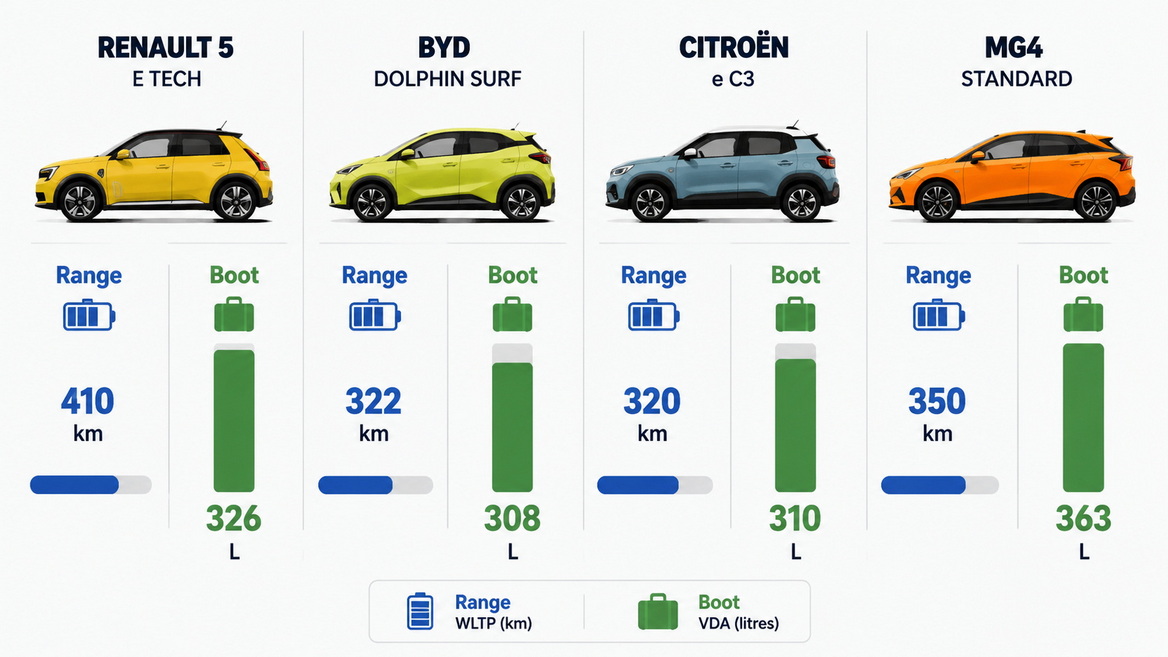
The following table summarises practical information that matters to urban drivers and fleet decision‑makers, based on the source content and typical configurations.
| Model | Powertrain focus | Approx. range (miles) | Boot (litres, seats up) | Notable strengths |
|---|---|---|---|---|
| Renault 5 E‑Tech | Full electric | 190–248 | 326 | Retro design, flexible battery sizes |
| BYD Dolphin Surf | Full electric | ~200 | Up to 1,037 seats‑down | Chinese EV tech, strong value |
| Citroën e‑C3 | Full electric | ~200 | 310 | Budget‑friendly, city‑optimised |
| Dacia Sandero | Petrol / bi‑fuel | Engine‑dependent | 328 | Very low purchase price |
| DS 3 (EV) | Hybrid / EV | ~215 | 350 | Premium feel in small package |
| Fiat 500e | Full electric | Model‑dependent | 185 | Iconic design, ultra‑compact |
| Ford Puma | Petrol / diesel / hybrid | Engine‑dependent | 456 | Big boot, crossover versatility |
| Hyundai i10 | Petrol | Engine‑dependent | 252 | Low insurance groups, 5‑year warranty |
| Kia Picanto | Petrol | Engine‑dependent | Not quoted | Very compact, well equipped |
| MG4 | Full electric | 218–239 | 363 | Competitive Chinese EV in Europe |
From inside the NEV supply chain, we assess small cars not just by brochure specs but by how they perform in real multi‑vehicle fleets across different countries.
Here is how our evaluation typically differs from a consumer‑focused blog:
- Operational profile first, model second
We start from your routes, charging windows and regulatory environment, then shortlist models that fit, rather than starting from brand popularity.
- Battery and thermal management scrutiny
For NEVs, battery chemistry, cooling and software matter as much as simple kWh numbers because they affect degradation and uptime over years of operation.
- Export readiness and compliance
We verify whether a given model has the necessary certifications and after‑sales support in your market, especially for heavy‑duty applications and cross‑border logistics.
- Scalability and parts ecosystem
Fleet deployments need models with robust parts availability and technical documentation, not just attractive launch pricing.
For example, where a standard article might describe the MG4's styling and range, we will also look at how its charging curve behaves on different DC chargers, and what that means for shift scheduling in a ride‑hailing fleet.
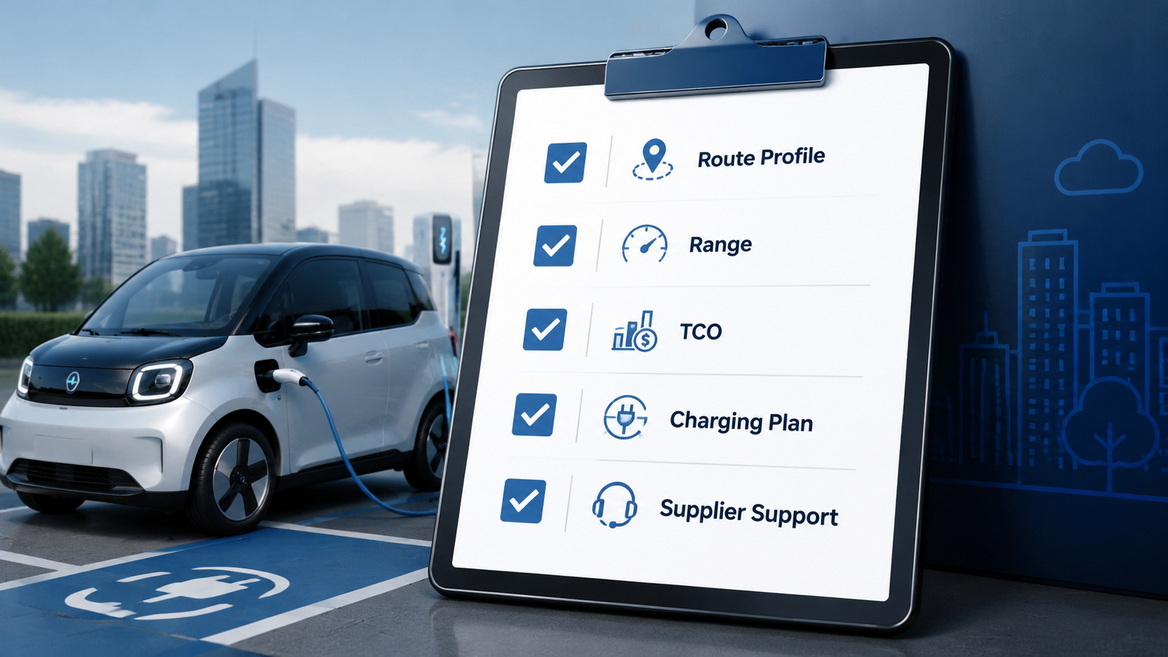
To move from research to decision, I recommend a simple five‑step process that we also use with our own overseas clients:
1. Define your mission profile
- Daily kilometres, route types and load patterns
- Number of stops and typical dwell times for charging or breaks
2. Shortlist 3–5 suitable models
- Mix of local favourites (e. g., Renault 5 E‑Tech, Fiat 500e) and competitive NEVs from Chinese manufacturers such as BYD or MG where available.
- Filter by range, boot space and safety needs.
3. Model total cost of ownership (TCO)
- Include purchase or lease cost, energy (electricity vs fuel), maintenance and potential incentives.
- Compare over at least 5 years to account for battery warranties.
4. Pilot with a limited fleet
- Deploy 2–10 vehicles in real routes for 3–6 months.
- Measure uptime, driver satisfaction, charging availability and unexpected costs.
5. Scale with a trusted NEV partner
- Once a winner emerges, work with a supplier or exporter (such as our KeyChain team) to secure consistent quality, custom configurations and long‑term parts support.
This structured approach ensures that small NEVs become productive assets, not experimental purchases.
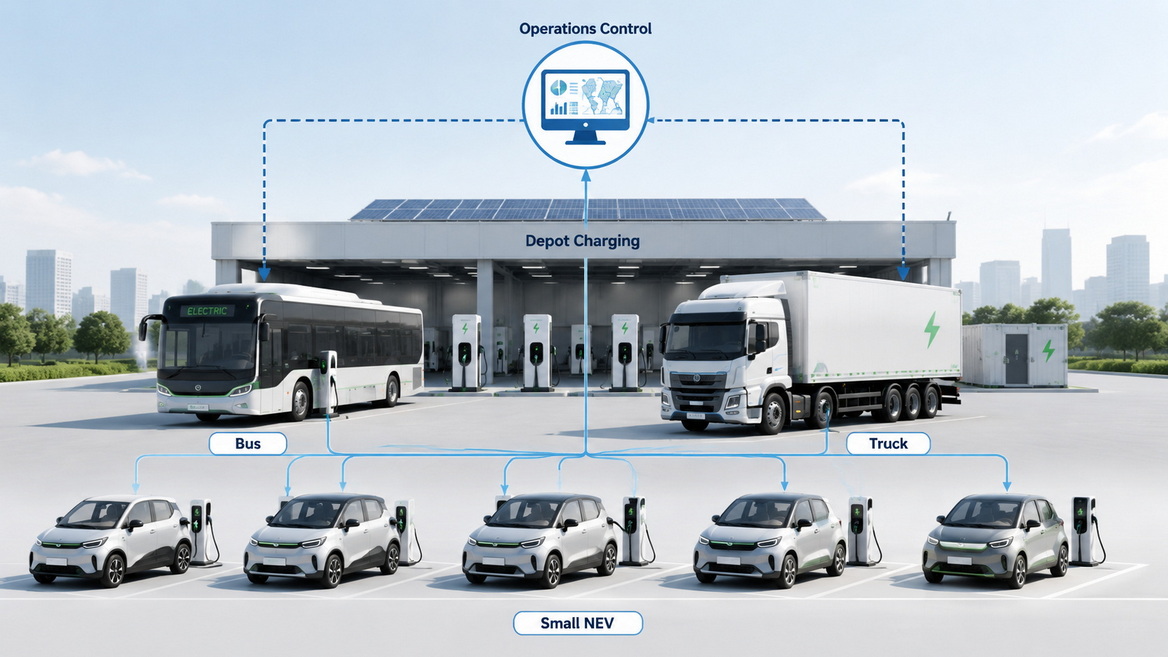
As a supplier focused on buses, heavy‑duty trucks and NEVs, we rarely see small cars in isolation. Instead, we help clients design layered fleets:
- Small NEVs / compact EVs
- Ideal for city‑centre operations, employee shuttles on short routes, hotel transfers, last‑mile inspection teams and management use.
- Electric buses and coaches
- Serve high‑volume corridors, airport shuttles and public transport, integrating with depot‑level charging infrastructure.
- New energy heavy‑duty trucks
- Support port logistics, regional deliveries and industrial transport with dedicated fast‑charging or battery‑swap systems.
By sourcing these layers from a single NEV‑focused exporter, operators can align charging architecture, telematics and maintenance standards across all vehicle classes. This is where KeyChain's role goes beyond a simple vehicle sale to system‑level optimisation.
If you are evaluating small new energy vehicles for your business, we can help you move from high‑level research to a concrete, data‑driven deployment plan. Our team at KeyChain works daily with NEV manufacturers, transport operators and international buyers to match the right small EVs, buses and heavy‑duty trucks to real‑world operations.
Contact our KeyChain export team to:
- Shortlist small NEV models aligned with your route patterns and charging options
- Compare Chinese and non‑Chinese NEV options from a TCO and performance standpoint
- Design an integrated fleet roadmap that combines small cars, buses and trucks under one NEV strategy
Yes. The latest generation of small NEVs from both European and Chinese manufacturers are designed for high‑frequency urban use, with battery warranties often covering 5–8 years or more when properly maintained.
For purely urban duty cycles, a realistic 150–200 miles of range is usually sufficient, especially if vehicles can charge overnight or during scheduled breaks. For mixed motorway use, targeting 200+ miles provides more operational flexibility.
Q3. Are Chinese small NEVs difficult to homologate and support overseas?
Reputable NEV exporters work only with models that meet destination‑market regulations and can provide documentation, training and parts support. The rapid growth of Chinese NEV exports has significantly increased the availability of compliant models in Europe, Latin America and other regions.
When electricity prices are reasonable and annual mileage is moderate to high, small NEVs often deliver lower TCO over a 5‑year period than comparable combustion or hybrid cars, particularly when factoring in reduced maintenance and available incentives.
For small fleets, a mix of depot AC charging and selective use of public DC fast chargers is usually sufficient. Larger fleets benefit from dedicated charging planning, including load management, scheduling and potential integration with bus and truck charging systems.
1. Evans Halshaw. "Top 10: Best Small Cars to Buy in the UK for 2025 – Evans Halshaw Blog."
https://www.evanshalshaw.com/blog/best-small-cars/
2. U. S. News. "Best Small Cars for 2026 and 2027."
https://cars.usnews.com/cars-trucks/rankings/small-cars
3. Car and Driver. "Best Compact Cars for 2026, Tested."
https://www.caranddriver.com/rankings/best-sedans/compact
4. CBT News. "China ships more EVs than gas cars for the first time."
https://www.cbtnews.com/china-hits-new-ev-export-milestone/
5. Electrive. "China achieves record NEV share – exports drive growth."
https://www.electrive.com/2026/06/10/china-achieves-record-nev-share-exports-drive-growth/
6. Google Search Central Blog (Chinese). "For visitors, or for search engines?"
https://developers.google.com/search/blog/2006/10/target-visitors-or-search-engines
7. Ranking. works. "2026 Latest Self-study Package for SEO (What is SEO? How to Do SEO)."
https://ranking.works/knowledge/seo/
8. Edmunds. "Best Compact Cars of 2026 and 2027."
https://www.edmunds.com/compact/
9. Kelley Blue Book. "Best Compact Cars of 2026."


